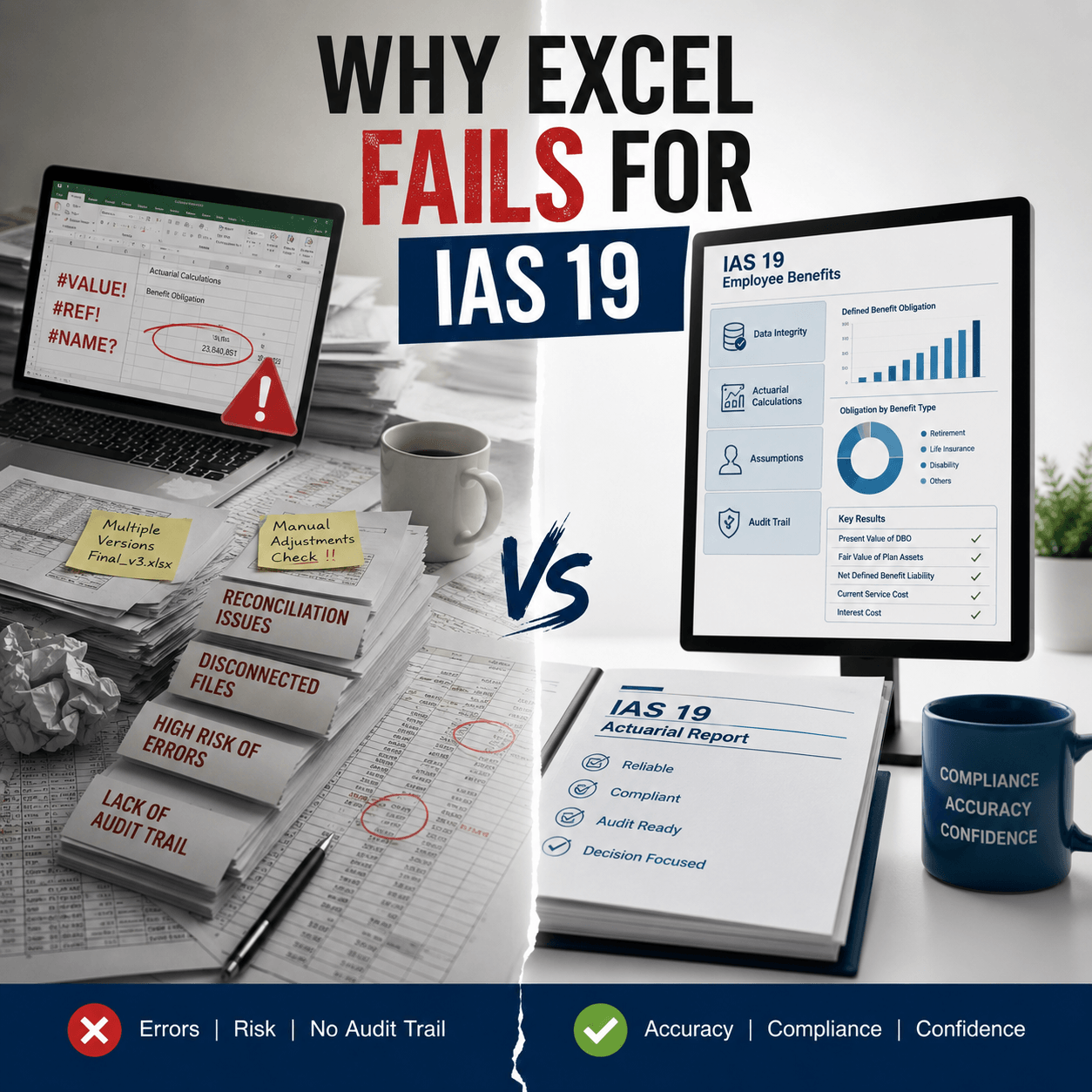
Modern IFRS Reporting Software: Is the Upgrade Worth It?
Finance leaders and compliance teams in regulated markets: how to run a real cost analysis for delta accounting upgrade costs — before the next standard cycle forces your hand.
✓ Written by IFRS TECH’s advisory team · ✓ Serving GCC, Europe & APAC · ✓ Actuaries + CPAs + CFAs
TL;DR
Upgrading to modern IFRS reporting software costs more upfront than most teams plan for, but the right analysis shows legacy systems cost more over time. This article covers the real components of an upgrade cost analysis, how delta accounting software decisions play out in regulated markets, and what separates a recoverable investment from an expensive mistake. Before you sign anything, run the three numbers your CFO actually needs. The tools you choose now will either carry you through IFRS 18 and beyond, or force another expensive overhaul in 18 months.
WTW revised its estimate of the total global cost of IFRS 17 implementation to between $21 billion and $27 billion across the insurance industry. That’s not an anomaly. That’s what happens when a major standard arrives and organizations haven’t built the infrastructure to absorb it.
Most of that cost wasn’t the software. It was everything around the software: data cleanup, process redesign, FTE hours, consultants brought in at the last minute, and reporting cycles that took three times as long as they should have. The teams that kept costs manageable were the ones who had already moved to a purpose-built modern IFRS reporting software platform before the deadline pressure hit.
That’s the argument this article makes. Not that upgrades are cheap. They’re not. But that the alternative — staying on legacy tools or overstretched spreadsheet environments — is almost always more expensive. What you need is a rigorous, honest cost analysis. Here’s what that looks like.
What this article covers:
- The real cost components of upgrading IFRS system financial reporting software, including what vendors rarely put in the quote
- A practical framework for build vs buy decisions in regulated GCC and APAC markets
- The three financial numbers every CFO needs before approving a delta accounting software upgrade
IFRS TECH’s advisory team has sat in enough post-implementation reviews to know where the surprises come from. This is what we’d tell you before you started, not after.
Quick diagnostic: If your team currently runs more than two manual reconciliation steps between your actuarial models and your final IFRS reports, your reporting infrastructure has a gap that software can close. The question isn’t whether to upgrade, it’s what it will cost and when you break even.
The Real Cost of Standing Still on Outdated IFRS System Software
Here’s a question worth sitting with: what does your current system actually cost you per year? Not the license. The total cost — manual hours, reconciliation errors, delayed close cycles, consultant patches, and the compliance risk that builds quietly in the background.
Most teams don’t calculate that number. They calculate the upgrade cost and stop there. That’s the wrong comparison.
License and Subscription Fees: What You’ll Actually Pay
For modern IFRS system financial reporting software, pricing splits roughly three ways: per-entity SaaS subscriptions (typically $30,000 to $120,000 annually for mid-sized insurers), modular enterprise pricing tied to volume and jurisdictions, and perpetual license models that come with large upfront commitments plus annual maintenance fees of 18% to 22% of list price.
The 24 largest multinationals spent an average of $175 million to $200 million each on IFRS 17 programme delivery, per the WTW survey cited above. Most of that figure included software, systems integration, and the people cost of running the programme. Smaller insurers averaged roughly $20 million per company.
Scale matters enormously here. A 12-entity GCC insurer has a completely different cost profile than a single-jurisdiction non-life carrier. For multi-entity IFRS tools, the pricing model you choose at the outset determines whether your software cost scales reasonably as you grow or becomes punishing.
Implementation and Data Migration Costs Nobody Warns You About
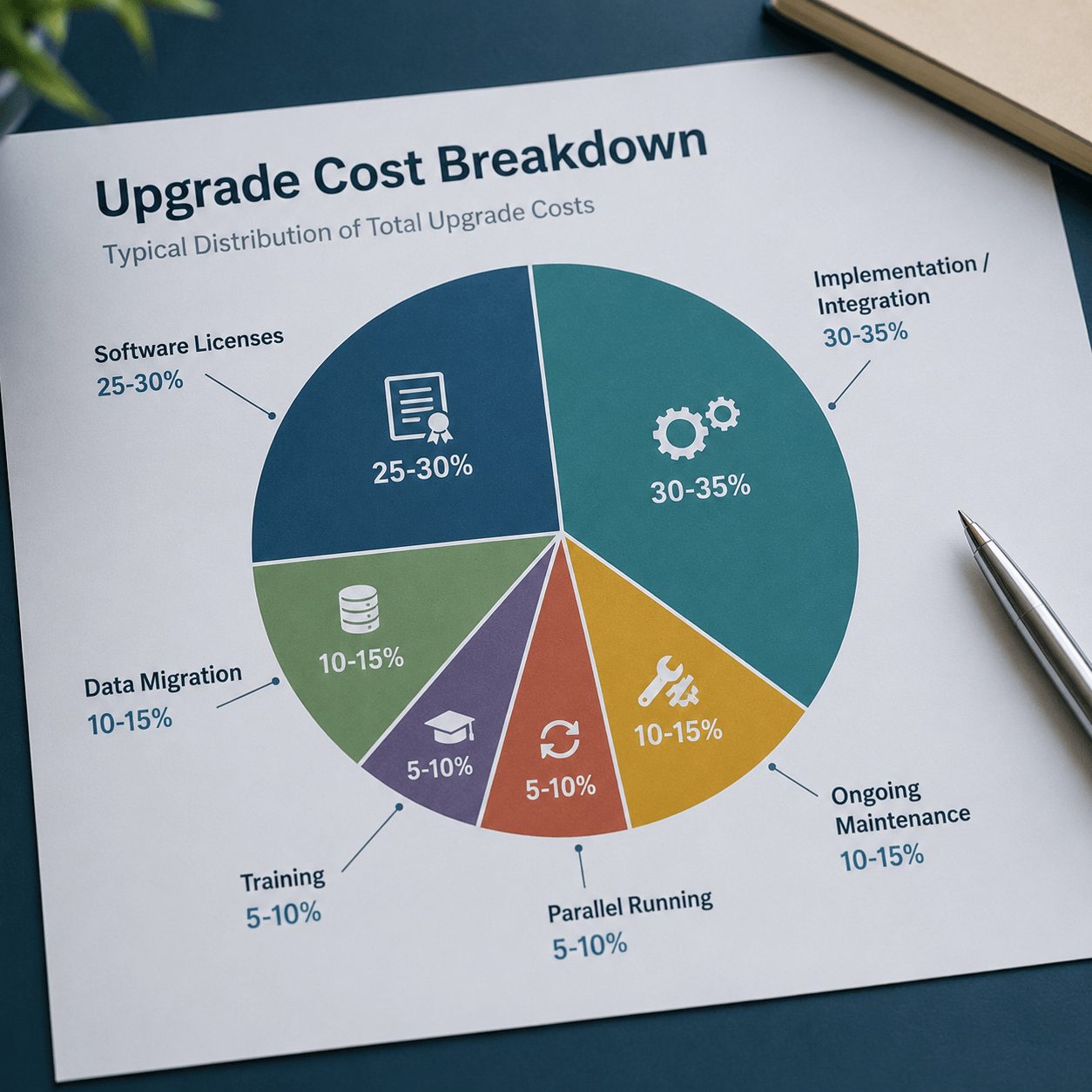
This is where upgrade budgets consistently break down. The software quote covers the software. It does not cover:
- Data cleansing and historical migration, often 20% to 35% of total project cost for firms running on legacy actuarial systems
- Integration build between your ERP, policy administration system, and the new reporting layer
- Parallel running periods where both old and new systems operate simultaneously, often for six to twelve months
- Staff retraining, especially for finance teams that have run on Excel-based workflows for years
WTW’s survey found that over 10,000 FTE employees globally were required to implement IFRS 17. People cost, not software cost, drove the majority of that spend.
If your current data sits across disconnected systems with no clean audit trail, budget for data work first. Everything else depends on it. Teams that skip this step and rush to go-live tend to discover the problem three months into production — at exactly the wrong moment.
Hidden Costs in Delta Accounting Software Upgrades
Delta accounting software, IFRS TECH’s Delta platform included typically runs a measurement approach that processes changes between reporting periods rather than full recalculations. This is efficient. But the integration cost between your source data and the delta layer is real, and it varies significantly based on how clean and structured your upstream data is.
The hidden costs here fall into two buckets. First, ongoing vendor support and customisation fees, most enterprise IFRS system software contracts include base support at 18% to 22% of annual license, but anything custom adds to that. Second, the cost of compliance lag: if your delta tools can’t absorb a new IASB amendment quickly, your team carries manual workarounds until the next software release. That cost is invisible on a spreadsheet but very visible in overtime hours during close cycles.
If you’re working through IFRS 17 software data challenges specifically, the data architecture questions deserve their own analysis before any vendor conversation. What the software costs is almost secondary to whether your underlying data can support it.
What Does Modern IFRS System Financial Reporting Software Actually Deliver?
The cost analysis only works if you’re measuring it against something real. So let’s be specific about what you actually get when you move from legacy tools to a purpose-built modern platform.
Speed: Closing the Books Faster Than Your Competitors
Gartner’s 2024 ERP Value Study is worth quoting directly on this: organizations that modernise to cloud-based architecture see up to 30% faster time-to-value and 20% higher process efficiency compared to firms running legacy core systems.
In practical terms for IFRS reporting: a financial services company that moves from a two-week month-end close to a three-day close doesn’t just save time. It changes what finance teams can do with that time — analysis, scenario modelling, early variance flagging. The close cycle is where most CFOs feel the pain of legacy systems most acutely. It’s also where the ROI of an upgrade is easiest to calculate.
Cirkul, a beverage manufacturer, replaced a legacy ERP and reported 20x ROI while cutting month-end close to one week. Not an IFRS story, but the operational dynamic is identical. Automation removes the manual steps that slow everything down.
Accuracy and Auditability Under IFRS 17 and IFRS 9
Manual reconciliation doesn’t just slow you down. It introduces error. And under IFRS 17 compliance solutions, the error tolerance is close to zero. Contractual Service Margin calculations, discount rate derivations, risk adjustment disclosures, these are areas where a single incorrect assumption can cascade through an entire set of financial statements.
Modern IFRS system software embeds the calculation logic, stores assumptions with full audit trails, and flags changes between periods. That’s not a nice-to-have. For insurers with regulators asking increasingly granular questions post-IFRS 17 adoption, it’s the difference between a clean audit and an uncomfortable one.
The EIOPA report on IFRS 17’s first year noted that 75% of insurers surveyed rely on EIOPA’s risk-free rate structures for their IFRS 17 calculations — but the final discount rates diverged significantly based on illiquidity adjustments. If your system doesn’t track those adjustments with complete transparency, you’re carrying disclosure risk you may not see until the auditors do. See the full analysis in IFRS 17 insurance reporting tools for how purpose-built platforms handle this.
How Enterprise Report Management Systems Like Delta Handle Multi-Entity Complexity
Enterprise report management systems — the delta category — are designed specifically to manage reporting across multiple entities, jurisdictions, and standards simultaneously. This matters more than most teams appreciate until they’re trying to consolidate a GCC group with entities operating under local GAAP, IFRS 17, and Solvency II simultaneously.
A well-configured delta system eliminates the manual mapping between reporting layers. It doesn’t just automate — it standardises. And standardisation is what makes group-level analysis meaningful. Without it, you’re comparing numbers that aren’t actually comparable, which is exactly the problem IFRS 18 (effective 2027, with comparatives required from 2026) is designed to fix at the income statement level.
Running an upgrade analysis right now?
IFRS TECH’s advisory team has built cost-benefit frameworks specifically for GCC and APAC insurance and financial services firms evaluating IFRS system financial reporting software upgrades. Take our 5-question IFRS Reporting Readiness Assessment to see where your current setup stands — and where the biggest efficiency gaps are.
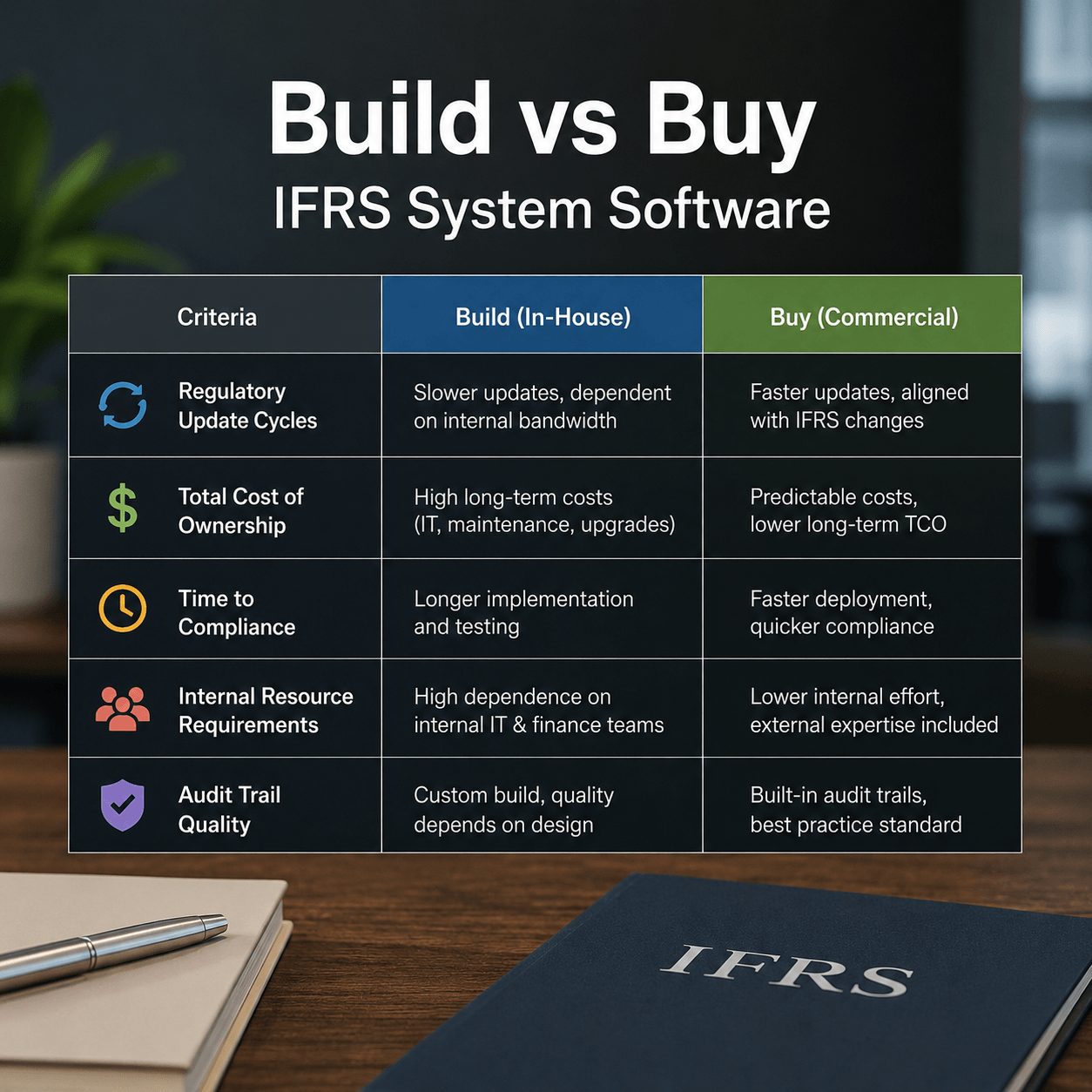
Build vs Buy for Modern IFRS Financial Software: Stop Sitting on the Fence
This is probably the question I find most frustrating in practice. Not because it’s a bad question — but because teams often spend six months studying it when the answer is already clear.
The Build Case (and Why It Fails Most Teams)
The build case sounds appealing: full control, no vendor dependency, software tailored exactly to your processes. The reality is different. Building a compliant, auditable IFRS reporting system from scratch requires specialist actuarial and accounting logic that most internal IT teams don’t have. It requires ongoing updates every time the IASB amends a standard. And it requires you to maintain it while also running the business.
IASB released amendments effective January 1, 2026 covering IFRS 1, IFRS 7, IFRS 9, and IFRS 10, with IFRS 18 requiring comparative 2026 figures for 2027 adoption. That’s not a one-time build. That’s a continuous development programme. Most organisations don’t have the resource depth to do that well, and the ones that try tend to discover it three to four years in — when the technical debt has already accumulated and the system has fallen behind the current standards. You can read more about managing these transitions through IFRS 4 phase 2 software upgrades.
Why Purpose-Built IFRS System Software Wins in Regulated Markets
Purpose-built IFRS system software packages the standards knowledge, the calculation engines, and the regulatory update cycle into one maintained product. You pay for that maintenance through your subscription or license. But you’re not hiring actuaries and developers to do it internally.
For regulated insurers in Saudi Arabia and the UAE — where SAMA and UAE Insurance Authority requirements layer on top of IFRS — the regulatory alignment built into a purpose-built platform is not something you can replicate cheaply in-house. The IFRS 17 software vendor shortlist process matters here: not all platforms are equally adapted to GCC-specific regulatory overlays.
The enterprise financial management software market hit an estimated $150 billion in 2025 and is growing at 12% CAGR through 2033. That growth reflects a market that has already voted on build vs buy. Most regulated financial institutions are buying.
How to Run a Real Upgrade Cost Analysis Before Signing Anything
There’s a right way to do this. Most teams don’t do it. They get a vendor quote, add a rough contingency, and call it a business case. That produces bad decisions.
The Three Numbers Every CFO Needs Before a Delta Accounting Upgrade
The three numbers are total cost of ownership (TCO), payback period, and the cost of staying put.
TCO is not the software license. It’s license plus implementation plus data migration plus integration plus training plus ongoing maintenance plus the internal FTE hours your team will spend managing the system. Build that number across a five-year horizon, not a one-year budget cycle.
Payback period is TCO divided by annual benefit. Annual benefit includes hours saved in close cycles (value them at your team’s blended rate), error reduction (value this conservatively at 0.5% of assets under management for a mid-sized insurer — it adds up quickly), and audit cost reduction. The Gartner-cited 20% process efficiency gain is a reasonable starting benchmark for regulated financial institutions.
Cost of staying put is the hardest number to build but the most important. Count the manual FTE hours per reporting cycle. Add the consultant costs when standards change. Add the compliance risk premium — what’s your best estimate of the cost of a material misstatement? I can’t give you a universal number here, but over 10,000 FTE globally delivered IFRS 17. For most firms, the people cost of managing compliance without modern tools dwarfs the software cost. Full stop.
Strategies for Cost-Effective IFRS Upgrades in the GCC
For GCC-based teams, three approaches consistently reduce upgrade costs without compromising on capability.
First: phase the rollout. Don’t try to replace everything at once. Start with the standard creating the most immediate compliance pressure — for most insurers right now, that’s IFRS 17 or IFRS 9 — and build from there. A phased approach lets you generate early ROI that helps fund later phases.
Second: standardise your data architecture before vendor selection. The single biggest cost driver in IFRS upgrades is bad upstream data. Firms that run a data audit six months before software selection reduce their implementation cost by roughly 25% to 35%, in our experience. That’s not a small number on a multi-million-dollar programme.
Third: choose a vendor with deep regional expertise, not just global scale. The IFRS 17 vendors for scalable compliance that work well in London don’t always carry the same depth in Riyadh or Abu Dhabi. SAMA-specific disclosures, Arabic-language audit requirements, and local regulatory liaison are not afterthoughts.
“IFRS TECH’s Delta IFRS 17 software has made insurance reporting more efficient for us. The automation features save us significant time, allowing my team to focus on more strategic tasks.” — Insurance Industry CFO, IFRS TECH client
Pros, Cons, and the Honest Trade-offs of Upgrading IFRS System Platforms
Let’s be direct about what this decision actually looks like.
The pros are real: Faster close cycles, cleaner audit trails, reduced manual error risk, built-in regulatory updates, and the capacity to absorb new standards without crisis-mode consulting engagements. For teams preparing for IFRS 18’s 2027 mandatory adoption — which requires 2026 comparative figures — having a platform that can handle the new income statement structure without a separate implementation project is a significant cost advantage.
The cons are also real: Upfront cost is substantial. Change management is hard. Data migration takes longer than anyone projects. And there’s a real risk of over-speccing: buying a platform sized for a 50-entity multinational when you’re running 8 entities in two jurisdictions. You end up paying for capability you don’t use.
Here’s the honest trade-off: the firms that consistently get good outcomes from IFRS software upgrades are the ones that right-size the platform to their actual complexity, not their aspirational complexity. A well-implemented mid-range solution beats a poorly implemented enterprise platform every time. The IFRS 17 software solutions that work are the ones that match the organisation, not the ones that have the longest feature list.
One more thing. I’ve seen teams delay upgrades because they’re waiting for the “right” time. There is no right time. There’s only the cost of waiting getting higher as standards evolve and technical debt compounds.
When the Numbers Say Go: Recognising the Right Moment to Modernise
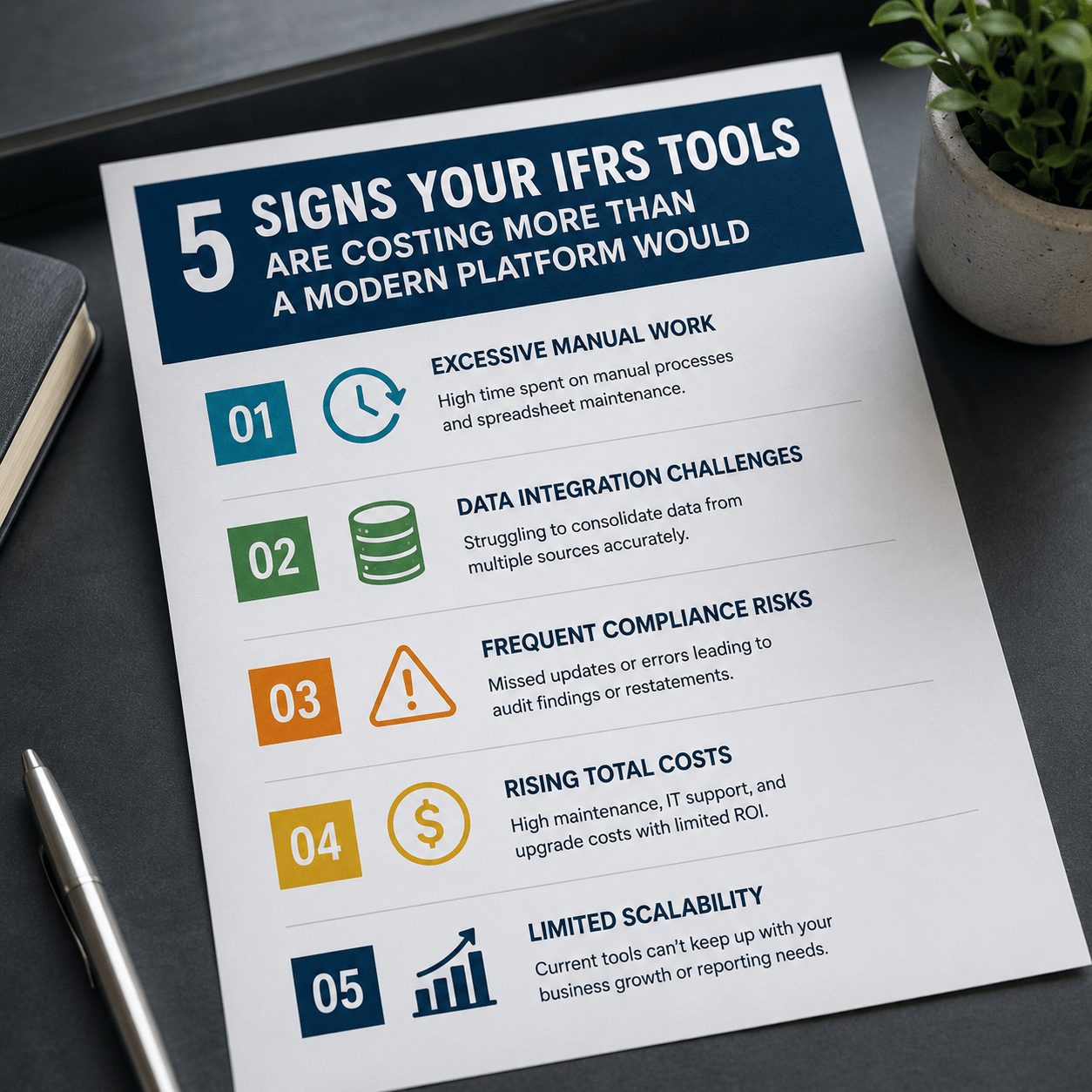
Signs Your Current IFRS Reporting Tools Are Costing More Than an Upgrade Would
You probably already know if you’re in this situation. But here are the signals worth naming explicitly.
When the IASB issues an amendment, your first question is “how long will it take IT to update the system?” rather than “when does the vendor release the patch?”
Any one of these signals is worth investigating. Three or more means the cost of staying put has already exceeded what a modern platform would cost you. If you’re carrying all four, you’re paying the penalty cost every single reporting cycle.
The IFRS 17 data management systems that sit at the core of modern platforms are designed specifically to eliminate these failure points. The question is whether you’re willing to quantify what they’re currently costing you.
What IFRS TECH’s Advisory Team Sees in the Field
A few observations from client engagements that don’t appear in vendor whitepapers.
Most teams underestimate the cost of parallel running by a factor of two. They budget for six months and run for twelve. Plan for twelve upfront and budget accordingly.
The fastest implementations we’ve seen share one common factor: a single internal owner with decision authority. Not a committee. One person who can say yes and say no without three layers of approval. Projects that lack this take roughly 40% longer in our experience.
And the most expensive mistake — more expensive than any technology decision — is rushing the data architecture to hit a go-live date. Every team that has done this has paid for it later. The IFRS 17 actuarial tools in insurance are only as good as the data flowing into them. If that data is unreliable, the software won’t fix it. It will just make the problem visible faster, which is good, but it’s better not to have the problem.
For non-life insurers in particular, getting the measurement model right from the start matters. The PAA versus GMM choice has downstream implications for data granularity requirements that will affect your system architecture. The IFRS 17 non life solutions page covers this in more detail.
What you now know:
- The true cost of a modern IFRS reporting software upgrade includes implementation, data migration, integration, parallel running, and training — not just the license fee. Build your business case across a five-year TCO horizon.
- Build vs buy is largely settled in regulated financial markets. Purpose-built IFRS system software beats internal builds on total cost, regulatory agility, and audit defensibility — especially for GCC-based firms with local regulatory overlays.
- The cost of staying on legacy tools is real and calculable. Manual FTE hours, reconciliation risk, compliance lag, and the consultant spend every time a standard changes add up to more than most teams ever quantify.
The upgrade question is ultimately a risk question. Not “can we afford to upgrade?” but “can we afford not to?” Given IFRS 18’s 2026 comparative requirement and the ongoing amendments to IFRS 9, IFRS 7, and IFRS 17 disclosure frameworks, the window for managing this on legacy tools is narrowing. The teams building their infrastructure now will have a meaningful advantage over the ones waiting for the next deadline to force their hand.
See how IFRS TECH’s IFRS 17 software platform end-to-end handles the full reporting chain — from actuarial inputs through to disclosure output — and what a phased upgrade looks like for your entity structure.
Ready to run a real upgrade cost analysis?
IFRS TECH’s advisory team works with GCC, European, and APAC insurers and financial institutions on exactly this. We’ll help you build the three-number business case — TCO, payback period, and cost of staying put — before you commit to any vendor conversation.
Our clients have reduced their IFRS reporting cycle time by an average of 40% in the first year post-implementation.
See IFRS TECH’s IFRS 17 software solutions and start your cost analysis →
Frequently Asked Questions
What does it actually cost to upgrade to modern IFRS system financial reporting software?
Total costs vary by organisation size and complexity. Smaller insurers typically see all-in upgrade costs between $500,000 and $3 million when you include implementation, data migration, integration, and parallel running. Mid-sized multinationals commonly invest $5 million to $20 million. License fees alone represent roughly 30% to 40% of total cost in most implementations.
Is purpose-built IFRS system software better than building an in-house solution?
For most regulated financial institutions, yes. Purpose-built platforms carry ongoing regulatory update cycles, embedded actuarial logic, and audit-trail architecture that internal builds rarely match. The build option only makes sense for very large organisations with dedicated in-house actuarial and software engineering teams willing to maintain the system indefinitely.
How long does an IFRS system software upgrade typically take?
Plan for 12 to 18 months for a full implementation including parallel running, even if your vendor quotes 6 to 9 months. Data migration and integration work consistently take longer than initial estimates. Organisations with clean, well-structured upstream data can compress this timeline by 30% to 40%.
What are the biggest hidden costs in a delta accounting software upgrade?
Data cleansing and migration costs, parallel running periods where both old and new systems operate simultaneously, staff retraining, and the internal FTE hours your finance team spends managing the transition. These commonly add 60% to 80% on top of the software license cost and are routinely underestimated in initial business cases.
When is the right time to upgrade IFRS reporting tools?
Before the next major standard deadline forces it. With IFRS 18 requiring 2026 comparative figures for 2027 adoption and ongoing IFRS 9 and IFRS 17 amendments, organisations that start their upgrade now have 18 months to implement without crisis-mode pressure. Waiting until deadline pressure arrives reliably doubles both cost and implementation risk.