TL;DR
Choosing the right IFRS 17 vendors for scalable compliance is one of the most consequential decisions your finance and actuarial teams will make. This guide walks you through the key criteria, from data integration and audit trail requirements to multi-entity scalability and security standards. You’ll find a vendor shortlist checklist, a step-by-step selection process, red flags to watch for, and a practical PoC framework to test real capability before you commit. Use it to move from evaluation to a confident decision.
IFRS 17 Vendors for Scalable Insurance Compliance: How to Assess the Right Fit
Your IFRS 17 vendor isn’t just a software purchase. It’s one of the most consequential technology decisions your finance and actuarial teams will make this decade.
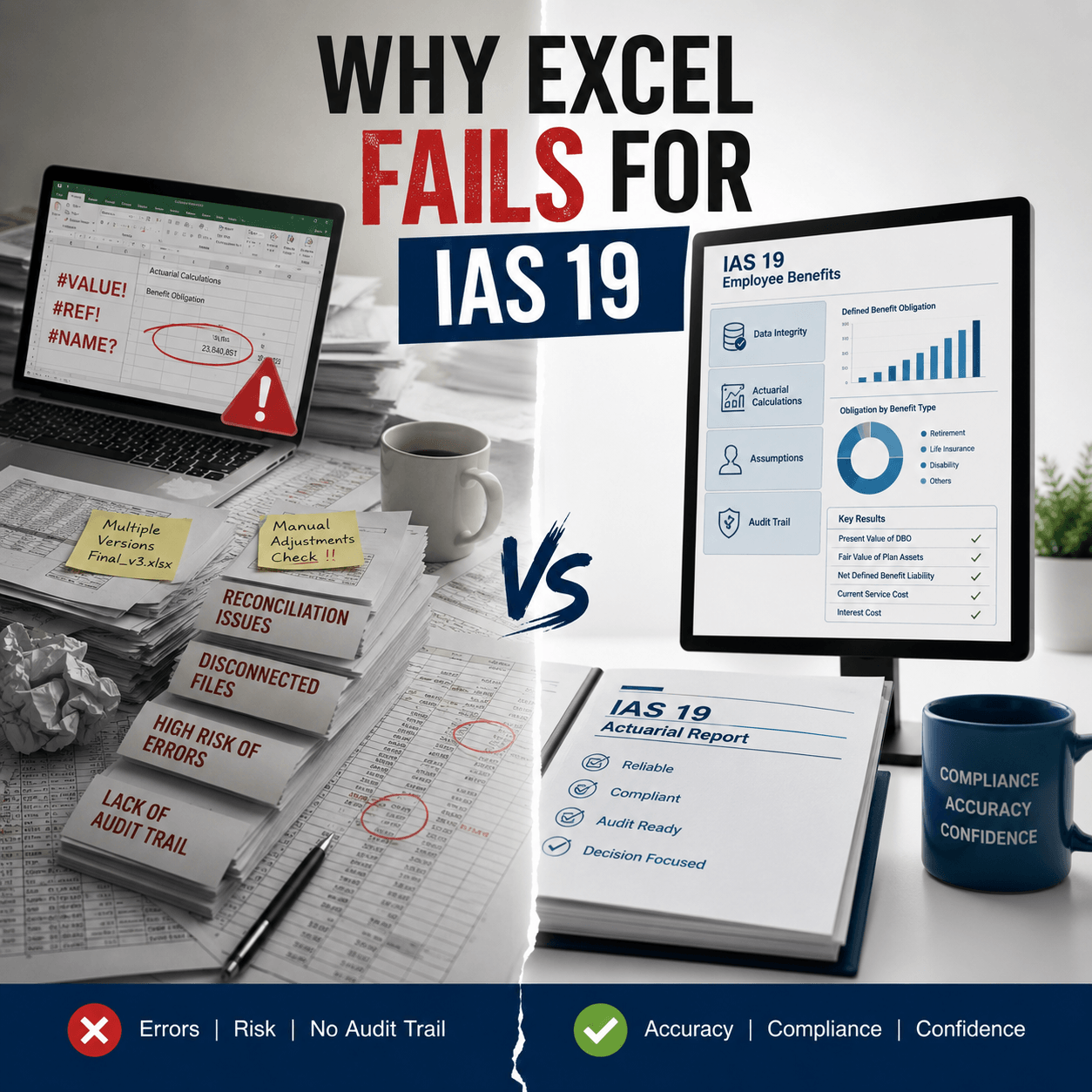
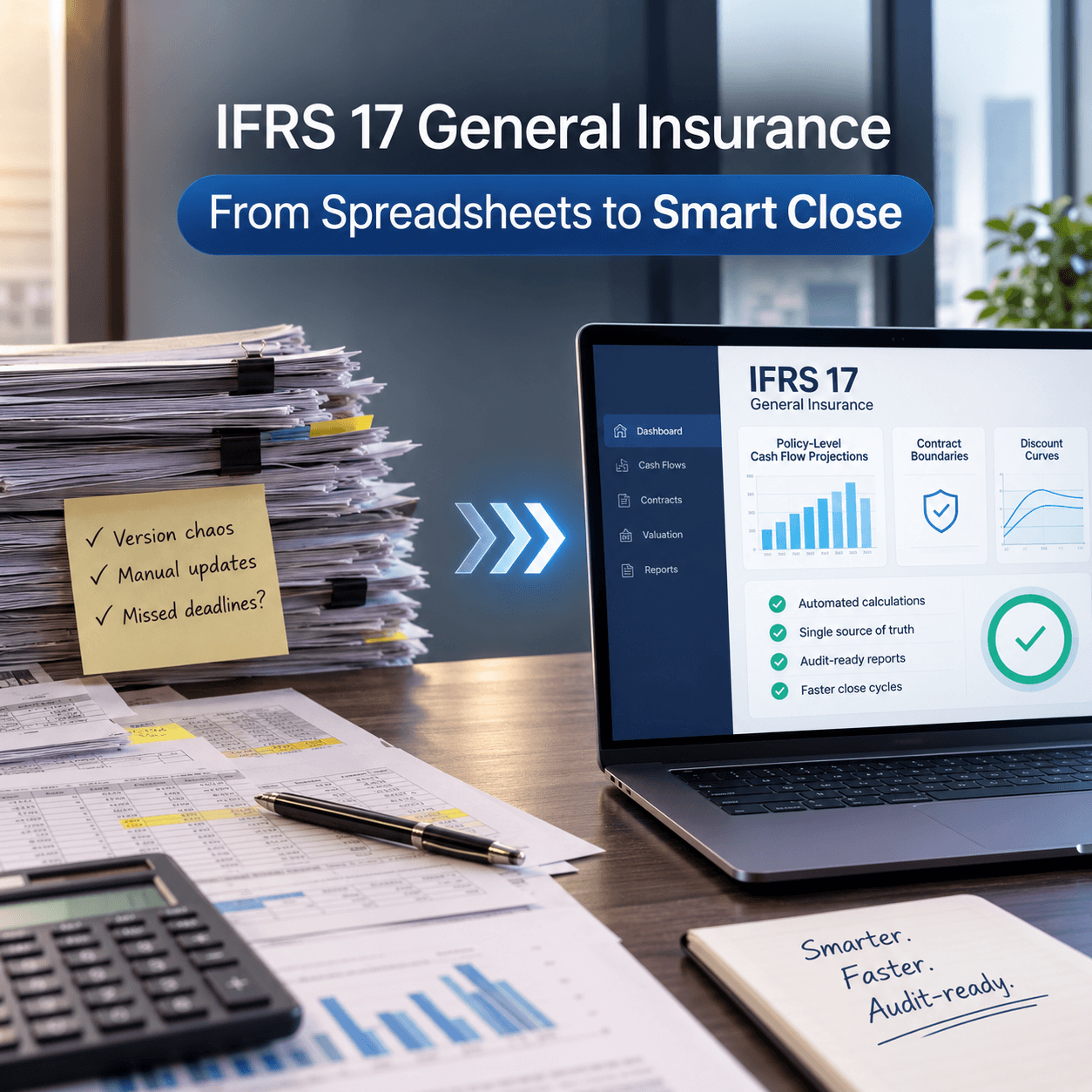
Many insurers have already found this out the hard way. They shortlisted vendors based on demos and feature lists, only to discover that the chosen platform couldn’t handle their policy volumes, lacked proper audit trails, or required months of IT effort just to connect to their ERP.
This guide is for insurance CFOs, finance directors, and actuarial leaders who are now at the decision stage. You’ve done the research. You know what IFRS 17 demands. What you need now is a clear framework to assess IFRS 17 vendors for scalable compliance without making costly mistakes.
IFRS 17 Vendors for Scalable Compliance: Key Criteria
Not every vendor can handle what your organization needs at scale. The differences between a vendor that works in a demo and a vendor that works in production are stark. Here’s what actually separates strong solutions from weak ones.
Must-Have Capabilities for Enterprise Scalability
Scalability isn’t just about policy count. It’s about how the system behaves under pressure: during quarter-end runs, during audits, and as your book grows. A production-grade solution should process high policy volumes without degrading performance. Ask vendors to share benchmarks at your projected volumes, not just their largest known client.
According to a 2024 report by the European Insurance and Occupational Pensions Authority (EIO), the vast majority of significant EU-based insurers had implemented IFRS 17 by the January 1, 2023 effective date. That implementation wave exposed scale limitations in a range of vendor solutions that looked capable on paper.
Delta IFRS 17 software, available via IFRSTech.com, is built on Amazon AWS and designed to scale automatically. Month-end close runs that used to take 15 to 20 days now complete in 5 to 7 days, a compression of 67% on average.
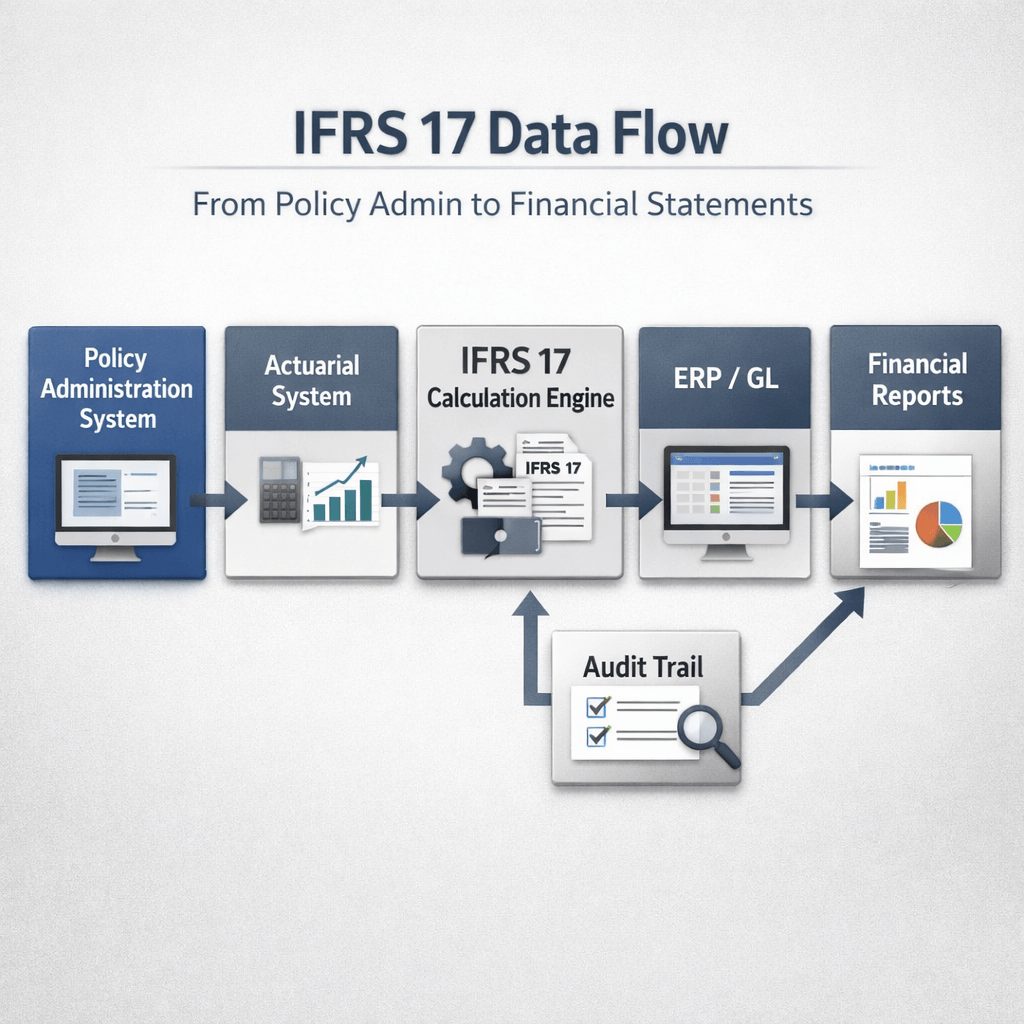
Data Integration With Finance and Actuarial Systems
A vendor that can’t connect cleanly to your actuarial platform and ERP is a liability. Manual data transfer between systems introduces version control risks, formula errors, and delays that defeat the purpose of automation.
The right IFRS 17 vendor should offer API-based integration, not file drops or manual exports. Delta integrates with SAP, Oracle Financials, Microsoft Dynamics, and major actuarial platforms like Prophet and AXIS. Integration typically completes in 3 to 6 weeks. That’s a meaningful difference from legacy solutions that quote 6 to 9 months.
For a deeper look at how data management shapes IFRS 17 performance, see this resource on IFRS 17 data management systems.
Auditability, Controls, and Regulatory Readiness
Regulators and auditors want to trace every number back to its source. If your vendor can’t show a clean line from source policy data to CSM calculation to GL posting, you’re exposed. This isn’t a nice-to-have. It’s a compliance requirement.
Delta’s audit trail system documents every calculation step with complete data lineage. Clients report a 38% reduction in external audit hours and zero material audit findings in the first year after implementation. Big 4 audit teams can move through reconciliations in days instead of weeks.
How to Assess IFRS 17 Vendor Solutions
Vendor assessment needs to go beyond feature checklists. The right process involves stress-testing real capabilities against your specific context.
Functional Coverage vs Configuration Flexibility
Most vendors support the General Measurement Model. Far fewer handle GMM, PAA, and VFA in one unified platform. If you write participating contracts, unit-linked products, or a mix of short- and long-duration contracts, you need a vendor who covers all three without requiring separate modules or workarounds.
Delta supports GMM, PAA, and VFA in a single platform. It applies the appropriate measurement model automatically based on contract characteristics, reducing manual classification effort and the risk of misclassification.
On the configuration side, ask whether business rules like discount rate methodologies, grouping logic, and cohort formation are parameterized. A metadata-driven architecture lets your team adjust to regulatory changes without waiting on vendor development cycles.
Handling High-Volume Insurance Data
Performance engineering matters more than most vendors admit. If a vendor can cut processing time by applying parallel computation and in-memory processing, that’s real value. Ask for evidence, not claims. A 2025 report on IFRS 17 in Asia notes that several major markets, including Hong Kong, Singapore, South Korea, and Malaysia, adopted the standard as of January 1, 2023, while others like China, India, Thailand, and Vietnam deferred to 2025 to 2027 (src). That means vendor scalability will face new stress as deferred-adoption markets go live.
Ask vendors: what’s your largest live client by policy count? What’s the run time at that volume? Can you name them as a reference? A vendor who can’t answer those questions with specifics has likely not been tested at enterprise scale.
Security, Governance, and Compliance Features
IFRS 17 data includes sensitive policyholder information, actuarial assumptions, and financial projections. Your vendor must meet enterprise-grade security standards. Delta holds ISO 27001 certification and SOC 2 Type II compliance. All transmissions use AES-256 encryption, and role-based access controls limit data visibility by job function.
Multi-factor authentication, IP restrictions, and comprehensive user activity logs are non-negotiable in 2026. If a vendor doesn’t offer these as standard, move on.
IFRS 17 Vendor Shortlist: Key Questions to Ask
Once you’ve narrowed your list to two or three vendors, use these questions to force honest answers. Vague or evasive responses are a signal.
Does the Solution Support All Measurement Models?
Ask specifically about VFA support for participating contracts. Many vendors claim full coverage but treat VFA as an edge case with limited automation. If you write any variable or unit-linked products, test this with your own data in a proof of concept. Don’t accept a demo built on generic data.
Delta supports PAA, GMM, and VFA natively in one platform. It handles onerous contract detection automatically at inception and each reporting period, with immediate SoCI recognition. That’s a detail that matters when auditors review contract cohort measurement.
Can It Scale Across Entities and Regions?
Multi-entity and multi-jurisdiction deployments add complexity that exposes architectural weaknesses. Ask how the system handles multi-currency data models, separate legal entity reporting, and different local GAAP requirements alongside IFRS 17. Some vendors handle single-entity deployments well but struggle with consolidated group reporting.
For context on how IFRS 17 compliance solutions address multi-entity structures, that resource provides relevant technical detail.
How Strong Is System Integration Capability?
Ask for a live demonstration of the ERP integration, not a diagram. See data actually flow from your actuarial system into the calculation engine and then into a test GL. If the vendor needs days to set that up for a demo, that’s a warning. Delta achieves full ERP integration in 3 to 6 weeks using standardized APIs with bidirectional data flow and automated journal entry posting.
IFRS 17 Vendor Evaluation Checklist for 2026
Use this checklist at the final stage of your vendor evaluation. Re-run it before signing anything.
Implementation Timelines and Dependencies
Ask for the typical implementation timeline broken down by phase: data migration, system configuration, actuarial-to-finance bridge setup, and user training. Then ask what causes implementations to run long. Vendors who answer honestly will tell you: data quality issues, legacy system integration complexity, and internal resource constraints are the usual culprits.
Delta implementations run 3 to 6 months for most insurers. Simple deployments with clean data complete in 3 months. Complex multi-entity or multi-transition-method deployments take up to 6 months. That’s significantly faster than the 9 to 12 months quoted by enterprise-focused alternatives.
Vendor Roadmap and Regulatory Updates
IFRS 17 is not a static standard. The IASB continues to issue guidance, and regulators in deferred-adoption markets will introduce local variations. Ask vendors how regulatory updates are deployed. Do they push changes automatically? Do you need to reconfigure rules? What’s the patch cadence? Delta deploys software updates automatically through its cloud infrastructure without disrupting production environments.
Also ask about the vendor’s development roadmap. A vendor with a clear, client-informed roadmap tied to IASB guidance is a safer long-term bet than one reacting to requirements after the fact.
Cost, ROI, and Long-Term Scalability
IFRS 17 software pricing varies based on policy volume, user count, deployment model, and feature set. Typical models include SaaS subscriptions with annual fees or perpetual licenses with maintenance costs. Cloud-based solutions generally offer lower upfront costs and predictable ongoing expenses.
When comparing total cost of ownership, include implementation services, training, ongoing support, and infrastructure. Delta’s cloud deployment reduces IT infrastructure costs by 40% on average compared to on-premise alternatives. Clients also report 120+ hours per quarter redirected from manual preparation to strategic analysis, which has its own financial value.
For a broader look at available options, this overview of IFRS 17 software solutions covers the market in more detail.
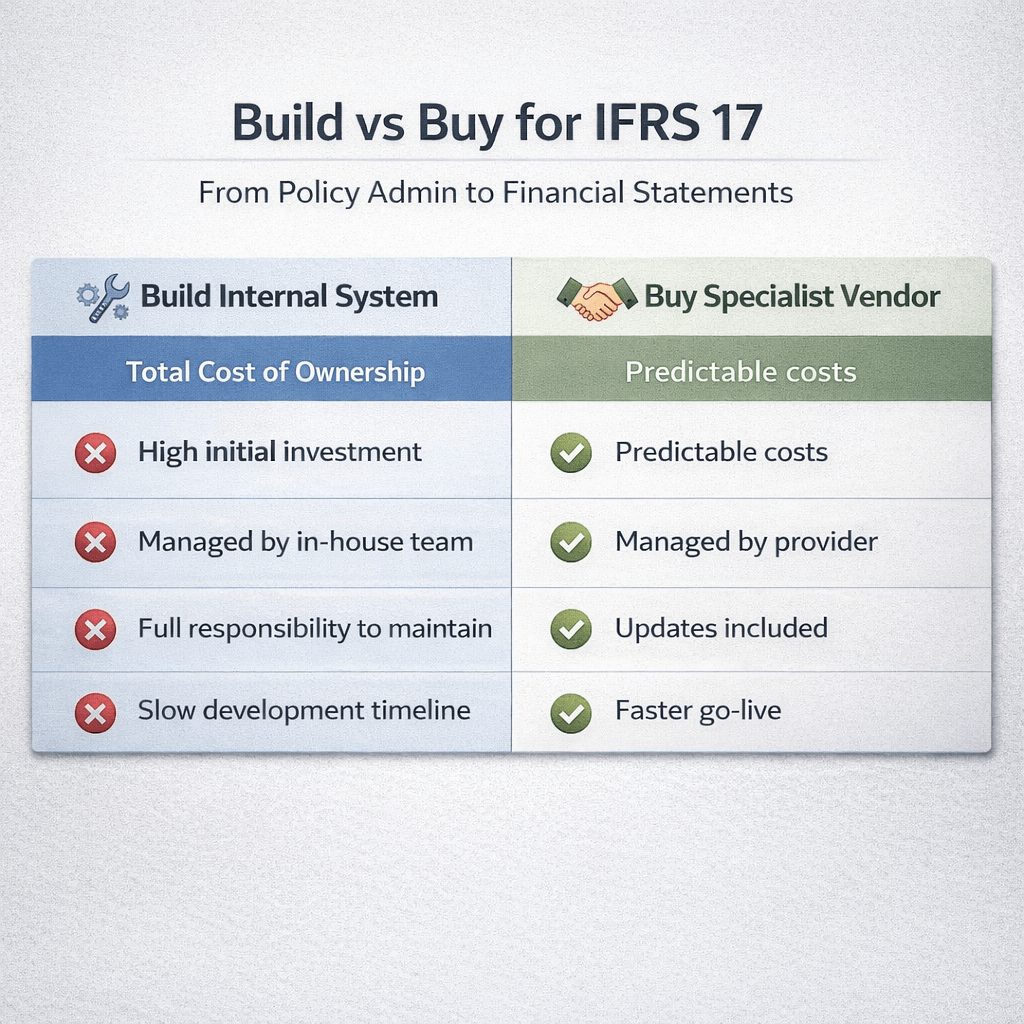
Build vs Buy: Choosing the Right IFRS 17 Strategy
Some finance leaders consider building an in-house IFRS 17 solution, particularly if they have strong internal IT teams. That decision deserves hard scrutiny.
Building internally means owning every calculation logic update as IASB guidance evolves. It means building and maintaining integrations with every connected system. It means creating audit trails from scratch to meet Big 4 standards. And it means doing all of that while running a live month-end close cycle.
Most insurers who have attempted this route have found that the ongoing maintenance cost exceeds the original build cost within two to three years. Specialized vendors carry that maintenance burden so you don’t have to. For insurers writing non-life contracts specifically, this resource on IFRS 17 non life solutions outlines what specialized solutions offer over general-purpose builds.
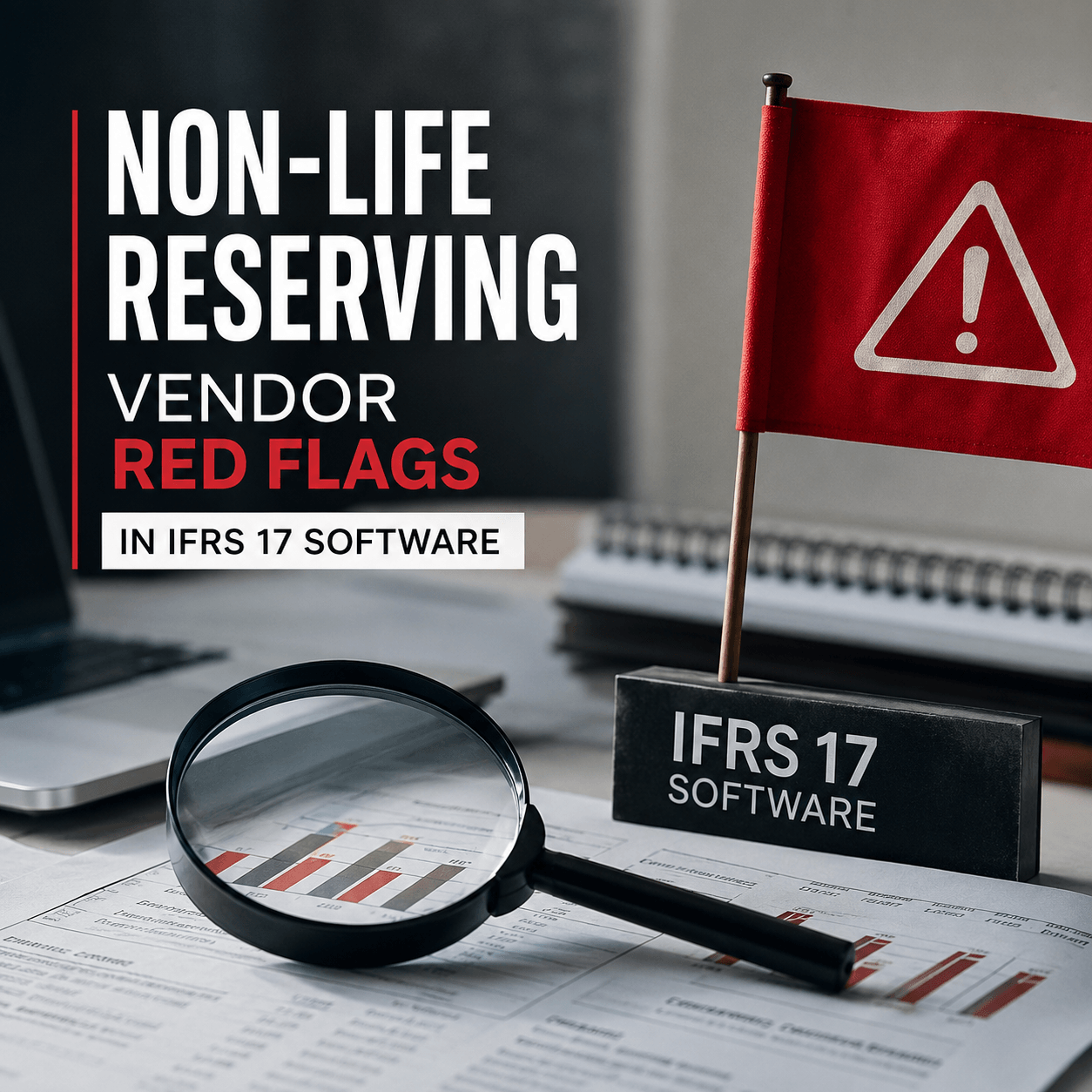
Common Red Flags When Selecting IFRS 17 Vendors
These signals should give you pause during evaluation. They don’t automatically disqualify a vendor, but each one warrants a direct conversation.
No named reference clients at your scale. If a vendor can’t connect you with a live client processing similar policy volumes, you may be their first enterprise deployment.
Demo runs on synthetic data only. Vendors who won’t run a proof of concept on your own data are often protecting weaknesses in their calculation logic or integration layer.
Vague answers on regulatory update timelines. If a vendor can’t tell you how long it took to deploy the last IASB amendment, that’s a maintenance risk you’ll own.
Manual steps in the audit trail. Any gap in the chain from source data to disclosure is a potential audit finding. Ask specifically where human intervention is required and why.
Integration timelines measured in months, not weeks. Modern API-based integrations shouldn’t require months of IT work. If a vendor quotes 6-plus months for ERP integration, their architecture may be outdated.
Pricing that doesn’t scale transparently. Vendors who can’t explain how pricing changes as your policy volume grows are often setting up for a difficult renewal conversation.
How to Run a Proof of Concept (PoC)
A PoC is the most reliable tool you have for separating vendor claims from vendor capability. Here’s how to run one that produces useful results.
Define your PoC scope precisely. Choose two or three contract types that represent your most complex measurement challenges. Include at least one onerous cohort, one PAA-eligible portfolio, and one GMM contract if you write all three.
Use your own data. Anonymized real data reveals integration complexity and data quality issues that synthetic data hides. If a vendor resists this, note it.
Test the audit trail end to end. Ask the vendor to show you a complete trace from source policy record through CSM calculation to a sample GL posting. If any step requires manual documentation, that’s a gap.
Measure processing time at volume. Run the PoC at 110% of your current policy count to stress-test performance. A system that performs well at your current size but degrades at projected growth is a future problem.
Involve both finance and actuarial users. Both teams need to evaluate the user experience. A platform that actuaries love but finance teams find opaque will create operational friction after go-live.
For background on the reporting tools you’ll be evaluating, this resource on IFRS 17 insurance reporting tools covers what to look for in disclosure generation and analytics.
Steps to Select the Right IFRS 17 Vendor
Follow these steps in sequence. Skipping steps or combining them is where most selection processes go wrong.
Step 1: Audit your current architecture. Map your core policy system, actuarial platform, and ERP. Identify the integration points, data quality gaps, and reporting obligations before you talk to any vendor.
Step 2: Define your target state. Document what compliance looks like in 12 months: close cycle target, audit readiness standard, user access model, and geographic scope.
Step 3: Build your RFP around your real requirements. Don’t use a generic template. Weight criteria by what actually matters for your book of business and internal capabilities.
Step 4: Run a structured shortlist. Use the key questions in this article to filter from a long list to two or three candidates. Eliminate vendors who can’t answer scalability and integration questions with specifics.
Step 5: Run a PoC on real data. Use the PoC approach outlined above. Give vendors 4 to 6 weeks and evaluate on process quality, not just output quality.
Step 6: Assess total cost of ownership. Compare implementation cost, licensing, ongoing support, and internal resource requirements across all remaining candidates.
Step 7: Verify references. Speak directly with insurers who have deployed the vendor’s solution at comparable scale. Ask about what went wrong, not just what went right.
The IFRS 17 implementation advisory team at Prima Consulting supports insurers through each of these steps, combining actuarial, accounting, and technology expertise in one engagement model.
FAQs on IFRS 17 Vendor Selection
What Should an IFRS 17 RFP Include?
A strong IFRS 17 RFP should include: measurement model requirements (GMM, PAA, VFA), data volume and processing time expectations, integration requirements by system, audit trail standards, security and governance requirements, implementation timeline constraints, and reference client expectations. Weight each criterion by business impact. Vendors who score high on your priorities, not just overall scores, are your strongest candidates.
How Long Does Implementation Take?
Most IFRS 17 implementations take 3 to 9 months depending on data quality, integration complexity, and the number of legal entities involved. Delta’s typical timeline is 3 to 6 months. Simple single-entity deployments with clean data can complete in 3 months. Multi-entity, multi-jurisdiction deployments with complex transition method requirements take closer to 6 months. Enterprise-focused alternatives from large software vendors often quote 9 to 12 months for comparable scope.
What Does IFRS 17 Software Cost?
IFRS 17 software pricing varies significantly based on policy volume, user count, deployment model, and feature scope. SaaS subscriptions are the most common model, with annual fees scaled to organizational size. Perpetual license models carry higher upfront costs with annual maintenance fees. Total cost of ownership should include implementation services, training, ongoing support, and (for on-premise deployments) infrastructure. Cloud-based solutions like Delta typically offer lower upfront investment and more predictable annual costs, with IT infrastructure savings of around 40% compared to on-premise installations.
Can IFRS 17 Systems Integrate With Existing Tools?
Yes, modern IFRS 17 platforms use API-based integration to connect with ERP systems (SAP, Oracle, Microsoft Dynamics) and actuarial platforms (Prophet, AXIS, MoSes). Bidirectional data flow means policy data flows into the IFRS 17 engine and journal entries post automatically to the GL without manual intervention. Delta achieves full integration in 3 to 6 weeks. If a vendor quotes longer timelines, ask specifically which integration layer causes the delay.
Ready to Assess IFRS 17 Vendors for Scalable Compliance?
Picking the wrong IFRS 17 vendor costs more than the software itself. It costs close cycles, audit hours, IT resources, and team confidence. The vendors worth shortlisting are the ones who can show you, not just tell you, that their platform scales, integrates cleanly, and keeps your auditors satisfied.
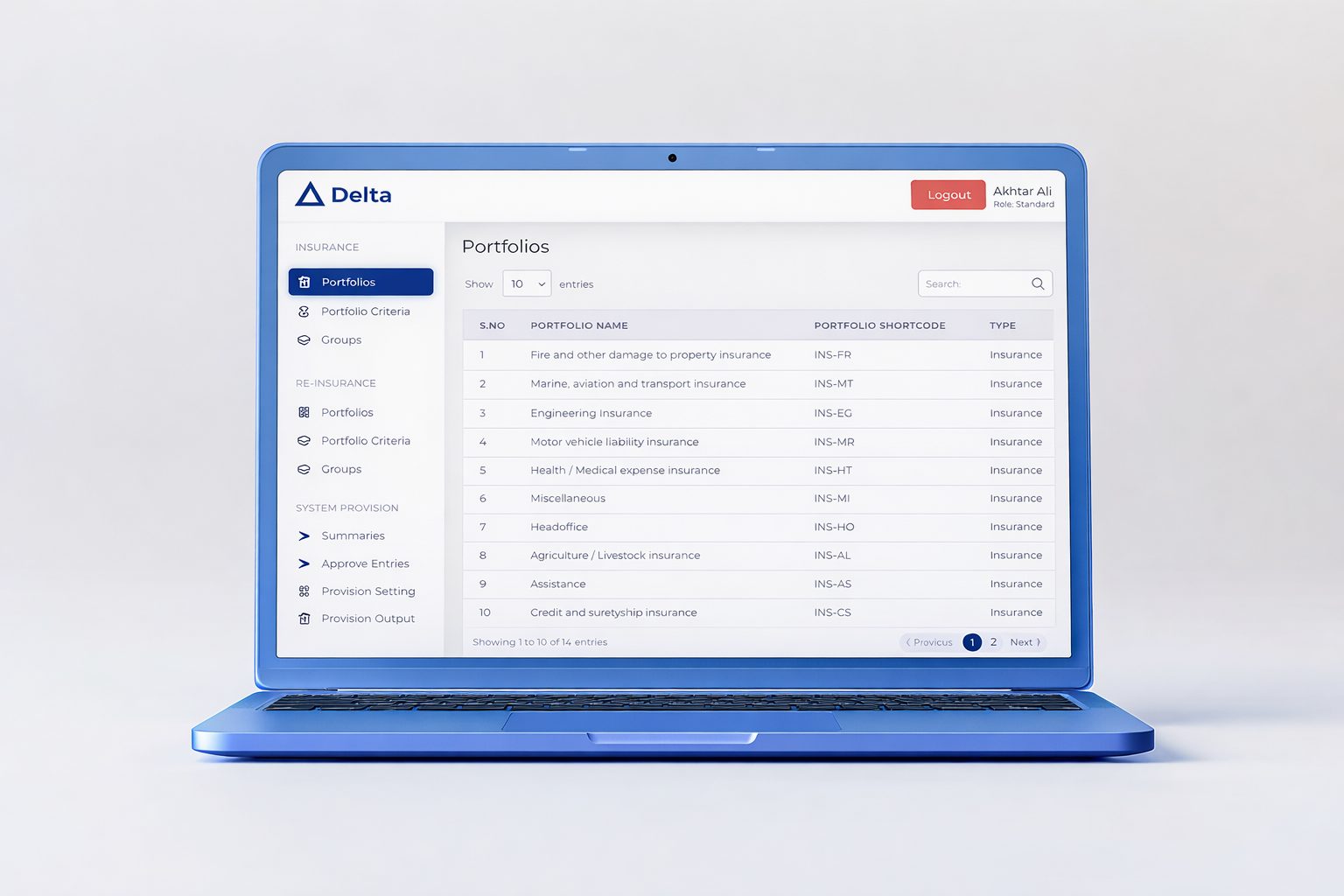
Delta IFRS 17 software from IFRSTech.com cuts month-end close from 20 days to 5 to 7 days, eliminates 80% of manual data preparation, and delivers complete audit-ready disclosures from a single cloud platform. Implementation completes in 3 to 6 months. Licensing scales transparently with your policy volume.
The IFRS 17 advisory team at Prima Consulting works alongside your finance, actuarial, and IT teams from vendor selection through live production. If you want a vendor assessment that’s grounded in your real architecture and compliance obligations, the team at primaconsulting.org is the right starting point.
Schedule your Delta demo today and see how IFRS 17 vendors for scalable compliance should perform in your environment.