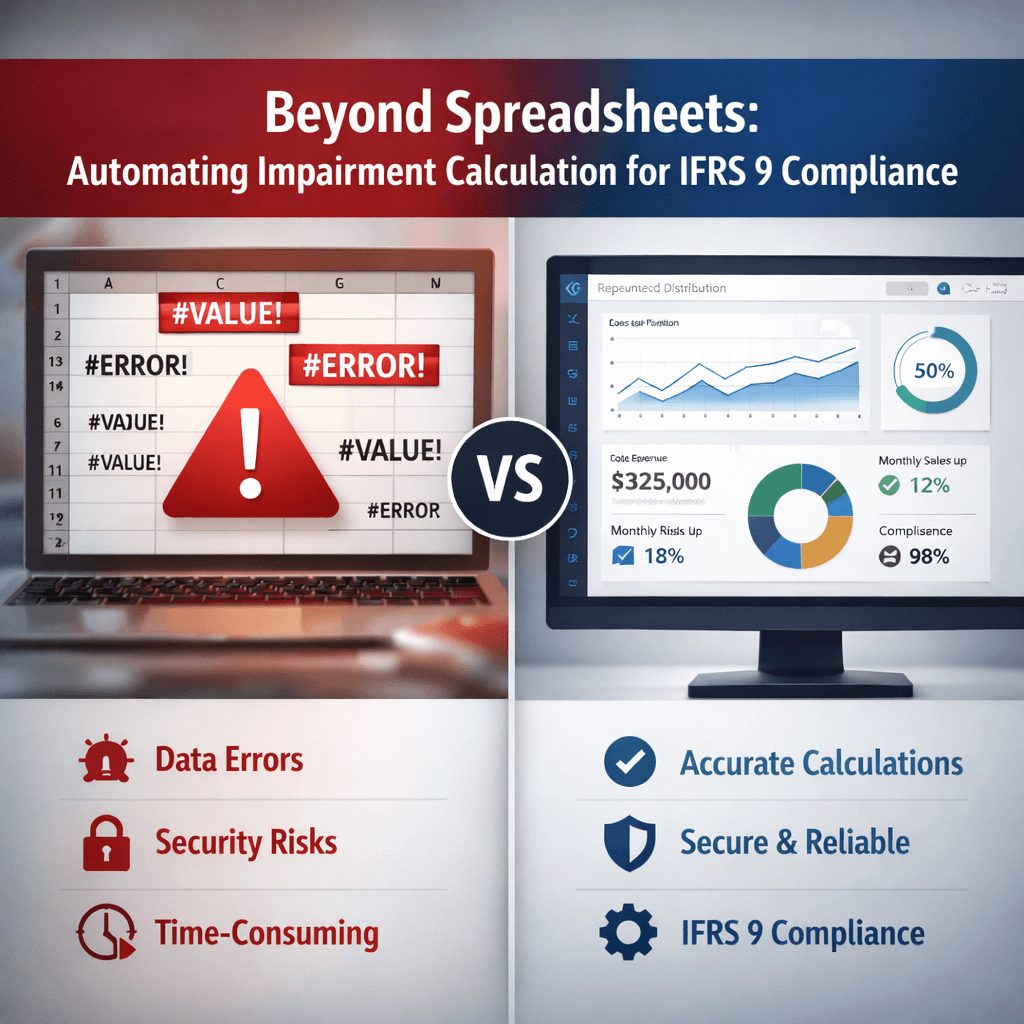
Multi-Entity IFRS Tools: Choose Right or Pay Later
What finance leaders running multi-entity operations must verify before committing to any IFRS ERP and why most vendor demos never show you the parts that break first.
✓ Written by IFRS TECH’s advisory team · ✓ Serving GCC, Europe & APAC · ✓ Actuaries + CPAs + CFAs
TL;DR
Choosing the right multi-entity IFRS tools isn’t about features, it’s about what survives contact with real operational complexity. This article covers the six criteria that separate scalable IFRS solutions from ones that collapse as you add entities, the red flags to watch in vendor conversations, and a working evaluation checklist built for finance teams managing operations across jurisdictions. If you’re finalizing a shortlist or re-evaluating a current IFRS ERP, start here.
Why Most IFRS Tool Decisions Break Under Pressure
When companies select IFRS tools for multi-entity operations, they almost never stress-test for the scenario that will matter most: what happens when entity count doubles, a new jurisdiction gets added mid-year, or a regulatory update changes how you calculate contract liabilities?
Most selections don’t fail on day one. They fail 18 months in, when the workarounds outnumber the workflows. That’s when teams realize the tool they chose was built for a single-entity world and retrofitted badly for group structures.
According to Gartner’s analysis, 70% of ERP implementations will fail to meet their objectives. The number isn’t abstract. It’s the result of teams buying on demo, not on architecture.
This article covers:
- What “scalable” actually means in the context of multi-entity IFRS tools not the vendor definition, the operational one
- Six non-negotiable criteria for evaluating any IFRS ERP or compliance solution
- The red flags that surface during vendor conversations when scalability is window dressing
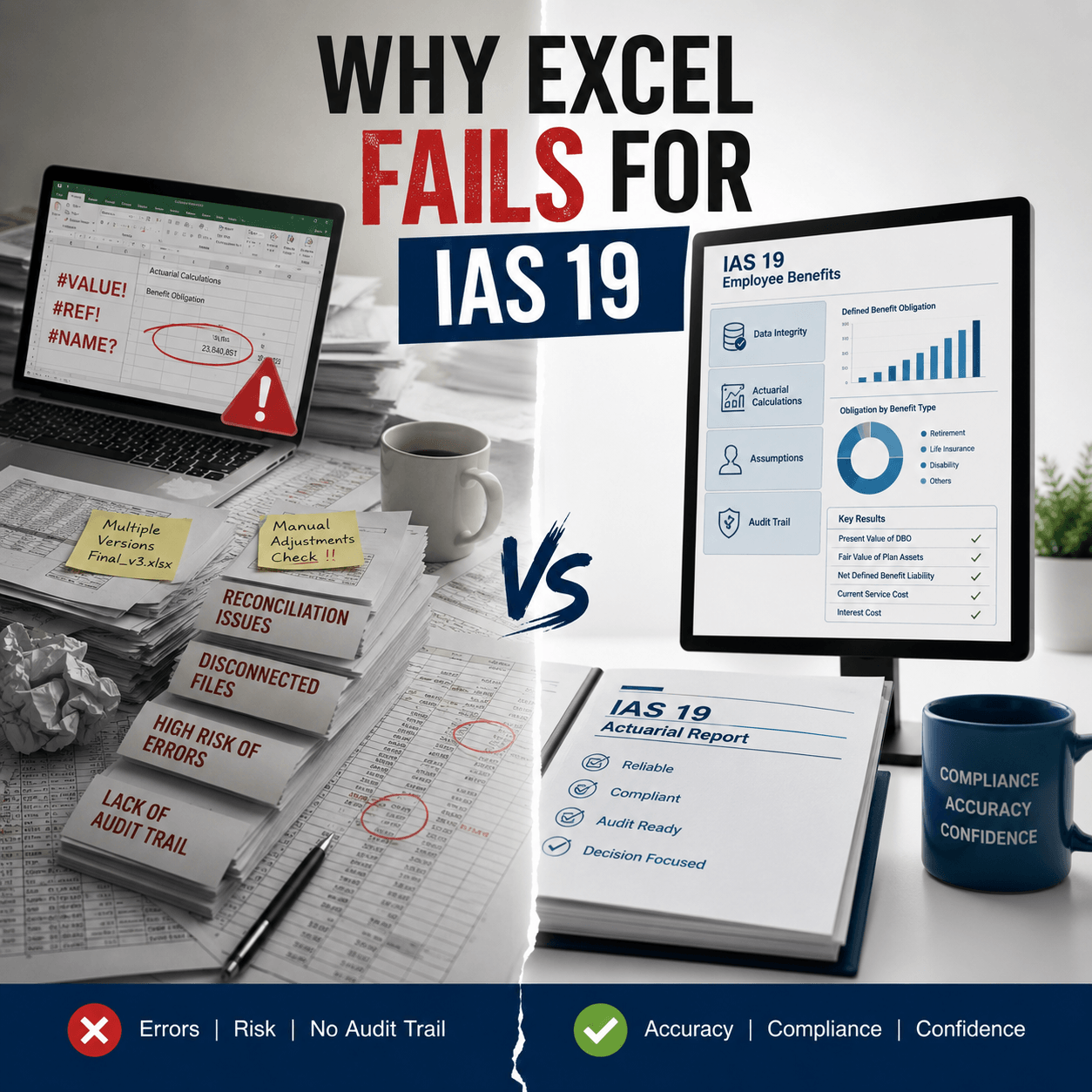
Quick diagnostic: If your team currently uses separate reconciliation files to bridge entity-level data to your group IFRS reports, your tools are already at capacity. What you’re about to read explains why and what the fix looks like.
What Does “Scalable” Actually Mean for Multi-Entity IFRS Tools?
Every vendor uses the word. Almost none of them mean the same thing by it.
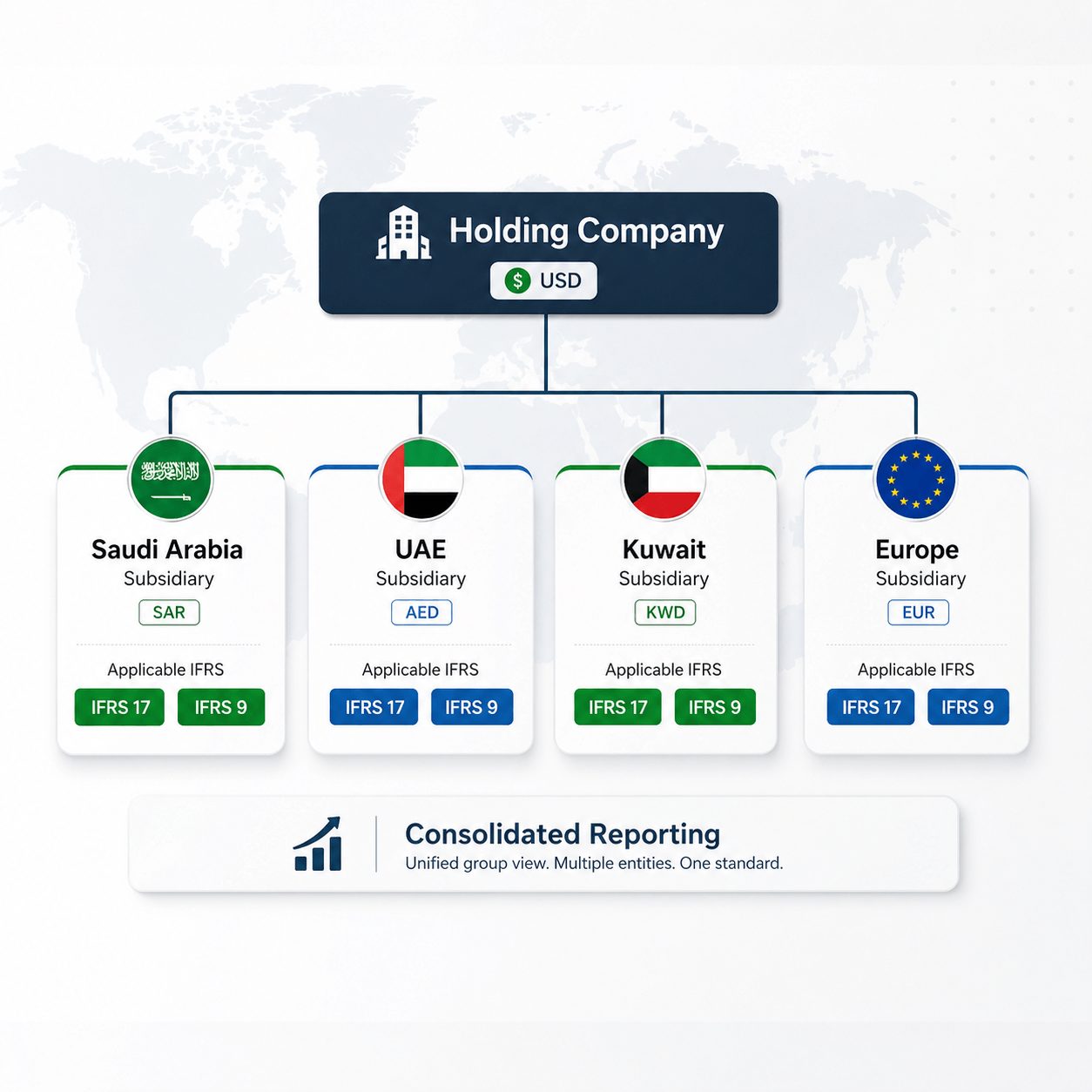
Real scalability for multi-entity IFRS compliant accounting software means three things, and only three. The tool handles legal-entity expansion without structural rework. It applies jurisdiction-specific IFRS rules without manual overrides. And it produces group-level consolidated reports across currencies without a separate consolidation layer bolted on the side.
If any one of those breaks, your “scalable” tool isn’t.
Legal-Entity Expansion Without Rebuilding
Adding an entity shouldn’t be a project. It should be a configuration task. If onboarding a new subsidiary requires IT involvement, custom development, or a new license negotiation, you don’t have a scalable IFRS solution, you have a system that charges you for your own growth.
The right architecture separates entity-level data management from the core calculation engine. You add the entity, map it to the group chart of accounts, assign jurisdiction parameters, and the system handles the rest. That’s it.
Jurisdiction-Specific Rule Handling at Scale
This is where most tools fall short. GCC operations, for example, involve regulatory bodies — SAMA in Saudi Arabia, the UAE Insurance Authority — each with its own interpretation of IFRS 17. A tool built for European insurance reporting may not carry those jurisdiction parameters. You end up building manual overrides. Those overrides become technical debt. That debt eventually breaks your close cycle.
For GCC insurers, the stakes are direct: annual cost increases of 15–25% are directly attributable to IFRS 17 compliance requirements when the underlying systems weren’t built for regional complexity from the start.
Consolidated Reporting Across Currencies
Multi-entity groups operate in multiple functional currencies. The tool needs to handle spot rates, average rates, and historical rates correctly — not approximately. One insurer operating across five GCC jurisdictions could have USD, SAR, AED, KWD, and QAR in play simultaneously. If the system uses a single currency engine with manual rate inputs, month-end becomes a three-day reconciliation exercise every time.
There’s a better benchmark: an optimized IFRS data pipeline can cut the monthly close from 20 days to 5 days — a 75% reduction — when multi-currency consolidation is built into the engine, not handled downstream in Excel.
The 6 Criteria That Define Scalable IFRS ERP Tools
These aren’t aspirational. They’re the minimum bar. If a vendor can’t demonstrate all six in a live environment — not a sandbox, a live client environment — keep looking.
1. Native Multi-Entity Architecture, Not Bolt-On
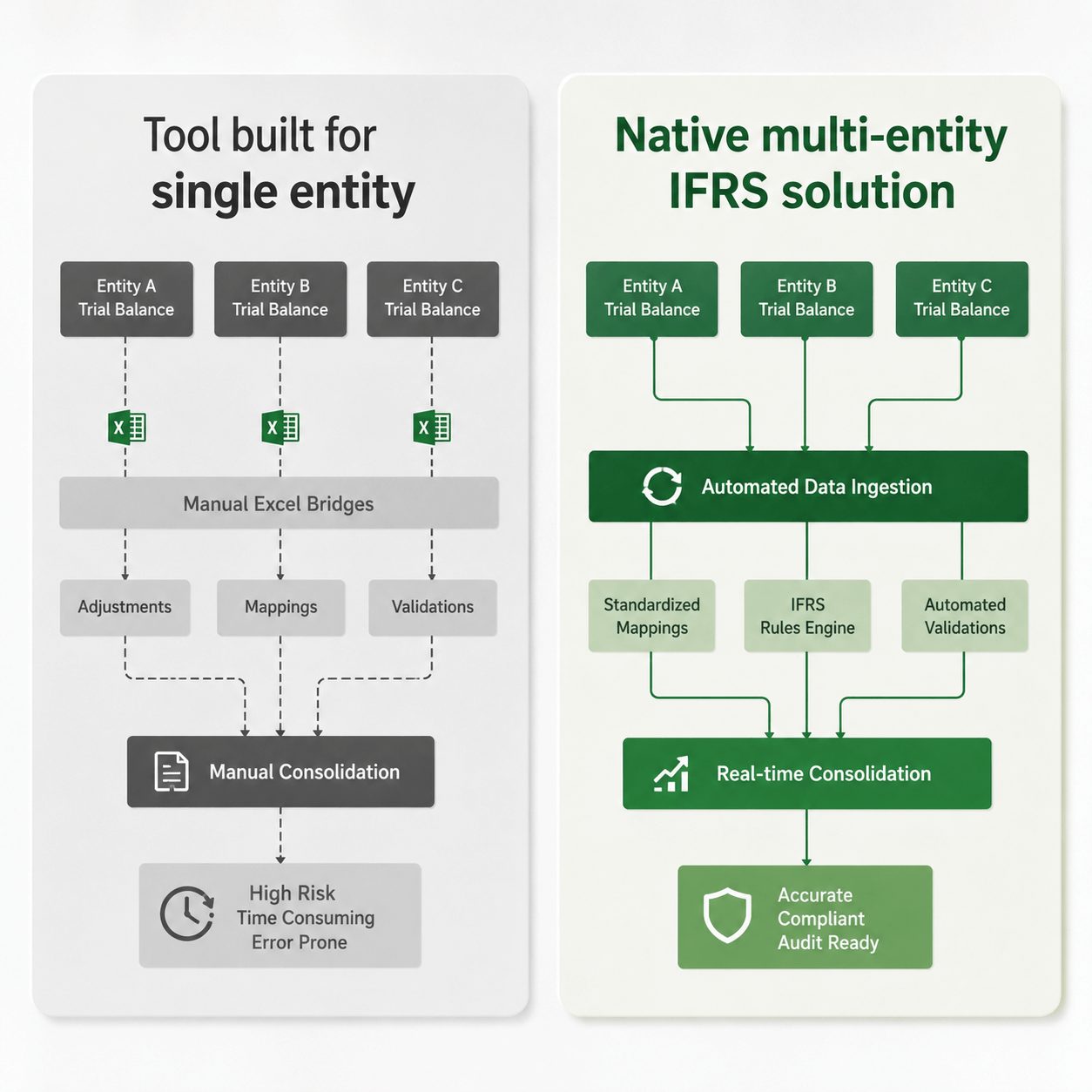
Ask this directly: was the multi-entity capability built into the product from day one, or was it added later? Bolt-on multi-entity modules always carry limitations — shared chart of accounts constraints, entity caps in standard licensing, or intercompany elimination logic that doesn’t handle partial ownership correctly.
Native architecture means the data model was designed around group structures from the start. Every entity is a first-class object in the system, with its own audit trail, its own close status, and its own reporting calendar if needed. That distinction matters when you’re running a year-end close across seven subsidiaries in four time zones.
2. IFRS-Compliant Accounting Software With Granular Data Modeling
IFRS isn’t one standard. It’s a stack. An insurance group in the GCC needs to handle IFRS 17 for contract measurement, IFRS 9 for financial instruments, and potentially IFRS 16 for lease liabilities — all simultaneously, all at the entity level, all feeding into group disclosures.
Granular data modeling means the system captures input data at the contract, policy, or instrument level — not just at the general ledger account level. That granularity is what makes the IFRS 17 calculations defensible. Without it, you’re estimating compliance, not demonstrating it. You can read more about why granular data capture defines implementation outcomes in our analysis of IFRS 17 software data challenges.
For GCC insurers specifically, data quality and integration consume 60–70% of IFRS 17 project resources on average. That number drops sharply when the tool was designed for this level of data complexity from the beginning.
Not sure if your current IFRS tools can handle a new entity or jurisdiction?
Take IFRS TECH’s 5-question Multi-Entity Readiness Assessment. It identifies architecture gaps in under 10 minutes — before they surface in your next reporting cycle.
See how IFRS TECH’s IFRS 17 software handles multi-entity compliance →
3. Automation Across the Close Cycle
Manual close processes are the first thing to collapse under multi-entity pressure. Each added subsidiary multiplies the number of reconciliations, intercompany eliminations, and currency adjustments. If those steps are human-driven, adding a fifth entity doesn’t add 20% to your workload — it often adds 50%, because the dependencies multiply.
Automated close workflows need to cover: intercompany matching and elimination, currency revaluation at correct rate types, actuarial data ingestion from external models, and disclosure pack generation. If any of those steps requires a manual handoff, that’s where errors concentrate. An IFRS 17 software platform built end-to-end eliminates those handoffs by design.
4. Auditability by Design, Not by Spreadsheet
Regulators and auditors don’t accept “trust us” anymore. Every IFRS calculation needs a traceable path from raw input data to disclosed output. That means the tool needs a native audit trail — not a reconciliation document you build manually after the fact.
Audit trail functionality should cover: who changed what, when, and why; version control on actuarial assumptions; and the ability to restate any period’s calculation without overwriting the original. If an auditor asks you to show the calculation basis for a specific group of contracts in Q2 2024, you should be able to pull it in minutes, not days.
This is particularly relevant for IFRS 17 data management systems, where the IASB’s granularity requirements make spreadsheet-based audit trails genuinely unmanageable at scale.
5. Vendor Track Record in Multi-Jurisdiction Deployments
Ask for references. Not case studies on the website — actual references. Finance teams at comparable organizations, in comparable jurisdictions, running comparable entity counts. Ask them specifically: what broke in year two? What couldn’t the tool handle natively? What did you have to build around?
Vendors with genuine multi-jurisdiction experience know exactly what questions you’re about to ask. They bring up the hard parts before you do. Vendors without that experience give you a product tour.
6. Modular Upgradability — IFRS Standards Change
IFRS 18 is already effective for annual periods beginning on or after January 1, 2027. It replaces IAS 1 and changes how income and expense are categorized and disclosed. Any IFRS ERP you select today needs to accommodate that update without requiring a re-implementation.
Modular upgradability means the vendor ships standard updates for new or amended IFRS Accounting Standards — not optional add-ons you negotiate separately. If the answer to “how do you handle IFRS 18 readiness?” is “we’ll scope that as a project,” that’s a red flag. If you need guidance on how existing tools are evolving, our review of IFRS 4 phase 2 software upgrades shows what good vendor responsiveness to standard changes actually looks like.
IFRS TECH has supported multi-entity IFRS implementations across GCC insurance groups, European holding companies, and South Asian insurers. The pattern is consistent: tools built for single-entity compliance create compounding rework costs when group structures grow. See what scalable vendor selection looks like in practice.
Red Flags in Non-Scalable IFRS Solution Providers
These come up repeatedly. Knowing them in advance saves months.
The “We Can Customize That” Trap
The right answer to “can your tool handle intercompany eliminations for minority-held subsidiaries?” is “yes, here’s how” — not “yes, we can build that for you.” But here’s the question that actually separates scalable IFRS solutions from the rest: ask the vendor to show you a live group close across five or more entities in their demo environment. Watch what’s manual. That’s your answer.
Entity Limits Hidden in Licensing
Some IFRS ERP vendors price by entity. Others cap entity counts at specific license tiers and charge step-up fees. This rarely surfaces in initial demos. It surfaces in contract negotiation, when you’re already eight weeks into an evaluation and switching is painful.
Ask directly: what is the entity limit at each pricing tier? What does entity expansion cost in year three? Is the intercompany elimination engine licensed separately? Get the answers in writing before the shortlist stage. An IFRS 17 software vendor shortlist process that doesn’t include licensing structure analysis is incomplete.
No Native IFRS 17 or IFRS 9 Calculation Engine
Some platforms market themselves as IFRS compliant accounting software based on their general ledger configuration flexibility. That’s not the same as a native calculation engine. IFRS 17 requires Contractual Service Margin calculations, coverage unit allocation, and risk adjustment measurement — none of which a configurable ledger handles without purpose-built logic underneath.
If the vendor’s answer to “where does the CSM calculation happen?” involves external actuarial models feeding a spreadsheet that feeds the ledger, that’s three failure points in your IFRS compliance architecture. IFRS 17 actuarial tools in insurance need to sit inside the platform, not beside it.
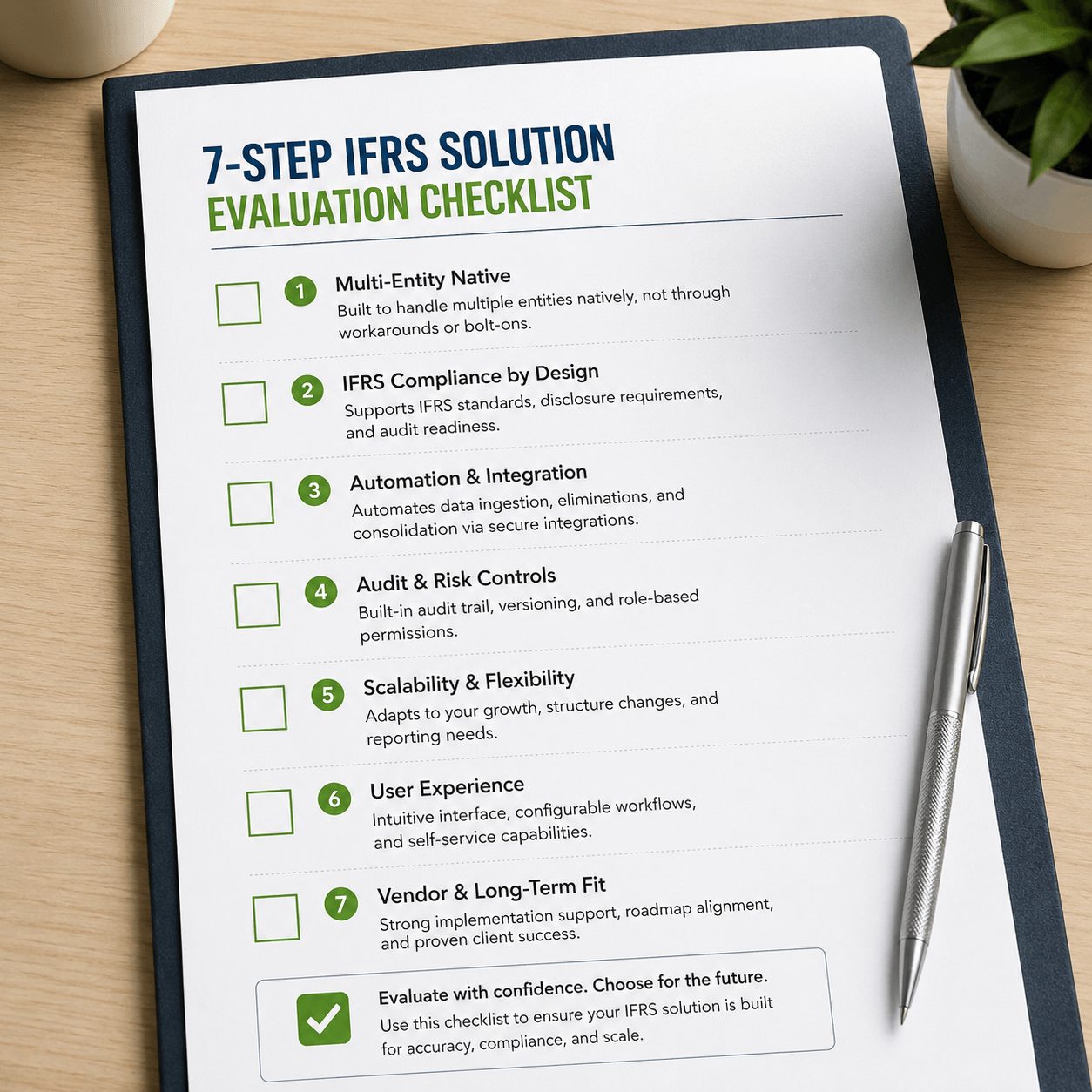
How to Run a Multi-Entity IFRS Evaluation: A Working Checklist
Run this before any vendor enters a shortlist.
- Architecture review: Request the data model documentation. Confirm entity objects are native, not simulated through cost centers or dimensions.
- Live multi-entity demo: Not a sandbox. A live or representative client environment with five or more entities, at least two currencies, and a completed year-end close. Watch where the manual steps are.
- Jurisdiction parameters: Confirm whether your specific regulatory jurisdictions (GCC, EU, APAC) are built into the system or require custom configuration.
- IFRS standard coverage: Verify native calculation engines for IFRS 17, IFRS 9, and IFRS 16 as applicable. Ask specifically how IFRS 18 is being addressed in the product roadmap.
- Audit trail demonstration: Ask the vendor to show a full calculation trace — from raw contract data to disclosed line item — for a specific reporting period.
- Licensing structure: Get entity limits, step-up pricing, and intercompany module licensing confirmed in writing before shortlisting.
- Reference check: Contact two live clients with similar entity counts and jurisdiction profiles. Ask specifically what broke in year two.
This checklist is also available in our detailed comparison of IFRS 17 software solutions with a focus on evaluation criteria.
If you’re building an IFRS tool shortlist right now, IFRS 17 compliance solutions that handle group structures differ significantly from single-entity tools. The distinction is worth mapping before you request demos.
What Scalability Looks Like in Practice: IFRS 17 as the Stress Test
IFRS 17 is the hardest test any multi-entity IFRS tool faces. It’s worth spending a moment on why.
An insurance group operating across four GCC jurisdictions has policy portfolios in each entity, actuarial models producing cash flow projections for each, and group-level disclosures that must consolidate all of it under a single set of measurement assumptions. The calculation complexity alone is significant. The data volume is larger. And the regulatory scrutiny is real — UAE insurers reported AED 42.4 billion (USD 11.5 billion) in turnover under IFRS 17 in 2023 alone, reflecting 19% growth from the prior year. That scale of reporting doesn’t run on spreadsheets.
What separates tools that survive this stress test? Three things come up consistently in our advisory work.
First: the actuarial engine and the accounting engine talk to each other natively. No file exports, no manual reconciliation between the two. Our review of IFRS 17 insurance reporting tools found that disconnected actuarial-to-accounting workflows are the single most common cause of close cycle failures in multi-entity groups.
Second: the group consolidation runs on the same data model as entity reporting. There’s no separate consolidation layer that requires its own mapping and maintenance. An IFRS 17 end-to-end non-life solution handles both layers from the same source data.
Third: the tool has already been through at least one full annual cycle with a multi-entity client. Not a pilot. A full year-end close, audited and signed off. That’s the reference you want.
I’ll be direct about something. I don’t have long-term data on how AI-assisted IFRS calculation tools perform under stress at scale — this is still relatively new territory. But the architecture principles haven’t changed: native data models, elimination of manual bridges, and jurisdiction-native rule sets determine whether multi-entity compliance holds together. That’s been true for ten years and it’s still true.
The Questions Your IFRS ERP Vendor Needs to Answer
These aren’t trick questions. A vendor with genuine multi-entity IFRS capability will answer them cleanly.
- What is the maximum number of entities a single client currently runs in production on your platform?
- How does your system handle intercompany eliminations when one subsidiary is 40% owned by the group and 60% by a third party?
- Show me how a new jurisdiction with a local regulatory calendar gets onboarded — how long does it take, who does it, and what’s the failure mode?
- When IFRS 18 comes into effect in 2027, will your platform update automatically or will that require a paid upgrade?
- What happens to group-level consolidation if one entity’s close is delayed? Does the rest of the group process, or does everything pause?
If any of those questions get deflected with “it depends” or “let us scope that,” you’re looking at a product that wasn’t built for your use case. And if the vendor can’t tell you what their biggest client’s entity count is, that’s usually because it’s smaller than yours.
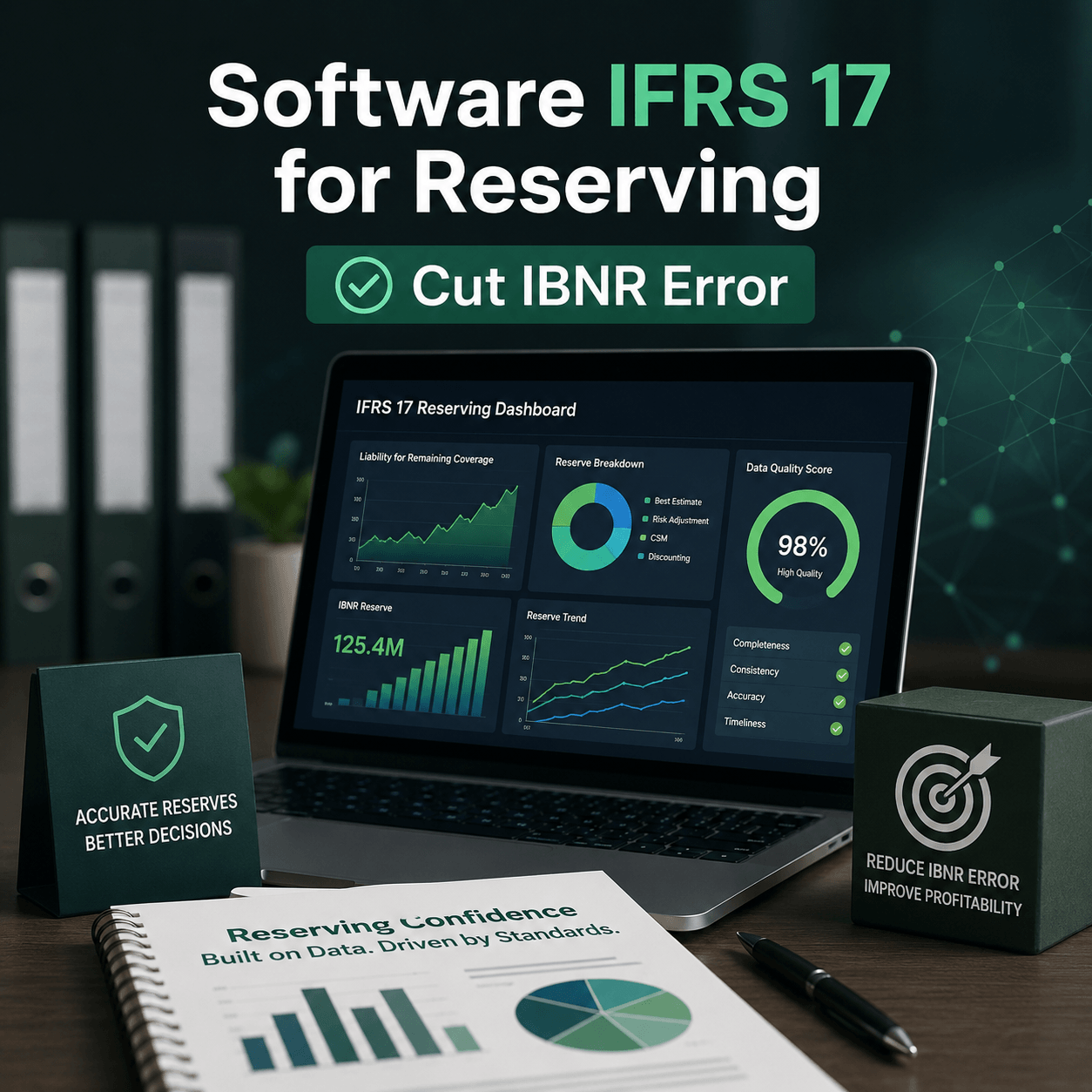
For non-life insurance groups specifically, the combination of IBNR calculations and IFRS 17 group reporting creates additional complexity. Our analysis of IBNR software integration requirements and our overview of IFRS 17 non-life solutions cover how these requirements interact across entity types.
What You Now Know
- Scalable multi-entity IFRS tools have three defining characteristics: native entity architecture, jurisdiction-specific rule handling, and automated multi-currency consolidation. Bolt-on multi-entity capability fails under growth pressure.
- The six evaluation criteria — native architecture, granular data modeling, automated close, audit trail design, vendor track record, and modular upgradability — are the minimum bar for any IFRS ERP selection in a multi-entity context.
- Vendor red flags are consistent and predictable: “we can customize that,” hidden entity licensing limits, and absence of native IFRS 17 and IFRS 9 calculation engines. Know them before you enter a vendor conversation.
Your Next Step Is a Live Architecture Review, Not Another Demo
Multi-entity IFRS tools are easy to demo well and hard to implement well. The gap between what you see in a vendor presentation and what your team experiences during a year-end close across six entities is where most selection mistakes live.
Ask for the architecture documentation. Get the client references. Run the checklist above before a single vendor enters your shortlist. And if you’re evaluating tools specifically for IFRS 17 compliance across group structures — start with the questions in this article, not the feature matrix the vendor sends you.
One last thing. By 2024, 78.6% of organizations chose cloud-based ERP over on-premise. The architecture question isn’t just about IFRS capability anymore — it’s about whether your compliance infrastructure can be updated in weeks, not years, as standards evolve. Modern IFRS reporting software is built on that assumption. Older systems are not.
Get this decision right the first time. The cost of switching is high. The cost of staying with the wrong tool is higher.
IFRS TECH’s advisory team works with multi-entity insurance and financial groups across GCC, Europe, and APAC to evaluate, implement, and scale IFRS-compliant platforms.
We’ve been through the architecture reviews, the vendor negotiations, and the year-end closes. We know what holds and what doesn’t.
See how IFRS TECH’s IFRS 17 software team handles multi-entity compliance at scale →
Trusted by GCC and European insurance groups · Actuaries, CPAs, and CFAs on every engagement
Frequently Asked Questions
What makes multi-entity IFRS tools different from standard IFRS compliant accounting software?
Standard IFRS compliant accounting software manages a single legal entity’s reporting. Multi-entity IFRS tools handle group consolidation, intercompany eliminations, multi-currency translation, and jurisdiction-specific rule sets simultaneously. The data architecture is fundamentally different — each entity needs its own audit trail and reporting calendar while feeding a single consolidated group output.
What are the biggest scalability red flags when evaluating an IFRS ERP?
Watch for three signals: entity limits embedded in licensing tiers, multi-entity capability delivered through customization rather than native architecture, and the absence of built-in IFRS 17 or IFRS 9 calculation engines. Each signals a product not built for group-level IFRS operations from the start.
How should a GCC insurance group approach the multi-entity IFRS tools evaluation criteria?
Start with jurisdiction parameters. Confirm the tool carries native rule sets for SAMA, UAE Insurance Authority, and relevant local regulators — not generic IFRS templates requiring manual configuration. Then verify intercompany elimination logic for partial ownership structures and test the IFRS 17 actuarial-to-accounting data flow with a real dataset before shortlisting.
How do you avoid poor scalability in IFRS ERP choices during procurement?
Ask vendors to run a live multi-entity close in a production environment, not a demo sandbox. Request references from clients with five or more entities in similar jurisdictions. Get licensing structure — including entity caps and step-up costs — in writing before evaluation begins. These three steps eliminate most poor-fit vendors early.
How does IFRS 18 affect the choice of scalable IFRS tools for multi-entity operations?
IFRS 18 replaces IAS 1 and takes effect for periods beginning January 1, 2027. It changes income and expense classification requirements. Any IFRS tool selected today must demonstrate a clear product roadmap for IFRS 18 compliance — shipped as a standard update, not a billable customization project.