TL;DR
Manual CSM processes are one of the biggest reasons insurers miss IFRS 17 reporting deadlines. Spreadsheet-based workflows create data silos, reconciliation gaps, and inconsistent risk adjustments that cause reporting lags across actuarial and finance teams. You’ll learn why these delays happen, how they affect revenue recognition and audit readiness, and what automated ifrs 17 software solutions do differently. From CSM roll-forward errors to broken audit trails, this article breaks down the root causes and walks you through a practical path to automation. Read it to understand what’s slowing your close and what you can do about it.
Insurance Contract Delays from Manual CSM: Why IFRS 17 Software Solutions Matter
Your team closes the books late again. The actuarial model ran overnight and still needs manual reconciliation. That’s the reality for insurers who haven’t yet moved to IFRS 17 software solutions built for the complexity of CSM reporting.
That kind of delay isn’t a one off problem. It’s what manual Contractual Service Margin (CSM) management looks like in practice, and it’s holding insurers back across every major market.
The way you calculate and track CSM under IFRS 17 directly affects your reporting timelines, your audit readiness, and your revenue recognition accuracy. When those processes rely on spreadsheets and disconnected systems, the risks multiply fast.
That’s why more insurers are moving to purpose-built ifrs 17 software solutions. These tools don’t just speed things up. They change how actuarial and finance teams work together, reducing errors and giving regulators the transparency they need.
This article breaks down why manual CSM processes cause so many reporting delays, and what the path forward looks like.
How IFRS 17 Software Solutions Eliminate CSM Delays
Manual CSM processes create delays at almost every step. From data collection to journal posting, each handoff between teams adds time and introduces risk.
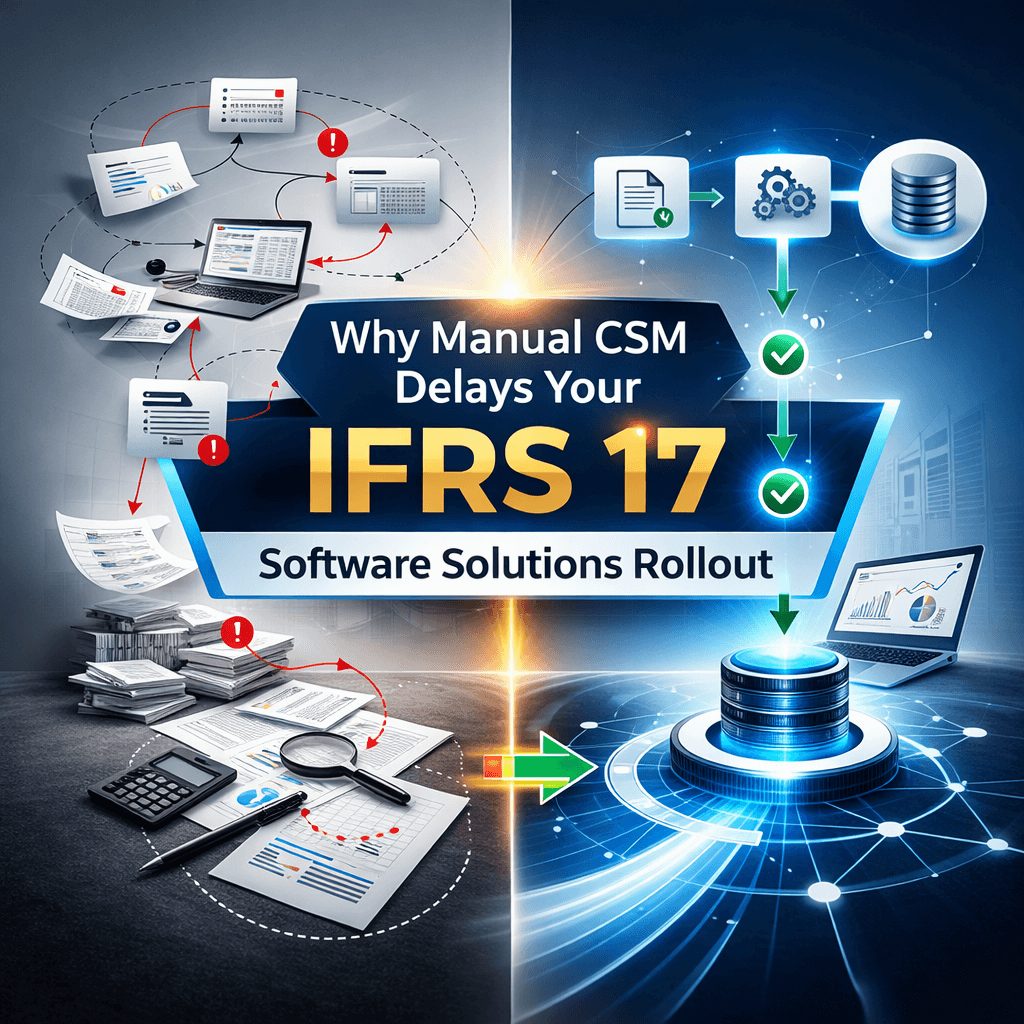
IFRS 17 software solutions replace those manual steps with automated workflows that run in real time, so your teams spend less time fixing errors and more time on analysis.
Data Silos and Spreadsheet Dependency
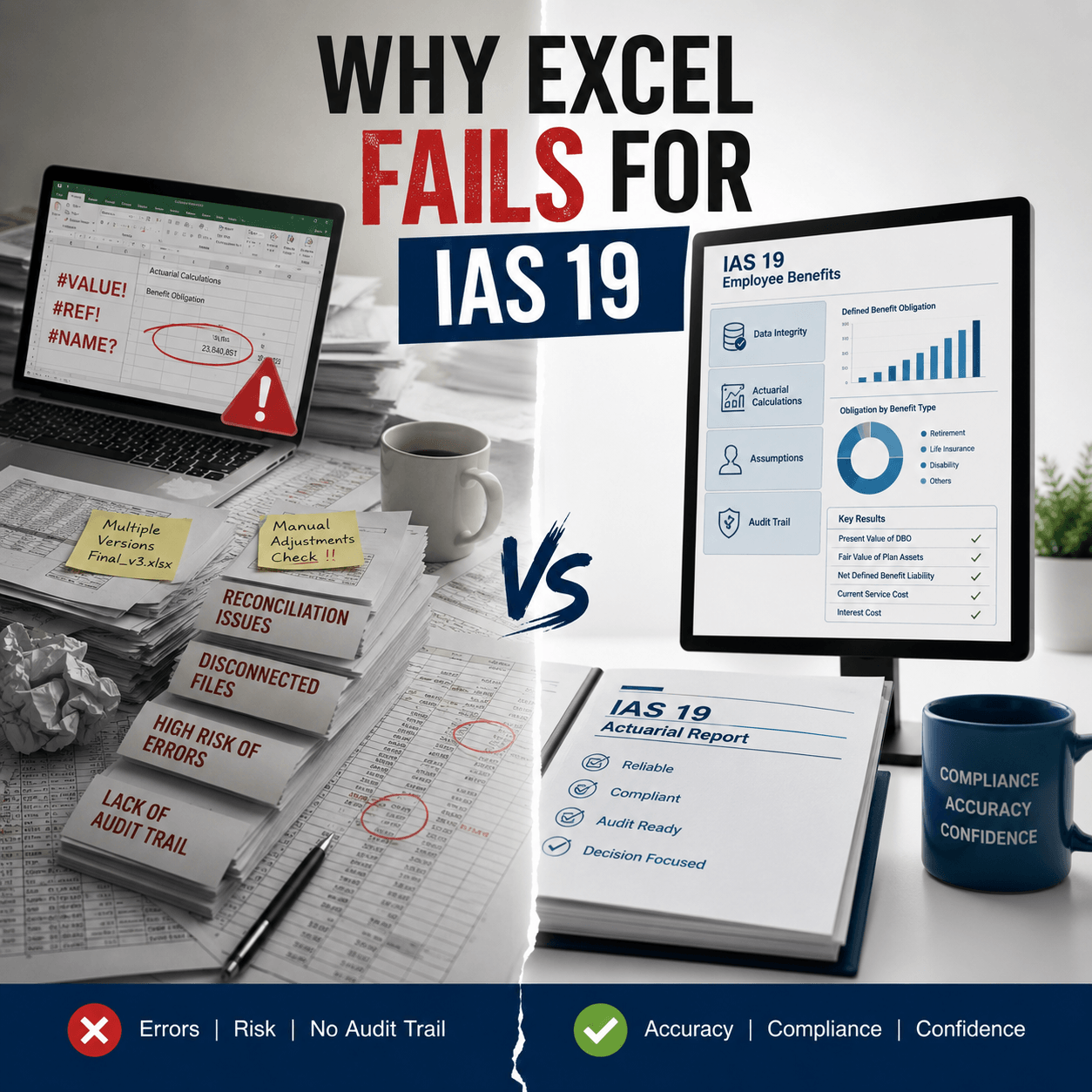
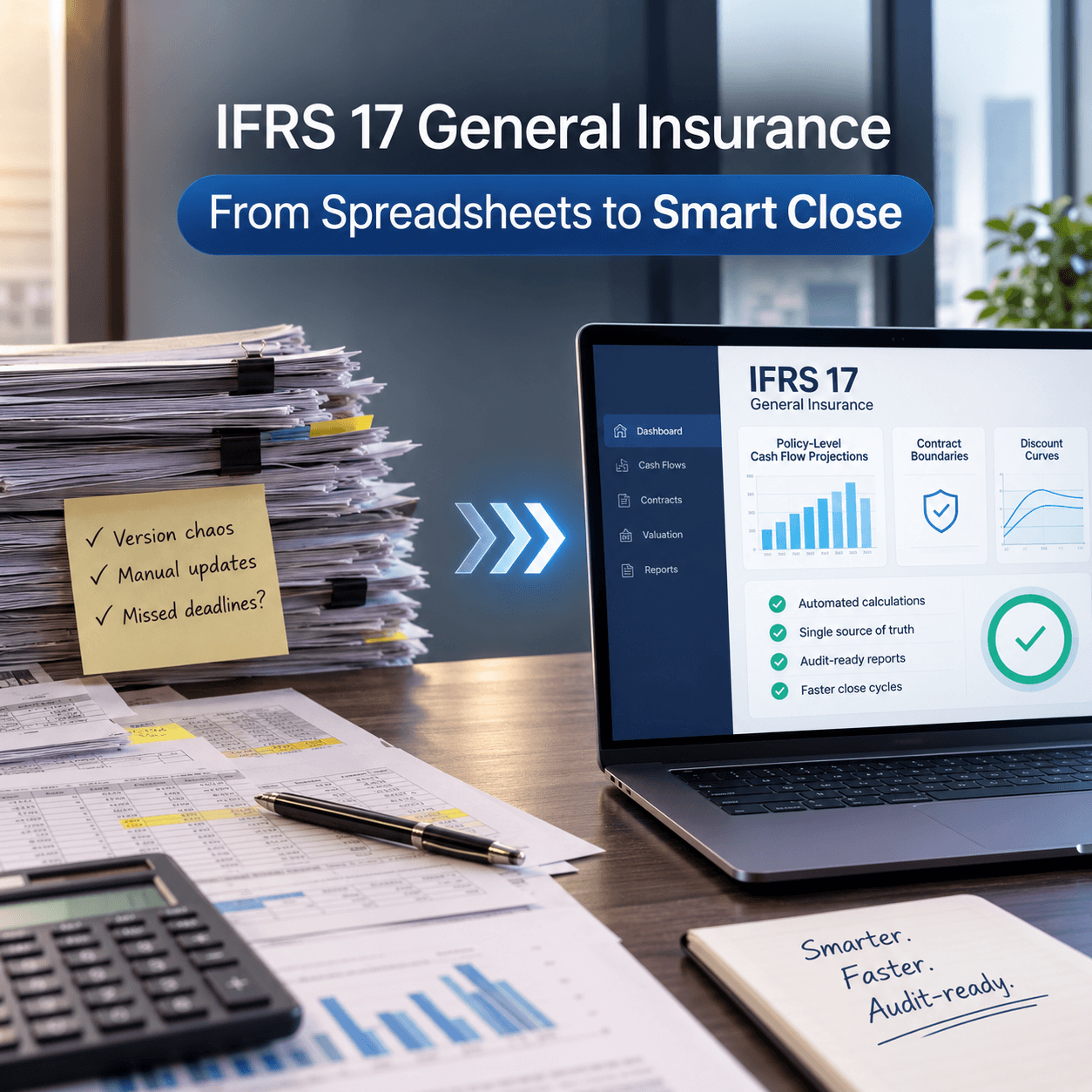
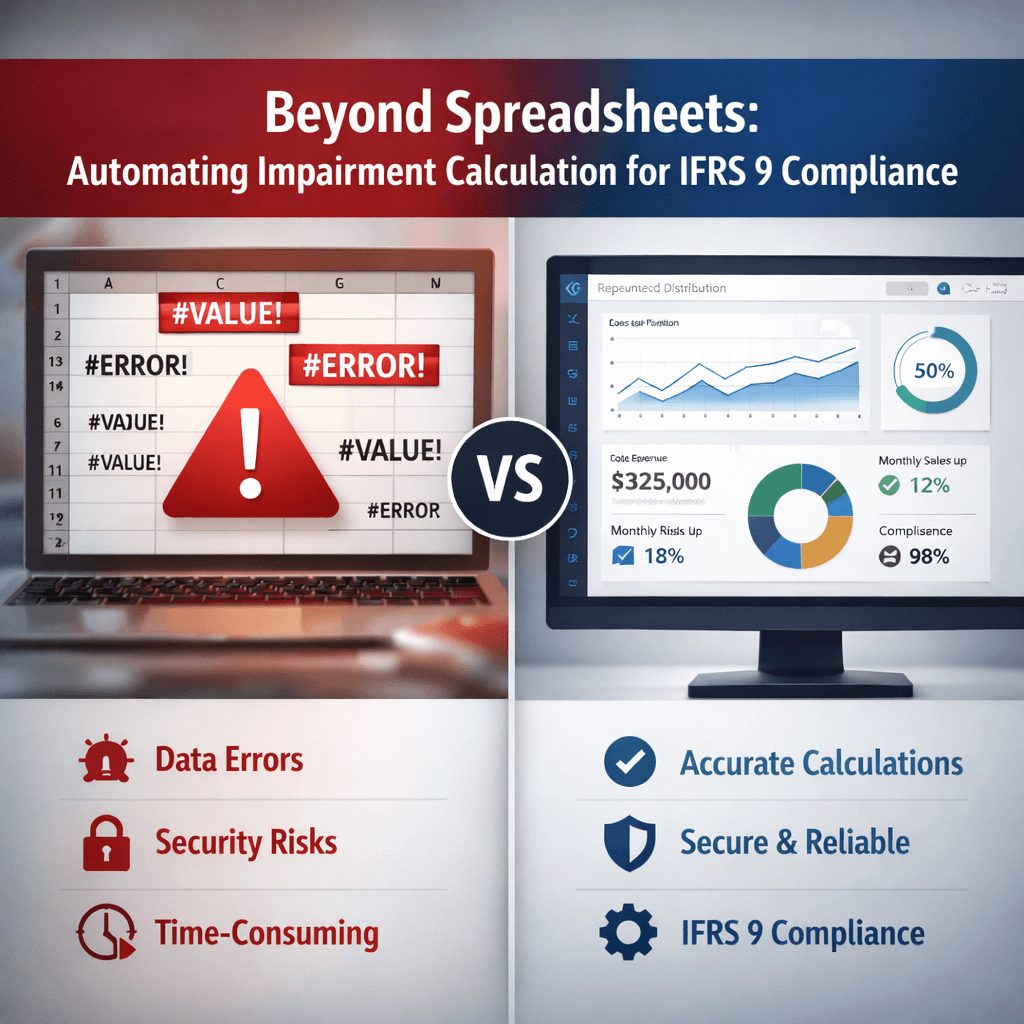
Most insurers still rely on spreadsheets to track CSM movements. The problem is that spreadsheets don’t connect to your policy administration or actuarial systems in real time.
That means your team rebuilds data manually every month. Files get emailed between departments, versions multiply, and by the time finance has the actuarial numbers, they’re already outdated.
According to EY, 62% of insurers faced significant data and system challenges for long-duration contracts under IFRS 17 in 2025, directly delaying CSM-related processes.
That stat isn’t surprising. Spreadsheet-based workflows weren’t built for the granularity IFRS 17 requires. You’d need a separate tracking model for every cohort, and those models don’t talk to each other.
Complex CSM Roll-Forward Adjustments
The CSM roll-forward is one of the most complex calculations in IFRS 17 reporting. You need to track expected cash flows, experience variances, discount rate changes, and CSM unlocking events, all within a single period.
When that process runs manually, even a small input error can cascade through the entire roll-forward. Your team then spends days checking outputs instead of closing the period.
The EIOPA found that IFRS 17 produced an average 9.5% higher non-life insurance liabilities compared to Solvency II in 2024, which shows just how significant these calculation differences are in practice.
If your team is manually adjusting for those differences every reporting cycle, the risk of inconsistent risk adjustments causing reporting lags is real and ongoing.
High Error Rates and Reconciliation Gaps
Manual processes introduce errors. That’s not a judgment. It’s a pattern backed by data across every industry that has studied it.
Research from Juro shows that inefficient contract workflows caused three to four weeks of delay on average in 2025, and that 40% of contract value can be lost due to inefficient contract management processes.
In the IFRS 17 context, those delays show up as late disclosures, restatements, and audit findings that could have been avoided with proper controls in place.
Limited Audit Trail and Compliance Risk
Regulators expect full traceability. When a number changes in your CSM report, you need to show exactly why it changed, who changed it, and when.
Spreadsheets don’t give you that. You might track changes in version history, but linking a specific cell edit to a business event or audit query is time-consuming and unreliable.
Manual CSM audit risks for insurers are growing as regulators increase scrutiny. A broken audit trail doesn’t just slow your close. It creates liability.
How Manual CSM Impacts IFRS 17 Reporting Timelines
It’s not just the calculation itself that slows you down. It’s the chain of events that follow every manual step in your process.
Slower Period-End Close
When your actuarial team finishes its model run and sends outputs to finance, those outputs need to be formatted, validated, and loaded into your reporting system.
Each of those steps takes time, and when something doesn’t reconcile, the whole cycle restarts. That’s why spreadsheet delays in IFRS insurance contracts are so common in practice.
A Loio study on contract management showed that over 50% of businesses lost opportunities due to contracting delays in 2026, and in-house legal and finance teams lost $122 for every hour spent on inefficient contract work.
For insurers under IFRS 17, the cost of a slow close isn’t just internal. It affects investor confidence and regulatory standing.
Inconsistent Revenue Recognition
CSM release drives revenue recognition under IFRS 17. If your CSM roll-forward contains errors or timing mismatches, your revenue figures will be wrong.
Inconsistent risk adjustments are a common cause of this. When actuarial and finance teams calculate risk differently, or when adjustments aren’t applied at the right granularity, the numbers diverge.
For context on what those inconsistencies can look like in practice, Prima Consulting’s team has covered the foundational mechanics in detail. You can read more at primaconsulting.org.
Increased Actuarial-Finance Misalignment
Actuaries think in probability and risk. Finance teams think in ledger entries and period allocation. Those two perspectives need to connect cleanly under IFRS 17, and they rarely do in manual workflows.
When actuarial outputs don’t match finance expectations, the back-and-forth can last days. Each query takes time to research, explain, and resolve before the period can close.
That misalignment is one of the main reasons regulatory pressure on non-life reporting has increased. Supervisors want consistent, explainable numbers, and manual processes make that harder to deliver.
Automation vs Manual CSM: What’s the Difference?
Manual and automated CSM processes aren’t just different in speed. They’re different in how your team works and what you’re able to do with the output.
Real-Time CSM Calculation Engines
Automated systems run CSM calculations continuously as inputs change. You don’t wait for a monthly model run to see where you stand.
That real-time visibility means your team can catch csm projection errors early, before they compound through the rest of the roll-forward.
Integrated Actuarial and Accounting Workflows
Integrated platforms connect your actuarial model outputs directly to your accounting ledger. When the actuary updates an assumption, the financial impact flows through automatically.
If you’re evaluating what an end-to-end setup looks like, this overview of IFRS 17 solutions covers how connected platforms handle non-life cash flows across the full reporting cycle.
Automated Journal Entries and Disclosures
One of the most time-consuming parts of manual IFRS 17 reporting is generating journal entries from actuarial outputs. Automated systems do that in seconds.
Disclosures that used to require multiple rounds of review can be generated directly from the system, with full traceability back to the source data.
Key Features of IFRS 17 Software Solutions
Not all software handles IFRS 17 the same way. These are the capabilities that matter most for CSM management.
Automated CSM Roll-Forward and Unlocking
The software should handle the full CSM roll-forward automatically, including unlocking for changes in estimates and applying experience adjustments at the cohort level.
This is where most manual processes break down. Automated roll-forward eliminates the reconciliation gap between what actuaries model and what finance reports.
Multi-GAAP and Multi-Entity Consolidation
Many insurers report under multiple frameworks simultaneously. Your IFRS 17 solution should support parallel reporting without requiring separate manual processes for each.
For groups with entities across multiple jurisdictions, IFRS 17 GCC implementation presents specific challenges around consolidation timelines and data standardization that require purpose-built tools.
Scenario Modeling and What-If Analysis
Good IFRS 17 software lets your team run scenarios before the period closes. You can test how changes in interest rates, lapse assumptions, or claims development affect your CSM balance.
That forward-looking capability is something manual spreadsheets simply can’t provide at the speed and granularity modern reporting demands.
Full Audit Trail and Regulatory Compliance
Every input change, calculation step, and output should be logged automatically. The audit trail should show who changed what, when, and why, with direct links to the source data.
This is non-negotiable for regulatory submissions and external audits. Manual processes can’t reliably produce this level of traceability.
Step-by-Step: Moving from Manual to Automated CSM
Making this transition doesn’t happen overnight, but it doesn’t need to be painful either. Here’s how most insurers approach it.
1. Assess Current CSM Processes
Start by mapping your current process from end to end. Where do delays typically happen? Where do reconciliation issues come up? Which manual steps add the most time?
This assessment gives you a clear baseline and helps you prioritize what to automate first.
2. Cleanse and Centralize Data
Before you can automate, you need clean data. That means standardizing inputs from policy administration, actuarial models, and general ledger systems.
Data quality issues are the most common reason IFRS 17 implementations run over time. Addressing them early makes everything downstream faster.
3. Configure IFRS 17 Measurement Models
Set up the General Measurement Model (GMM) or Premium Allocation Approach (PAA) configuration that fits your product mix. This includes cohort definitions, discount rate curves, and risk adjustment methodology.
For a deeper look at what IFRS 17 implementation involves from a regulatory and technical angle, the team at Prima Consulting covers IFRS 17 implementation in practical detail.
4. Integrate Actuarial and Finance Systems
Connect your actuarial outputs to your accounting platform so data flows without manual intervention. This step typically requires API connections or a dedicated integration layer.
Once this integration is in place, your finance team gets actuarial data in the format they need, when they need it, without chasing emails.
5. Test, Validate, and Optimize
Run parallel calculations for at least one full reporting cycle before going live. Compare automated outputs against your manual results and investigate any differences.
After go-live, continue reviewing outputs for the first few periods and use scenario modeling to stress-test assumptions before each close.
Business Benefits of Automating CSM
The case for automation isn’t just about speed. It changes what your team is capable of doing with the time they get back.
Faster Financial Close Cycles
Zurich Financial Services in Australia cut life insurance application processing time from 22 days to less than one day using AI-driven tools in 2025, according to Deloitte.
While processing and reporting aren’t the same function, the magnitude of reduction is consistent with what automated IFRS 17 workflows deliver for period-end close cycles.
Improved Accuracy and Reduced Rework
When calculations run automatically from a single source of data, the rate of reconciliation errors drops significantly. Your team isn’t fixing the same problems every month.
For context on how data-related challenges affect software performance and accuracy, this breakdown of IFRS 17 software data challenges covers the most common issues insurers face when transitioning from manual to automated workflows.
Enhanced Transparency for Stakeholders
Boards, auditors, and regulators want explanations, not just numbers. Automated systems produce documentation as a byproduct of the calculation process.
That transparency builds confidence in your numbers and reduces the time your team spends preparing supplemental reports after the fact.
Scalable Infrastructure for Growth
Manual processes don’t scale. As your book of business grows, the volume of contracts and cohorts increases, and the manual workload grows with it.
Automated systems handle that growth without requiring proportional increases in team size or reporting time.
Common Implementation Challenges
Knowing what to expect makes the transition go more smoothly. These are the challenges most insurers run into.
Data Quality and Legacy System Integration
Legacy policy administration systems often store data in formats that don’t map cleanly to IFRS 17 requirements. This is the most common source of delays during implementation.
Plan for data mapping and transformation work upfront. It’s not glamorous, but it determines how well everything else works.
Change Management Across Departments
Moving from manual to automated processes means changing how actuaries, finance teams, and IT work together. That requires clear communication and training.
Teams that resist the change often do so because they don’t understand why the new process is better. Early involvement and transparent communication address that.
Managing Regulatory and Disclosure Requirements
IFRS 17 disclosure requirements are detailed and vary by jurisdiction. Your software configuration needs to produce outputs that match exactly what regulators in your markets expect.
Getting this right from the start is much easier with experienced advisors. The team at Prima Consulting works specifically on IFRS 17 implementation across different regulatory environments and can help map disclosure requirements to your system configuration.

Frequently Asked Questions
What is CSM under IFRS 17?
The Contractual Service Margin is an IFRS 17 balance sheet component that represents unearned profit on insurance contracts. It releases into revenue as coverage is provided over the contract period. CSM must be tracked at the cohort level and updated each reporting period to reflect changes in estimates and cash flows.
Why does manual CSM cause reporting delays?
Manual CSM processes depend on spreadsheets, email handoffs, and disconnected systems. Each step introduces the possibility of errors that require investigation and correction before the period can close. Reconciliation between actuarial and accounting outputs is particularly time-consuming when done manually, and inconsistent risk adjustments causing reporting lags are a frequent outcome.
How do IFRS 17 software solutions improve compliance?
Purpose-built IFRS 17 software automates the calculation, roll-forward, and disclosure process with a full audit trail at every step. This gives regulators and auditors clear documentation of how every number was produced, which significantly reduces compliance risk compared to manual processes.
Can automation reduce actuarial workload?
Yes. Automation handles the repetitive calculation and reconciliation steps that consume most of the actuarial team’s reporting time. That frees actuaries to focus on assumption-setting, model validation, and analysis rather than data preparation and error-checking.
The Cost of Waiting on Manual CSM Has Already Started
Every reporting cycle that runs on manual CSM processes adds delay, increases error risk, and widens the gap between actuarial and finance outputs.
The IFRS 17 standard isn’t getting simpler. Regulatory expectations are growing, and the insurers that have moved to purpose-built ifrs 17 software solutions are already seeing faster closes and cleaner audit trails.
The practical question isn’t whether automation makes sense. It’s how long you can afford to wait before the cost of staying manual becomes harder to justify.
If you’re assessing where your current process stands and what a transition would look like, the advisory team at Prima Consulting works with insurers at every stage of the IFRS 17 implementation process.
Talk to the Prima Consulting team to understand what automated CSM management looks like for your specific market and product mix.