For non-life finance and actuarial teams still running cash flow projections in spreadsheets, and losing nights to it every close.
TL;DR
An IFRS 17 general insurance solution replaces manual spreadsheet close cycles with automated, policy-level cash flow projections. Non-life insurers still stuck in Excel face audit risks, version chaos, and blown deadlines. This piece covers the real cost of manual data pains, why spreadsheet delays plague IFRS general insurance work, and how the right platform fixes contract boundaries and discount curves. Read on to see where your close is bleeding time. Then decide what to fix first.
Why an IFRS 17 General Insurance Solution Matters Now
When IFRS 17 took effect on 1 January 2023, most non-life insurers underestimated the data problem.
They knew the rules changed. What caught them off guard was the plumbing. Suddenly every policy needed traceable cash flow projections, and the old close process could not carry the load. That gap is exactly what a proper IFRS 17 general insurance solution closes.
Here’s the thing. An IFRS 17 general insurance solution is not a nice-to-have anymore. Regulators in Saudi Arabia and the UAE now expect clean, auditable numbers on a fixed calendar. Miss that, and the questions start.
Most P&C insurers picked the premium allocation approach to keep things simple. Roughly 90% of non-life liabilities in Europe run on the PAA, per EIOPA’s first-year study. Simpler on paper. Messier in the data.
What this article covers:
- Where manual data pains cost non life insurers the most
- Why spreadsheet delays break IFRS general insurance reporting
- What to look for in an ifrs 17 solución no vida platform
IFRS TECH builds Delta, a purpose-built IFRS 17 platform for exactly this problem. More on that later, when it’s relevant.
What Manual Data Pains Actually Cost Non-Life Insurers
Let’s be clear. The pain is not the standard. The pain is the spreadsheet.
Under IFRS 4, non-life teams could hold claims reserves undiscounted and move on. IFRS 17 killed that shortcut. Now every long-term cash flow gets discounted, and the projections have to reconcile from source to disclosure.
So teams did what teams do. They built more spreadsheets.
KPMG found that many insurers leaned on thousands of spreadsheets and ad-hoc databases to bridge the gaps in their data architecture. That’s not a system. That’s a liability with a filename.
Manual Data Pains for Non Life Insurers: The Hidden Version Trap
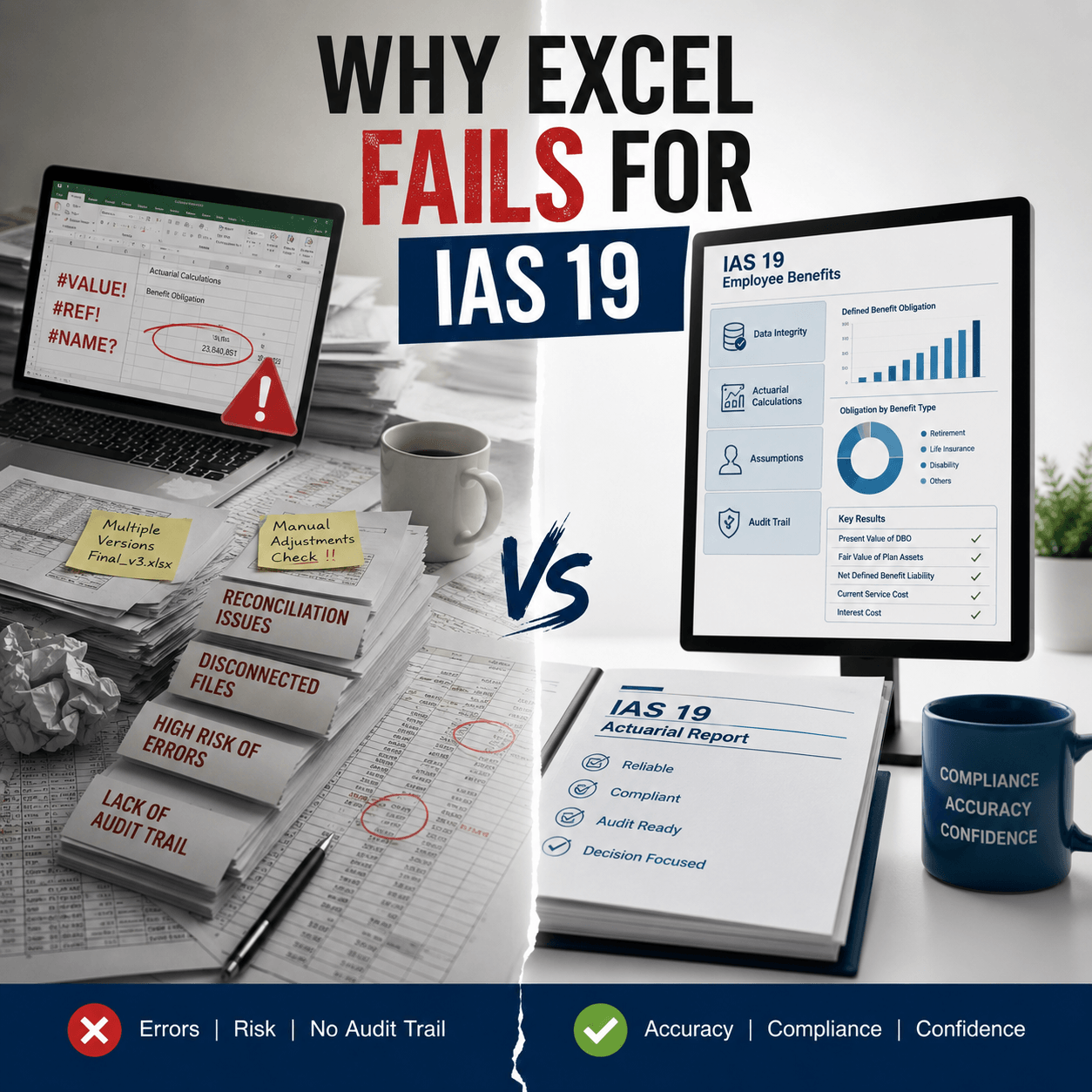
Ask any actuary who owns the reserving model. The scariest moment is not the calculation. It’s not knowing which version of the file is the real one.
One analyst updates the discount curve. Another tweaks the contract boundaries. A third emails a “final_v7_USE THIS” copy at 11pm. By morning, nobody trusts the number.
This is where IFRS 17 data challenges stop being technical and start being reputational. When the auditor asks how a figure was derived, “we think it was this tab” is not an answer.
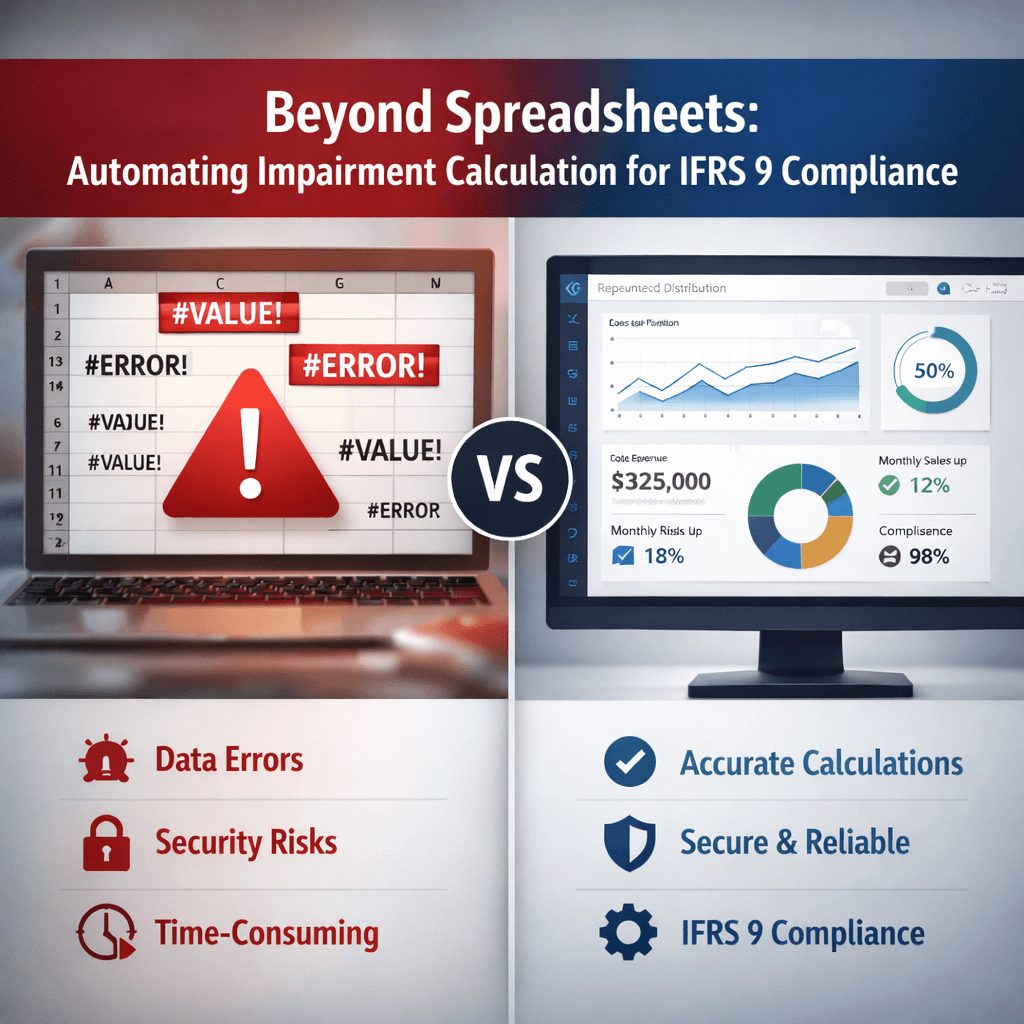
Manual data pains non life insurers feel most at quarter-end. The projections balloon. The granularity IFRS 17 demands, policy-level detail across millions of contracts, does not fit in a workbook. Excel was never built for that.
These manual data pains non life carriers absorb are not evenly spread. Small books cope. Large P&C portfolios do not. And that’s the point where an IFRS 17 general insurance solution earns its keep.
Spreadsheet Delays in IFRS General Insurance Reporting
Time is the tax you pay for manual work.
Spreadsheet delays ifrs general insurance teams face compound quietly. A curve update here. A remapping there. Each one small. Together they push the close past the deadline.
EY’s global survey grew from 68 respondents in 2021 to 91 life, non-life, and composite insurers by 2022, and a recurring theme held: teams wanted to cut the noise between internal numbers and external reporting. Manual handoffs are the noise.
An IFRS 17 general insurance solution attacks the delay at the root. It automates the projection engine, so a discount curve change flows through every affected group without a single copy-paste.
Quick self-check. If your last close ran later than planned, ask why. Was it the numbers, or was it finding, merging, and re-checking the files that held the numbers?
The Audit Risks Hiding in Your Cash Projections
Here’s a question worth sitting with. If your auditor rebuilt your IFRS 17 cash flows from scratch, would they land on your number?
For a lot of non-life insurers, the honest answer is: maybe.
Audit risks cash projections carry are rarely about fraud. They’re about traceability. IFRS 17 requires an unbroken line from source data to the reported figure. Manual processes snap that line every time a value gets typed by hand.
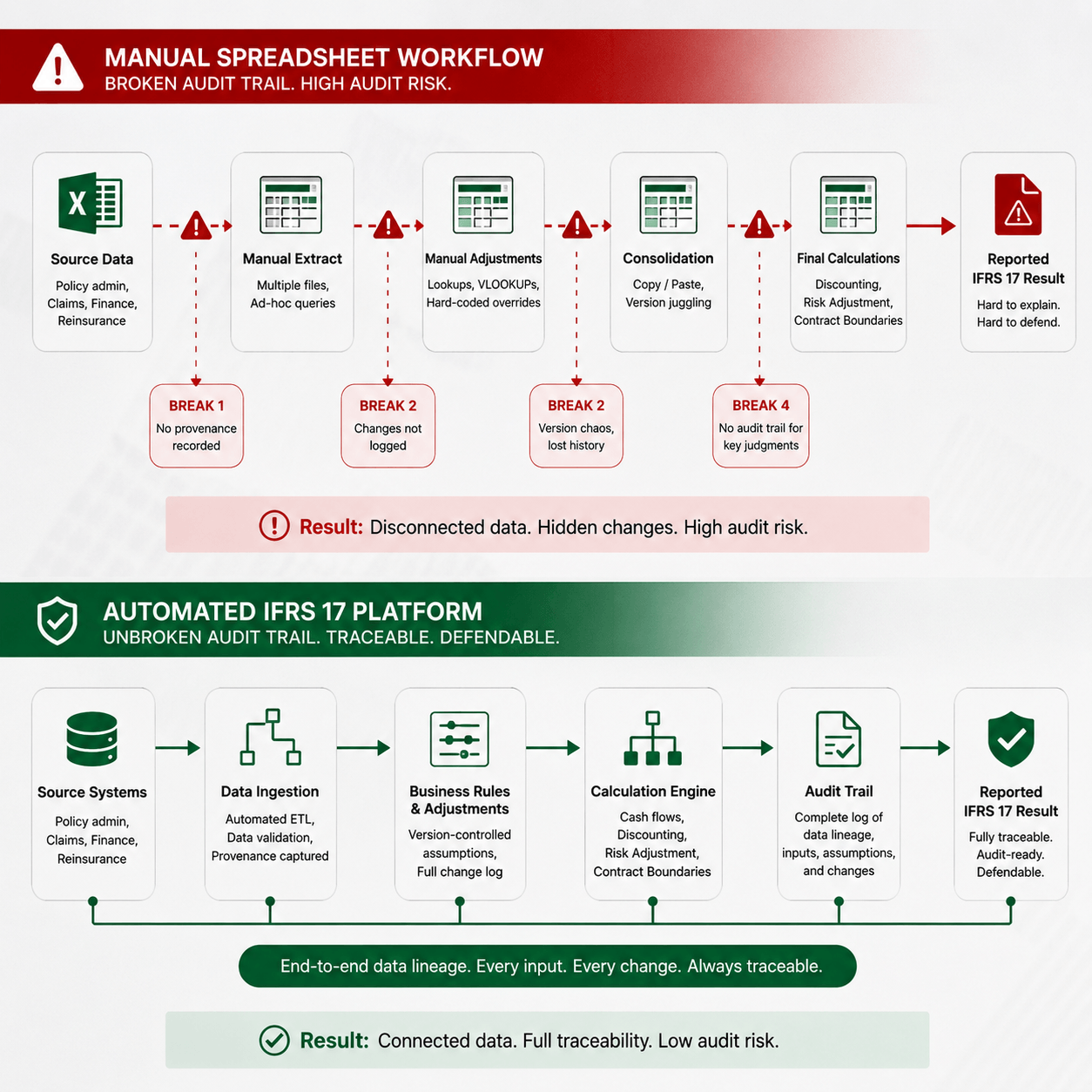
Discount curves make it worse. Under IFRS 17, insurers derive their own discount rates rather than pulling a prescribed set. EIOPA found that 75% of surveyed insurers still lean on published risk-free curves as a starting point, then adjust for illiquidity. Every adjustment is a judgment. Every judgment needs an audit trail.
Contract boundaries add another layer. Deciding where a contract starts and ends changes which cash flows you project. Get it wrong, and the restatement risk is real. A strong non-life IFRS 17 solution encodes those boundary rules once, then applies them consistently. No re-litigating the logic each quarter.
I’ll admit the limit here. No platform removes actuarial judgment. What it removes is the risk that good judgment gets lost in a bad file.
How to Choose an IFRS 17 Solución No Vida Platform
You might think the answer is the biggest, most feature-heavy system on the market. Often it’s the opposite.
For non-life, the best ifrs 17 solución no vida fit is a platform that handles the PAA cleanly without forcing you into life-insurance complexity you’ll never use. Match the tool to your book. A right-sized IFRS 17 general insurance solution beats an over-built one every time.
Watch for a few things.
- Policy-level projections at scale. The engine has to run cash flow projections across your full portfolio, not a sampled subset. If it chokes above a certain contract count, walk away.
- Built-in contract boundaries and discount curves logic. These should be configured once and governed, not rebuilt each cycle in a side-spreadsheet.
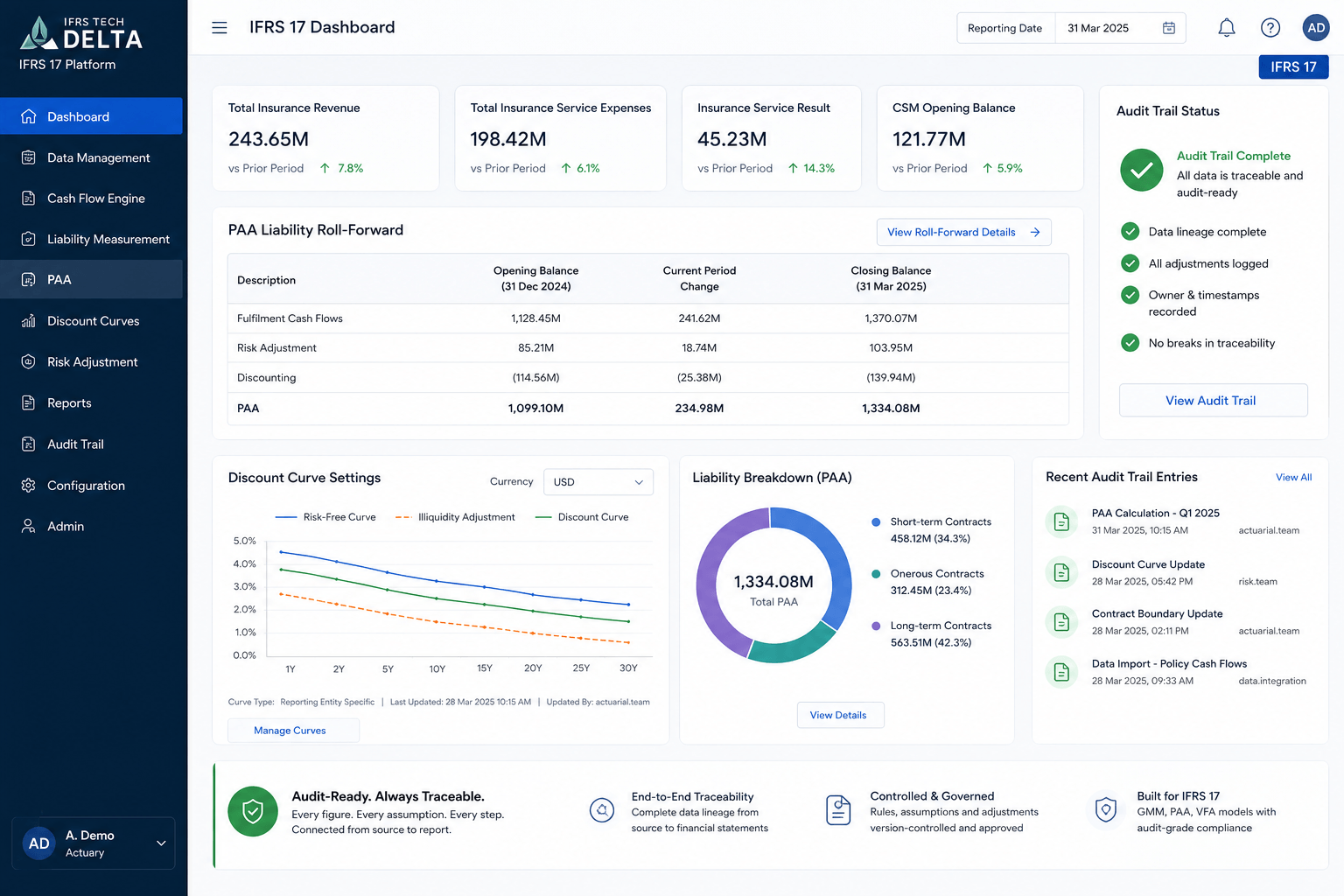
- A real audit trail. Every number should trace back to source with a timestamp and an owner. This is the difference between a compliant tool and an auditable one.
- Integration with what you already run. A metadata-driven layer that unifies legacy systems beats a rip-and-replace every time.
One insurer in KPMG’s analysis unified data from nine separate systems into a common format using a metadata-driven integration layer. Faster onboarding. Easier maintenance. That’s the shape of a solution that lasts.
Delta, IFRS TECH’s IFRS 17 software platform, was built around GMM, VFA, and PAA models so non-life teams get the simplified path without losing the audit-grade backbone. Insurers across the GCC and APAC run it for exactly the pains described here.
Build vs Buy: The Question Behind the Question
Some teams still ask whether they should just build it in-house.
Fair question. And sometimes the answer is yes, if you have a standing team of actuaries and engineers with time to spare. Most non-life insurers do not.
The real cost of building is not the first version. It’s the maintenance. IFRS 17 interpretations shift. Regulators in Saudi Arabia and the UAE update expectations. Someone has to keep the engine current, and that someone is expensive.
Buying an IFRS 17 general insurance solution shifts that burden. The vendor owns the standard’s evolution. You own the numbers. For most teams, that trade is worth it. And a bought IFRS 17 general insurance solution starts working this close, not two build cycles from now.
If you want to weigh both paths properly, our take on the IFRS 17 vendor shortlist lays out what separates a demo-ware pitch from a platform that survives your third year-end.
IFRS Tech
Want to see how Delta handles your non-life cash flow projections? Book a free product demo.
No obligation · Live walkthrough · GCC, Europe & APAC
What Good Looks Like at Year-End
Picture the close you actually want.
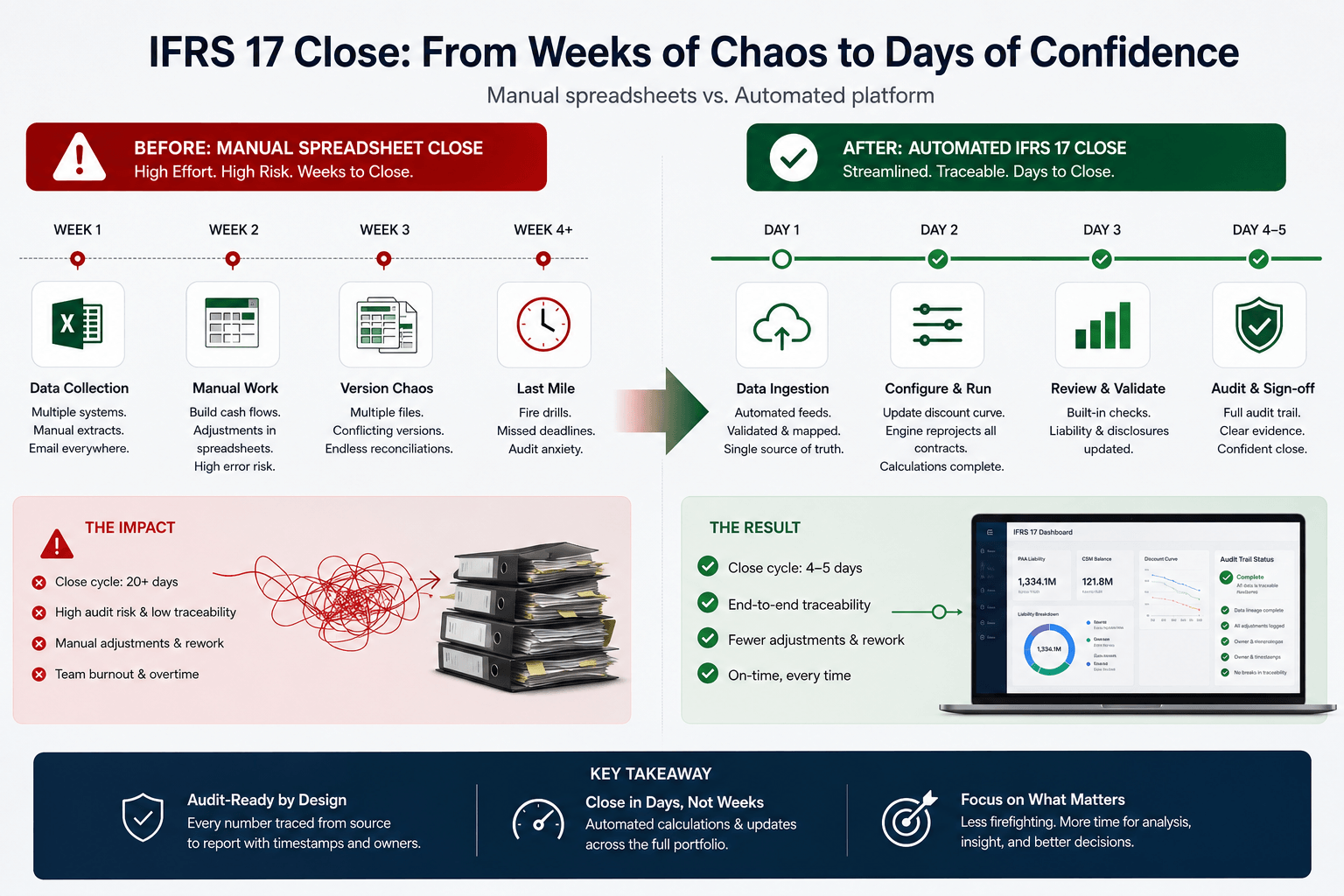
A discount curve update lands. You change it once. The engine reprojects every affected group of contracts, recalculates the liability, and updates the disclosures. No emailed files. No midnight version hunt.
The auditor asks how a figure was built. You click. The trail shows source data, the boundary logic applied, the curve used, and who signed off. That’s it.
This is not a fantasy. It’s what a working IFRS 17 general insurance solution delivers for non-life insurers who stopped fighting Excel. Teams that made the switch report close cycles measured in days, not the frantic weeks manual work demands.
Even so, the software is only half the story. Clean input data and disciplined governance still matter. A platform amplifies good process. It cannot invent one.
What you now know:
- Manual spreadsheets create audit risks in cash projections that traceability rules will expose
- Spreadsheet delays compound at quarter-end and push non-life closes past deadline
- The right non-life platform handles PAA, contract boundaries, and discount curves without side-files
Where to Go From Here
If your last close ran on adrenaline and copy-paste, that’s your signal.
An IFRS 17 general insurance solution exists to end the manual data pains that non-life insurers have quietly absorbed since 2023. The audit risks in your cash projections are not going away on their own. Neither are the discount curves and contract boundaries that manual work keeps mishandling.
You don’t have to fix it all this quarter. Start by seeing what an automated close looks like on your own data. Then decide.
The teams sleeping through year-end already did.
Free Product Demo
See Delta handle non-life cash flow projections, on your data, your use case.
IFRS Tech’s advisors walk you through Delta IFRS 17 live, PAA models, contract boundaries, and discount curves included. First demo is always free, no pitch, just the product.