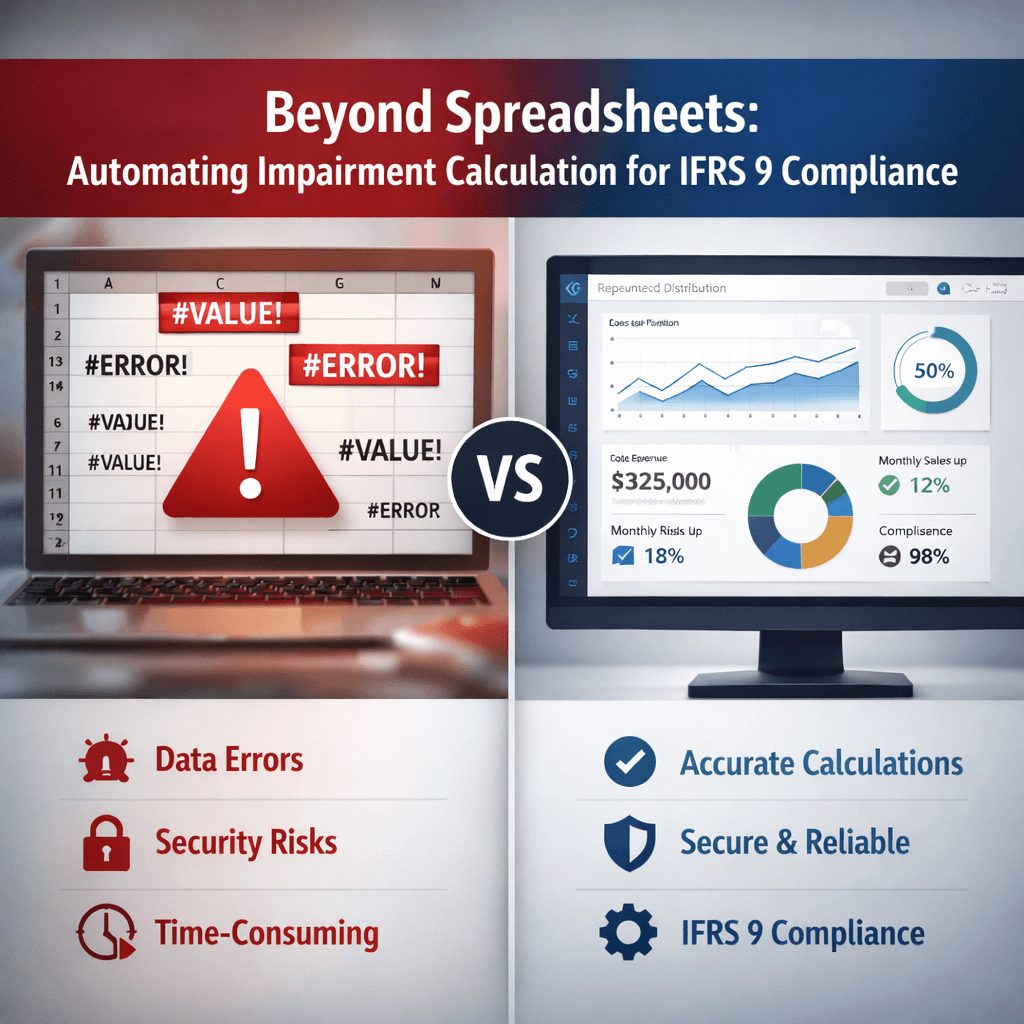
Finance and actuarial leaders across GCC, Europe, and APAC: how to pick the right IFRS partner before your data problems become your auditor’s problems, in time for your next close cycle.
✓ Written by IFRS TECH’s advisory team · ✓ Serving GCC, Europe & APAC · ✓ Actuaries + CPAs + CFAs
TL;DR
Choosing the right IFRS consulting services for data isn’t about finding the biggest firm with the most credentials. Your choice will determine how fast you close, how clean your disclosures are, and whether your data governance can hold up under audit. This article covers the five criteria that actually predict consulting success, the red flags most teams miss before signing, and how optimization in IFRS compliance technology plays into a selection decision many organizations treat too casually. Use this to build your evaluation framework and shortlist with confidence.
Why Your IFRS Consulting Services for Data Choice Will Define Your Close Cycle
Here’s a number worth sitting with: IFRS 17 implementation has cost large multinationals up to USD 200 million. That’s the high end, sure. But even mid-sized insurers in the GCC are absorbing costs in the tens of millions, and most of the overruns trace back to the same root cause. They picked the wrong consulting partner for their data environment.
Not a bad firm. Not an unqualified team. Just the wrong fit for the specific data complexity they were dealing with.
That distinction matters. And most selection processes don’t catch it.
Regulatory compliance mandates grew by 38% globally in 2024, which means the demand for IFRS consulting is climbing fast. More vendors, more claims, more proposals that all look similar in a shortlist presentation. The criteria most teams use — years of experience, brand recognition, price — aren’t wrong, but they’re incomplete. They screen for surface-level credibility, not for the technical and operational fit that determines whether your data infrastructure actually meets the standard.
What this article covers:
- The five criteria that differentiate genuinely capable IFRS consulting services for data from firms that will drain your budget and extend your timeline.
- The red flags that rarely appear in RFP responses but show up clearly in reference checks and proof-of-concept work.
- How to adapt your evaluation when IFRS insurance compliance or multi-jurisdictional GCC data environments add complexity to the picture.
The finance and risk consulting market is valued at USD 27.1 billion in 2025, projected to reach USD 50.9 billion by 2035. That growth doesn’t mean better options across the board. It means more options, which makes evaluation discipline more important than ever.
What Most Teams Get Wrong Before They Ever Sign a Contract
You might think the biggest selection mistake is rushing the decision. It’s not. Teams that rush usually know they’re rushing. The more dangerous mistake is applying a rigorous process to the wrong criteria.
They Evaluate Credentials Instead of Data Workflows
Most shortlists are built on three things: the consultant’s IFRS experience (years, certifications, past projects), their proposal quality, and their price. These aren’t useless inputs. But they say almost nothing about whether a firm understands how to work with your actual data.
IFRS data systems for regulatory compliance require consultants who understand how your policy systems, actuarial engines, and general ledger interact at the contract level. A firm that has done 30 IFRS 17 implementations but always worked with SAP and Oracle may struggle significantly with your Oracle Flexcube environment or a bespoke legacy system built in the early 2000s.
Ask for their data integration methodology. Not the high-level answer — the specifics. Which ETL tools do they use? How do they handle granularity requirements when source data doesn’t exist at the contract level? How many data reconciliation cycles have their previous clients needed before sign-off? If a firm can’t answer these questions in concrete terms, that tells you something important.
They Treat IFRS Compliance Services as a One-Time Project
IFRS standards change. IASB issues amendments. Regulatory guidance in specific markets — Saudi Arabia’s SAMA, for example, or the UAE’s CBUAE — updates how standards get interpreted locally.
A consulting engagement that solves your current reporting problem but leaves you without internal capability is a dependency, not a solution. The right partner transfers knowledge. They build your team’s ability to run ad-hoc reports, test scenarios, and update assumptions without picking up the phone to a consultant every time something changes in the standard.
Over 63% of financial institutions now adopt analytics-driven consulting and 58% focus on governance optimization — which signals that the market has moved beyond pure compliance implementation and into ongoing data capability building. Your selection criteria should reflect that shift.
Take our 5-question IFRS Consulting Readiness Assessment
Find out whether your current evaluation framework is built to identify the right data partner — or just the most credible-looking one.
See how IFRS TECH’s consulting advisory team approaches readiness scoring →
The Criteria That Actually Matter When Selecting IFRS Consulting Services for Data
Here’s the right framework. Five criteria, each with a diagnostic question you can use in any evaluation conversation.
Criterion 1 – Data Architecture Fluency, Not Just Standard Knowledge
The best IFRS consultants think like data engineers as much as they think like accountants. IFRS 17, IFRS 9, and IFRS 16 all impose data granularity requirements that most legacy systems weren’t built to handle. Your consultant needs to diagnose your data architecture — gap it against the standard’s requirements — and build a realistic remediation path.
Ask this: “Walk me through how you’d approach a situation where our source system doesn’t hold data at the contract level required by IFRS 17.” The answer should be specific, not conceptual. A good answer names tools, names a process, and names the risks. A weak answer describes a general approach to data migration.
[IMAGE PLACEHOLDER: Diagram showing three-layer data architecture — source systems, transformation layer, reporting output — mapped to IFRS 17 data requirements]
Criterion 2 – Demonstrated Experience With Your Specific IFRS Standard
IFRS consulting is not monolithic. A firm with deep IFRS 15 experience may have only surface familiarity with IFRS 17 insurance contract accounting. The technical requirements are completely different. The data intensity is different. The actuarial-finance integration is different.
Don’t accept “we’ve done IFRS work” as proof of capability. Ask for named clients at comparable scale and book of business who’ve completed the standard you’re implementing. Then call them. Ask specifically whether the senior consultants who handled the project stayed engaged through delivery, or whether junior staff took over after the first few months.
That question surfaces one of the most common and costly problems in IFRS engagements. The senior team wins the business. Someone else delivers it.
Criterion 3 – Senior Team Stability Throughout the Engagement
This deserves its own criterion because it’s that common and that damaging.
Build contractual commitments around team continuity. Specify which named individuals will be present at which phases. Agree on an escalation process if a senior resource is replaced mid-engagement. Any firm that resists these terms is telling you something about how they staff projects.
Full stop.
Criterion 4 – Transparent Methodology With Measurable Deliverables
Vague project scopes protect the consultant, not the client. Every phase of your IFRS consulting engagement should have defined outputs, acceptance criteria, and a checkpoint where you decide whether to proceed.
The IFRS consulting services for data space has matured enough that there’s no excuse for a proposal that describes activities without describing outputs. “We will conduct a data readiness assessment” is an activity. “We will deliver a documented data gap analysis covering all 14 data elements required for IFRS 17 CSM calculation, with a remediation timeline and estimated resource cost” is a deliverable.
One of those gives you something to measure. The other gives the consultant room to move the goalposts.
Criterion 5 – Technology Neutrality in IFRS Compliance Technology
About 78% of organizations cite ERP connectivity as a top purchase criterion when selecting IFRS compliance technology. The problem is that many consulting firms have preferred vendor relationships that influence their technology recommendations more than your actual technical environment does.
Ask directly: “Do you receive referral fees, licensing revenue, or partnership incentives from any technology vendors you might recommend?” The answer shapes everything that comes after it.
A genuinely neutral consultant will recommend the platform that fits your architecture, your team’s capability, and your budget — not the one that generates the most margin for their firm. Cloud-based platforms now account for 68% of financial consulting software deployments globally, which means the field is broad enough that a neutral advisor has real options to work with.
[IMAGE PLACEHOLDER: Comparison table graphic showing three IFRS compliance technology categories — cloud-native, hybrid, on-premise — with key selection factors for each]
One client result: A GCC-based insurer we worked with cut their year-end close from 62 days to 31 days after switching to a consultant with genuine data architecture depth and switching from a vendor-tied technology recommendation to a platform better suited to their SAP S/4HANA environment. Read about the approach IFRS TECH takes with data-layer consulting →
Red Flags in IFRS Solutions Consulting You Should Not Ignore
Most red flags appear before the contract is signed. Teams ignore them because the proposal looks good, the references are positive, and the price is competitive. Don’t ignore them.
Vague Timelines With No Data Milestones
A project plan that describes phases in weeks but doesn’t tie those phases to data readiness milestones is not a project plan. It’s a calendar. The two are different.
IFRS compliance projects fail on data timelines more than anywhere else. If your consultant can’t tell you exactly when your data will be validated, reconciled, and signed off as ready for calculation, your close date is already at risk.
No Proof of Concept Before Full Commitment
The right approach here is simple. Run a proof of concept on a representative slice of real data — four to six weeks, defined scope, defined success criteria — before committing to full implementation. Any vendor who resists this is either not confident in their methodology or not willing to put their output quality on the line before the contract is signed.
Both are problems.
Consultants Who Avoid Talking About Data Governance
What happens after the consultant leaves? If a firm can’t articulate a data governance framework — who owns data quality ongoing, what the audit trail looks like, how assumption updates get tracked and approved — then you’re building a reporting capability that’s dependent on external support indefinitely.
The IASB’s own 2024 implementation review flagged data intensity and systems demands as primary ongoing challenges for IFRS 17 adopters. A consulting firm that doesn’t address governance head-on isn’t preparing you for that reality.
IFRS Consulting Evaluation Checklist
A structured scoring framework covering all five criteria, red flags to probe, and reference-check questions your procurement team can use today.
See how IFRS TECH’s advisory team builds evaluation frameworks for data-intensive IFRS engagements →
How to Assess Optimization in IFRS Consulting Across the GCC and UAE
Here’s something global consulting firms won’t always tell you upfront: GCC data environments are genuinely different. Not harder, necessarily. But different in ways that matter for how you select and evaluate an IFRS consulting partner.
Regional Data Complexity Adds a Layer Most Global Firms Miss
Multi-currency environments are standard across the GCC. But so are legacy core banking systems that weren’t built with IFRS granularity requirements in mind. Add Arabic-language source data, SAMA-specific regulatory interpretations, and reporting obligations that layer IFRS on top of local GAAP requirements in parallel, and you have a data environment that requires regional expertise, not just global methodology.
A firm that has done 50 IFRS implementations in Europe but zero in the GCC is not automatically qualified to work in the GCC. Ask specifically about GCC deployments, about experience with SAMA and CBUAE regulatory alignment, how they handle bilingual data reconciliation.
That’s the question most teams forget to ask. Then they wonder six months in why their timeline slipped.
IFRS Insurance Compliance in Saudi Arabia: A Case in Point
IFRS insurance compliance in Saudi Arabia carries specific nuances that go beyond the base IFRS 17 standard. SAMA’s guidance on discount rate methodologies, for example, differs in interpretation from how European regulators approach the same provision. Actuarial model validation processes align with SAMA’s own framework, which a consultant unfamiliar with the local regulatory environment will underestimate in their project scope.
I don’t have long-term comparative data on GCC-specific implementation timelines versus global averages — that granular breakdown isn’t publicly available yet. But from practitioner experience, GCC-based projects with consultants who had regional experience ran notably closer to initial timeline estimates than those with globally credentialed but regionally unfamiliar firms.
The pattern is consistent enough to be a selection criterion in its own right.
[IMAGE PLACEHOLDER: Regional map graphic highlighting GCC countries with data complexity indicators — multi-currency, dual-GAAP requirements, and SAMA/CBUAE regulatory layers]
A Decision Checklist for IFRS Consulting Evaluations
Use this before finalizing your shortlist. Each question is designed to surface information that standard RFP responses won’t give you.
- Data architecture question: “Walk me through your approach when source data doesn’t exist at the contract level required by the standard.” Look for specificity, not frameworks.
- Standard-specific question: “Name three clients at comparable scale who have completed the same standard we’re implementing. May we contact them?” Resistance here is a flag.
- Team continuity question: “Which named individuals will be present at each phase of delivery? What is your policy when a senior resource is unavailable?” Put this in the contract.
- Deliverables question: “Can you convert every phase activity in your proposal into a measurable output with acceptance criteria?” If they can’t, the scope isn’t real yet.
- Technology neutrality question: “Do you receive any commercial benefit from technology vendors you might recommend?” Then evaluate the answer.
- Regional experience question: “Describe your specific experience with regulatory alignment in our jurisdiction.” For GCC clients: push for SAMA/CBUAE specifics.
- Proof of concept question: “Are you willing to run a four-to-six-week PoC on real data before full contract commitment?” Yes or no tells you a great deal.
Seven questions. That’s it. They won’t all produce good answers. The ones that don’t are the most valuable part of the exercise.
What You Now Know
- The five criteria that predict IFRS consulting success for data-intensive environments: data architecture fluency, standard-specific experience, senior team stability, transparent deliverables, and technology neutrality.
- The three red flags most teams overlook: vague timelines without data milestones, resistance to proof-of-concept work, and consultants who avoid data governance conversations.
- Why GCC-specific expertise matters for IFRS insurance compliance and how to probe for it in an evaluation conversation.
Your Evaluation Process Is the Optimization Decision
Every team that has watched an IFRS consulting engagement run over budget and over timeline will point to the same root issue: they selected on credibility instead of fit. Credibility is a threshold, not a differentiator. Once a firm clears the minimum bar on experience and qualifications, the decision should come down to data architecture fluency, team continuity commitments, and their willingness to put output quality on the line before the contract is signed. Those are the factors that predict close cycle performance, audit readiness, and whether your IFRS consulting services for data investment actually builds internal capability or just solves the immediate reporting problem. One of those outcomes is worth the investment. The other is a dependency you’ll be managing for years.
See how IFRS TECH’s data consulting team approaches IFRS 17 and IFRS 9 data architecture reviews across GCC, Europe, and APAC →
Start with a data readiness review from IFRS TECH’s advisory team
Trusted by actuaries, CFOs, and finance controllers across 14 markets.
FAQ
What criteria define good IFRS consulting services for data optimization?
The five criteria that matter most are data architecture fluency, standard-specific implementation experience, senior team stability across the engagement, transparent deliverables with acceptance criteria, and technology neutrality. Firms that meet all five are genuinely capable of improving your data optimization outcomes, not just your compliance checkbox.
How do I avoid poor criteria in IFRS compliance technology selection?
Don’t evaluate technology separately from your consulting partner’s recommendation process. Ask whether your consultant has commercial ties to any vendors they recommend. Over 78% of organizations prioritize ERP integration as a purchase criterion — your consultant should help you evaluate that fit objectively, not steer you toward a preferred vendor relationship.
What are the red flags in selecting IFRS data providers?
Three red flags stand out: vague project timelines without measurable data milestones, resistance to running a proof of concept on real data before contract commitment, and consultants who don’t discuss post-engagement data governance. Any one of these should trigger deeper scrutiny before you sign.
What does optimization mean in IFRS insurance compliance consulting?
Optimization in IFRS insurance compliance means reducing close cycle time, improving first-close accuracy, and building internal data governance capability that doesn’t require ongoing external consultant support. If your engagement ends and your team can’t run reports independently, that’s a compliance solution — not an optimized one.
How should GCC companies approach IFRS solutions consulting selection?
GCC organizations should prioritize consultants with specific regional regulatory experience — SAMA and CBUAE alignment, bilingual data environments, and dual-GAAP reporting requirements. A globally credentialed firm without GCC deployments will underestimate regional complexity. Probe for named local references and ask specifically about jurisdiction-specific guidance interpretation.