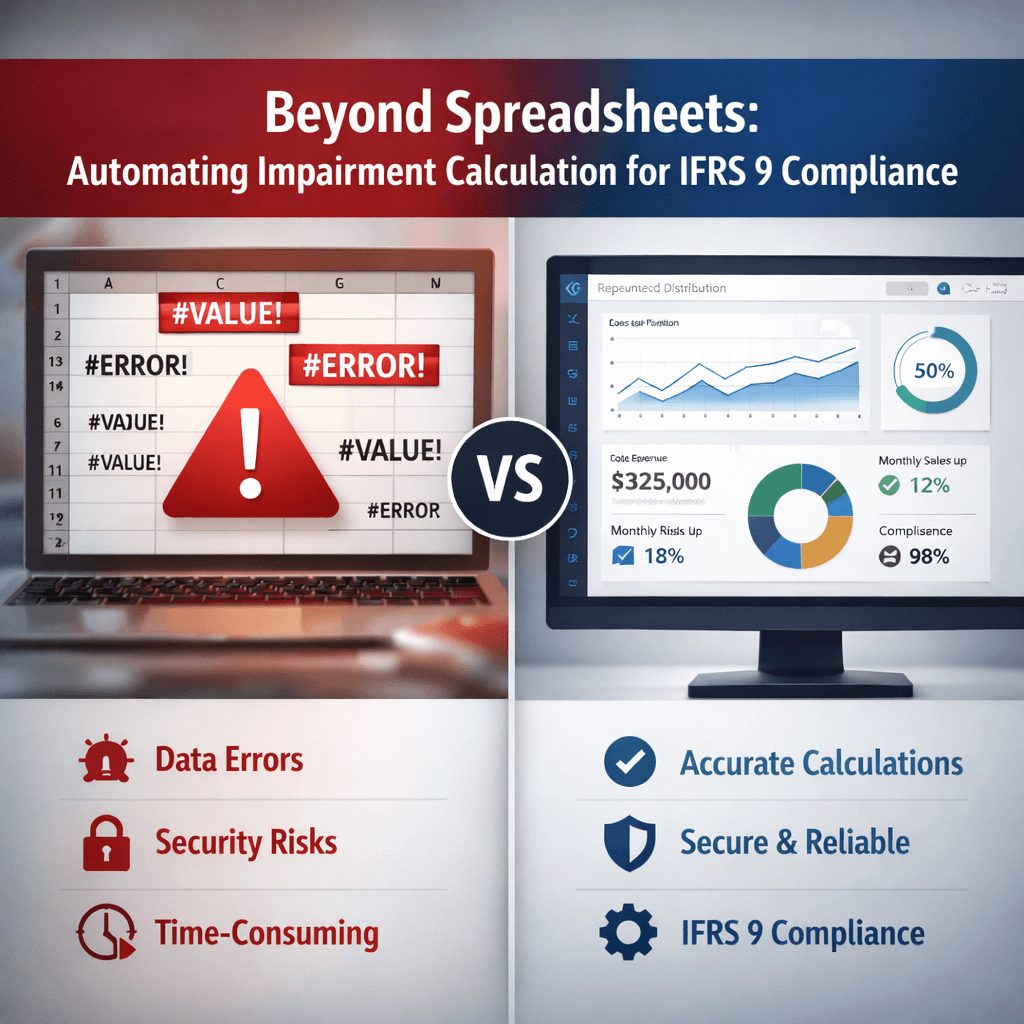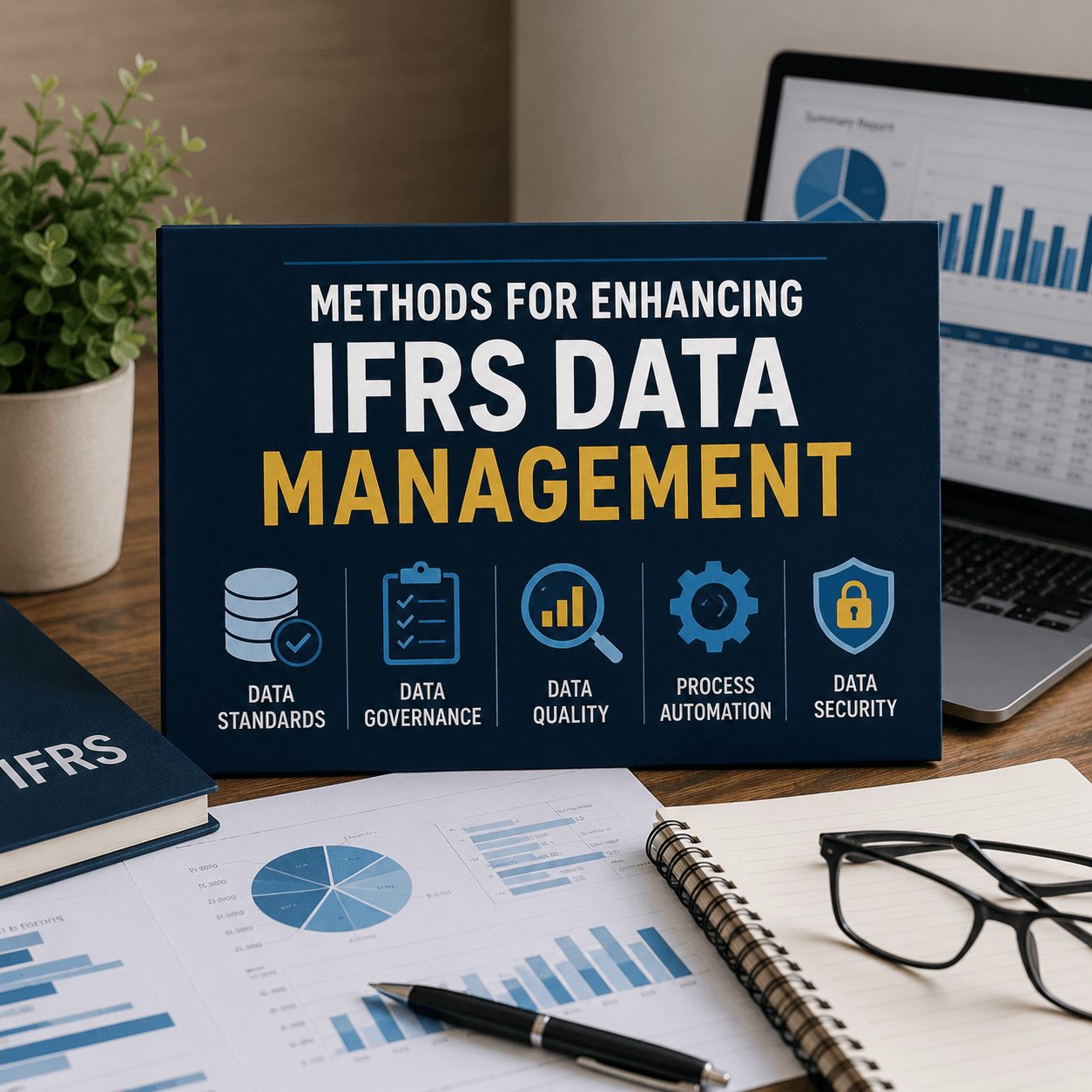
Get IFRS data right from source to statement. Learn four proven methods that cut manual work, reduce compliance risk, and scale with your enterprise.
✓ Written by IFRS TECH’s advisory team · ✓ Serving GCC, Europe & APAC · ✓ Actuaries + CPAs + CFAs
TL;DR
IFRS data management in enterprise systems doesn’t have to be a bottleneck. This article covers four methods to enhance how you handle, track, and automate IFRS data: building stronger governance, automating repetitive processing, tracking data lineage end-to-end, and choosing the right tools for your stack. You’ll see why legacy systems fail, what metadata-driven integration actually means, and how to pick between building custom or buying off-the-shelf. Read this if you’re tired of spreadsheets, manual reconciliation, and audit scrambles.
What’s Blocking Enterprise IFRS Data Management (And How to Fix It)
Here’s the thing about IFRS data management: it’s not hard because the standard is hard. It’s hard because your data isn’t ready.
Companies implementing IFRS don’t just need to understand the accounting. They need to know where their data lives, how it moves between systems, and whether it’s right when it lands. That last part is where most programs stumble.
85% of organizations report increased compliance complexity, and for finance teams juggling IFRS on top of existing operational chaos, the gap between “we follow IFRS” and “our IFRS data is trustworthy” feels massive.
The problem shows up in three ways. First, data scattered across nine, ten, sometimes fifteen different systems with no clear ownership. Second, no visibility into what happened to a number after it left the source. Third, manual fixes that creep in at year-end because the automated path doesn’t work.
What you need to fix it:
- A governance model that says who owns what data, not just in theory.
- Automation that replaces manual steps, not just documents them.
- End-to-end visibility into how data moves from transaction to financial statement.
The good news is these aren’t new ideas. Insurance companies, banks, and large financial services firms have figured this out. They’ve invested in it. And they’ve proven it works. Your job is to find the method that fits your complexity level and your timeline.
[IMAGE PLACEHOLDER: Enterprise data flow diagram showing IFRS systems integration across source systems, data layer, and financial reporting]
Build Stronger Data Governance Frameworks for IFRS Compliance
Data governance is the policy layer that says: this number is valid, this owner is responsible, and this lineage is tracked.
You don’t need a 400-page governance document. You need clarity on four things: who owns each piece of data, how quality gets verified, what’s the source of truth, and who can change what.
Most teams skip this. They jump straight to tools. That’s backward.
92% of enterprises implementing data governance do it because they realized tooling alone doesn’t work. The tools just enforce the rules. The rules come first.
Here’s what matters for IFRS:
First: assign a data owner for each IFRS domain. Not a committee. One person. Actuarial CSM data? You own it. Insurance receivables? That’s yours. Give them the authority to say what’s right, and the time to oversee it. Data stewardship actually works when one person has skin in the game.
Second: document your mappings. Every field that flows into your IFRS system needs a source, a transformation rule, and a validation check. Write it down. Put it in a data catalog or a spreadsheet. Doesn’t matter the tool. What matters is that finance, actuarial, and IT all agree on what the number means.
Third: test lineage before you go live. Walk a single transaction from policy admin through the actuarial engine, into the general ledger, and onto the financial statement. If you can’t trace it, your data isn’t ready.
This step separates organizations that pass audits from organizations that stress-test audits. The question auditors ask is always: where did this come from? If you can answer it in two minutes, you’re good. If you need two weeks to track it down, you’ve got a control gap.
Governance doesn’t replace technology. It sets the expectations technology has to meet.
Automate IFRS Data Processing to Cut Manual Work
Manual data work kills two things: accuracy and speed. You can’t have both when humans are copying numbers between systems.
Automation has led to 98% improvement in data accuracy in accounting. That’s not a minor lift. That’s the difference between spreadsheet risk and audit confidence.
The places to automate first are the places that repeat, that touch lots of records, and that need to be right. For IFRS, that’s usually:
Data extraction and mapping. If you’re pulling data from policy systems, actuarial models, or general ledgers, build a pipeline that runs every night. Not every week. Every night. Tools like Informatica, Talend, or cloud-native ETL platforms can handle hundreds of millions of rows. You’re not special. The tooling exists. Use it.
Validation and reconciliation. The moment data lands, run it through automated checks: completeness, format, business rule consistency. Mortgage approval checks that once took 4-6 hours now run in near real time after automation tool deployment. Your IFRS reconciliation can work the same way. Flag anomalies in minutes, not days.
Currency conversion and discount rate application. These change constantly. Hard-code them in a spreadsheet and you’ll miss updates. Put them in a metadata layer and they update once, everywhere. One source of truth beats a hundred spreadsheet versions.
What you shouldn’t automate yet: judgment calls. If a number looks wrong and needs investigation, keep that human. But the decision of whether something looks wrong should be automated. The investigation should be streamlined. But the final call should stay with the person who understands the business.
[IMAGE PLACEHOLDER: Before and after comparison showing manual IFRS processing workflow versus automated data pipeline]
Choosing the Right Tools: Best Practices for Enterprise Implementation
This is where most projects fail. Not because the tech is bad. Because they pick the wrong tech for their situation.
You have three basic paths: build custom, buy packaged IFRS software, or buy a data platform and configure it yourself.
Build custom if your IFRS flows are so unique that off-the-shelf software forces you to change your business. This is rare. Mostly it’s an excuse. Building custom means you own the bugs, the maintenance, and the upgrades forever. Your team becomes the IFRS platform team. That’s expensive and it’s slow.
Buy IFRS-specific software if your industry is insurance and you’re implementing IFRS 17 or IFRS 9. Tools like Moody’s Analytics AXIS, Appian for workflow, and specialized insurance platforms have seen this problem a thousand times. They’ve solved the hard parts. You pay a premium, but you get time to market and lower risk. ERP systems must now support parallel ledgers, valuation layers, and automated disclosures as data governance becomes mission-critical. Purpose-built software does this out of the box.
Buy a data platform like Snowflake, Azure Synapse, or BigQuery if you’ve got complex data and you want flexibility. You’re buying the plumbing, not the IFRS logic. This works if you have strong data engineering and you’re willing to spend 6-12 months building. You get flexibility. You give up speed.
The honest answer for most mid-sized to large enterprises: buy packaged IFRS software and supplement it with integration and governance tooling. The packaged tools have the IFRS logic baked in. You spend your time on data quality and governance, not reinventing the wheel.
49% of CFOs feel blocked by poor data quality when making critical financial decisions. The tool won’t fix that. Your governance will. So pick a tool that gets out of your way on governance.
One last point: make sure your tool can integrate with your existing stack. If you’re running SAP, Oracle, or Workday in the back office, your IFRS tool has to plug into that. Integration friction kills more projects than complexity does.
Metadata-Driven Integration: The Backbone of Scale
Here’s what metadata-driven means: instead of hard-coding your transformation rules in code or Excel, you store them as data.
So instead of a custom SQL script that says “multiply field X by discount rate Y,” you store X, Y, and the multiplication rule in a metadata table. Tomorrow, when discount rate Y changes, you update one row in the metadata table. The transformation picks up the change automatically.
This matters for IFRS because the rates, currency codes, and business logic change constantly. If your IFRS pipeline is hand-coded, you’re redeploying every month. If it’s metadata-driven, you’re updating configuration.
One insurer did this. They had nine disparate systems feeding into IFRS 17. Different formats, different schemas, different calculation logic. Instead of building nine custom connectors, they built one metadata-driven integration layer. Field mappings, business rules, validation checks all live in metadata. One system speaks to all nine. When a new data feed comes in, they add metadata. No code changes.
That’s scale. That’s what you want.
The trade-off: you need a platform that supports this (most modern data tools do), and you need to think in terms of configuration, not coding. Your team has to shift mindset. But once they do, you move fast.
End-to-End Data Lineage Tracking
Data lineage answers one question: where did this number come from?
For auditors, that’s the only question that matters. For you, it’s the only question that matters too. If you can’t trace a number, you don’t control it.
Most organizations don’t have this. They have documentation. They have a map. What they don’t have is an automated, auditable record of what data flowed where, when it changed, and who approved the change.
Building this is simpler than you think. Your data pipeline should log every transformation. Source table, timestamp, transformation applied, result. Store these logs. Query them. When an auditor asks, show them the log.
This isn’t optional for IFRS. Regulators demand it. Auditors look for it. And honestly, if you’re running IFRS at any scale, you need it for your own sanity.
Tools like Collibra, Atlan, and Alation make this visible. Cloud data warehouses like Snowflake and BigQuery support it natively. Pick your tool and turn it on. The infrastructure cost is near zero. The compliance and operational upside is huge.
[IMAGE PLACEHOLDER: Data lineage visualization showing source systems flowing through transformation layer to IFRS reporting outputs]
Real-Time Data Quality Controls
Quality checks at the end of the month are too late. You need them at the source, in real time.
Real-time means: the moment data lands, it gets checked. If it fails, it’s flagged before anyone downstream uses it. This is the difference between catching an error today and finding out about it during audit.
Build three types of checks:
Format checks: is the date a date, is the number a number, is the field populated? These are free. Every system can do this.
Business rule checks: is the dollar amount in range, does the contract ID exist, are the dates in sequence? These require knowledge of your business, but they’re doable with SQL or Python.
Cross-system reconciliation: does the total debit match the total credit, do the actuarial projections match the finance entry, are the totals consistent? This is where most errors hide. Someone entered the right numbers in two places but they don’t match for technical reasons.
When a check fails, don’t block the pipeline. Flag it. Create an exception queue. Have a human triage it within an hour. That balance between automation and control is what separates “we have quality” from “we have audit risk.”
What You Now Know
- IFRS data management fails when governance is weak, not when the standard is hard. Build policies first, tools second.
- Automation cuts manual work and improves accuracy to 98%+ levels. Start with repetitive, high-volume processes like nightly data extracts and validation checks.
- Pick packaged IFRS tools over custom builds for speed to compliance and lower operational risk.
The Real Cost of Getting This Wrong
What happens when your IFRS data management isn’t strong? You miss deadlines and financial statements get restated.
The insurance industry spent US$21-27 billion implementing IFRS 17. Most of that came from organizations without governance or automation. They retrofitted their way to compliance.
You don’t have to. Build it right the first time.
[IMAGE PLACEHOLDER: Case study graphic showing cost savings from proper IFRS data management]
Take the IFRS Data Readiness Assessment
Where’s your organization right now on IFRS data management? Answer five questions and get a baseline. No email required. Just clarity on where to focus first.
See how IFRS TECH’s consulting services team approaches data transformation →
Frequently Asked Questions
How long does it take to build proper IFRS data governance?
For a mid-sized organization with 2-5 IFRS-material processes, 8-12 weeks to define policies, identify data owners, and document mappings. Implementation takes longer. Governance is ongoing, not a one-time project. Start with one domain. Get it right. Scale from there.
Can we use our existing data warehouse for IFRS?
Usually, yes. Most modern data warehouses (Snowflake, BigQuery, Azure Synapse) can handle IFRS data volumes and complexity. The question is whether your existing data governance and integration pipelines support the granularity IFRS requires. You might be fine on storage but weak on data quality or lineage. Assess those first.
What’s the ROI on automation for IFRS data processing?
Labor savings are obvious: fewer manual reconciliations, fewer Excel fixes. But the real ROI is reduced audit risk, faster close cycles, and the ability to scale without hiring. 88% of FP&A teams use AI for data analysis, and accuracy gains are measurable. For most organizations, ROI breaks even in 12-18 months.
Is IFRS data management the same for banking and insurance?
No. Insurance has contract-level granularity and actuarial complexity. Banking has portfolio-level risk and valuation models. The principles (governance, lineage, automation) are the same. The implementation details (what fields, what checks, what rates) are different. Use industry-specific tools when you can.
Should we build or buy an IFRS platform?
Buy if you need speed and your requirements fit a standard package. Build if your business model is truly unique and you have strong engineering talent. Most teams should buy packaged IFRS software and supplement with integration and governance tools. Modern IFRS data systems for regulatory requirements are built and battle-tested. Don’t reinvent them unless you have to.
Next Step: Start with data governance assessment. Identify your IFRS-material processes. Assign owners. Document mappings. That’s week one. From there, build your roadmap to automation and tooling.
Schedule a consultation with IFRS TECH’s data governance team →