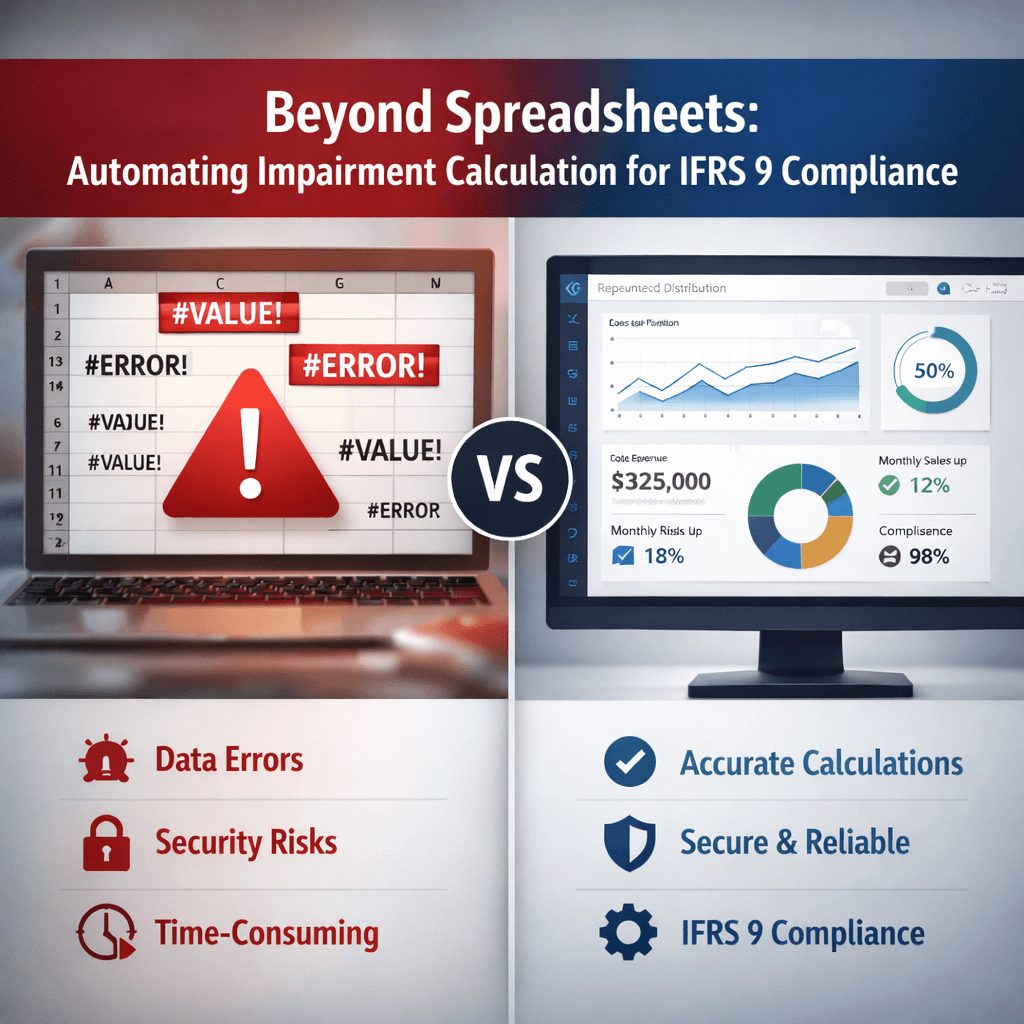
Finance and HR leaders managing employee equity plans under IFRS 2 face mounting risks from under-built tools, missed disclosures, and valuation models that can’t keep pace with plan complexity.
✓ Written by IFRS TECH’s advisory team · ✓ Serving GCC, Europe & APAC · ✓ Actuaries + CPAs + CFAs
TL;DR
Share plan valuations and accounting software that’s not purpose-built for IFRS 2 creates real audit exposure. This article covers why generic tools fail at classification and fair value measurement, what implementation hurdles trip up even experienced finance teams, and which disclosure gaps the FRC flagged in its October 2025 review. If your share plan accounting runs on spreadsheets or an off-the-shelf ERP, read this before your next year-end closes.
One in four companies couldn’t back up their fair value assumptions during a 2024 audit review. That’s not a rounding issue or a minor gap in the notes. It’s a disclosure failure on one of the most scrutinised lines in the financial statements. And most of the time, it traces back to the same place: share plan valuations and accounting software that wasn’t built to handle what IFRS 2 actually requires.
The Financial Reporting Council published its thematic review of IFRS 2 compliance in October 2025, covering 20 listed companies. The findings were direct. Classification errors, missing group disclosures, and incomplete valuation documentation were common. Not fringe cases. Common.
This article covers:
- Why most accounting software fails at the point of share plan valuation
- The specific IFRS 2 hurdles that hit startups and mid-size teams hardest
- What audit-ready accounts production looks like in practice
IFRS TECH works with finance teams across the GCC, Europe, and APAC who face these exact problems each reporting cycle. The patterns are consistent — and so are the fixes.
Why Share Plan Valuations and Accounting Software Keep Failing Teams
The IFRS 2 Problem Most Finance Teams Underestimate
Here’s the thing most teams don’t catch until it’s too late: IFRS 2 isn’t just a valuation standard. It’s a classification, recognition, measurement, and disclosure standard all at once. Each grant type, each vesting trigger, each settlement method changes the accounting treatment. A software tool that handles the Black-Scholes calculation but doesn’t flag a modification event is half a solution. Actually, it’s worse than that — it creates a false sense of coverage.
About 30% of IFRS 2 compliance errors found during audits in 2023 came from misclassification of share-based payment transactions. Not complex modelling failures. Basic classification. That tells you the problem starts before the spreadsheet opens.
The equity-settled versus cash-settled distinction sounds simple. It’s not. The FRC’s October 2025 review found that where settlement choice exists, companies regularly failed to determine who held that choice or what accounting obligation it created. These aren’t edge cases. They’re standard plan features that generic tools just don’t handle.
See how IFRS TECH’s actuarial valuation software for IAS compliance approaches complex grant-date fair value problems under live audit conditions.
What Generic Tools Actually Cost You at Audit Time
[IMAGE PLACEHOLDER: Infographic showing the five most common IFRS 2 audit flags — misclassification, missing Monte Carlo documentation, incomplete group disclosures, undisclosed modification events, and incorrect tax treatment in equity]
Generic ERP systems — SAP, Oracle, even Microsoft Dynamics — were built for general ledger work. When someone bolts an IFRS 2 module on top, you get a tool that handles the journal entry but not the valuation trail the auditor is looking for. The expense gets recorded. The documentation doesn’t.
What auditors actually check isn’t just the number. They want the valuation model, the assumptions, how volatility was calculated, what the expected term was based on, and whether any modifications changed the grant-date fair value. Most generic tools produce none of that. Your finance team produces it manually, in a separate spreadsheet, disconnected from the system of record.
That’s the risk. Not the calculation. The audit trail.
Quick Diagnostic: Is Your Share Plan Software Audit-Ready?
Ask your team these four questions before your next year-end:
- Can your software produce a full valuation trail — model, inputs, assumptions — for every grant, on demand?
- Does it flag plan modifications automatically or require a manual review trigger?
- Does it separate equity-settled from cash-settled treatment at the transaction level?
- Does it handle group scheme accounting — parent and subsidiary entries — within the same workflow?
If any answer is no, your current tool has a gap the next audit will find.
The Biggest Implementation Hurdles in Share Plan Valuations
Valuation Model Selection: Black-Scholes vs. Monte Carlo
You might think any competent finance team can pick the right model. But that choice isn’t just technical — it’s defensible documentation under IFRS 2. The FRC’s 2025 thematic review noted that companies in its sample used Black-Scholes when no market conditions were present and Monte Carlo when they were. That’s correct practice. What the review also found: companies weren’t always explaining why they chose one over the other, or disclosing the assumptions with enough precision for auditors to test them.
Monte Carlo simulations require inputs like total shareholder return correlations, peer group data, and projected volatility over the vesting period. Generic IFRS accounts production software doesn’t run that. Neither does Excel, not reliably. And when a team tries to run it manually each cycle, assumptions drift year to year without a clear documented rationale. Auditors notice.
The choice of model matters less than the discipline around it. Pick Black-Scholes for a standard share option with service conditions only. Use Monte Carlo the moment you introduce a market condition. But document both decisions as if the auditor is reading over your shoulder, because they will be.
Data Gaps That Break Accounts Production Software IFRS Workflows
The data problem in share plan accounting is worse than most teams realise going in. You need historical share price data, volatility calculations over the option term, risk-free rates pegged to the grant date, expected dividend yields, and employee forfeiture estimates. Then, for each modification event, you need a full before-and-after valuation to calculate incremental fair value.
Most IFRS financial reporting and analysis software assumes clean, structured input data. That’s not what mid-size companies have. They have grant records in one system, payroll data in another, HR records somewhere else, and cap table information in a spreadsheet that three people have edited over four years. When the software hits that data gap, it either errors out or produces numbers with no audit trail.
What’s interesting is that this isn’t a software limitation so much as an architecture problem. The implementation fails because the data layer was never designed for IFRS 2 workflows. That’s a planning failure, and it shows up at the worst time: when your auditor is asking why the forfeitures in the notes don’t match the HR system.
Good benefits valuation software solves this by treating data integrity as a first-order problem, not an afterthought.
Modification Events Nobody Planned For
This is where most implementations quietly fail. A plan gets modified — vesting period shortened, exercise price reduced, performance condition removed — and nobody flags it as an IFRS 2 accounting event. The original grant carries on in the system. The incremental fair value never gets calculated. The expense is understated.
The FRC’s thematic review found this consistently. Modification accounting requires a new measurement of the award at modification date, comparison to the original grant-date fair value, and recognition of any incremental benefit over the remainder of the vesting period. That’s a separate valuation run. Most software — and most teams — don’t have a workflow that triggers it automatically.
Take the 5-Question IFRS 2 Readiness Assessment
Find out whether your current share plan accounting process will hold up under an FRC-style review. Takes under three minutes.
How IFRS Accounts Production Software Fails Startups
IFRS 2 Reporting Platforms for Startups: What’s Missing
You might think the startup problem is just scale. Not enough grants to justify specialist software. That’s the wrong frame. The startup problem is complexity without resources. A seed-stage company issuing EMI options or unapproved options to 15 employees has classification questions, market condition questions, and group accounting questions that are just as hard as those facing a FTSE 250 company. They just have a two-person finance team to deal with them.
[IMAGE PLACEHOLDER: Side-by-side comparison table showing what a typical startup’s IFRS 2 reporting process looks like in a spreadsheet versus a purpose-built IFRS 2 reporting platform for startups, with audit-readiness indicators for each]
IFRS 2 reporting platforms built for startups should handle: grant-date fair value calculations with documented assumptions, forfeiture rate estimates with a clear methodology, automatic reclassification when options lapse or are modified, and disclosure templates that satisfy IFRS 2 paragraphs 44 through 52. Most platforms marketed to startups do two of those four. The rest they leave to whoever does the year-end.
The equity management software market hit roughly USD 800 million in 2024 and is projected to grow to USD 2.49 billion by 2034. That growth is real. But size of market doesn’t mean quality of IFRS 2 coverage. Many platforms in that market are cap table tools with a reporting tab bolted on. Not the same thing.
Scaling Hurdles When Manual Valuations Meet Audit Season
Here’s a hard truth about scaling: the problems that look manageable with 20 grants become serious with 200. Forfeiture rates require statistical credibility. Volatility calculations need enough price history to be defensible. Monte Carlo models need a proper peer set. None of that scales well in a spreadsheet, and none of it is straightforward in a generic ERP either.
87% of businesses are either using or planning to use digital equity management solutions. But digital doesn’t mean IFRS-compliant. A Carta cap table is digital. It is not, by itself, an IFRS 2 accounts production tool. The gap between what these platforms track and what auditors need at year-end is where most scaling hurdles live.
There’s also the timing problem. Audit season is not the moment to discover your valuation inputs are inconsistent. By then, the grant dates are months old, the assumptions are hard to reconstruct, and the incremental fair value on that December modification is anyone’s guess. Fix this in the workflow, not the year-end crunch.
IFRS TECH’s advisory team has worked with finance functions across GCC-listed companies, European startups, and APAC multinationals navigating IFRS 2 at every stage of growth. See our approach to share plan accounting.
Regulatory Hurdles You’re Probably Not Tracking
IFRS Financial Reporting and Analysis Software: The Gap
IFRS 2 operates across more than 140 countries. That means the same grant awarded to employees in London, Dubai, and Singapore carries different tax implications, different disclosure requirements under local rules, and potentially different settlement classifications depending on the jurisdiction. IFRS financial reporting and analysis software that handles UK practice well may handle GCC practice poorly.
This is not a hypothetical. The FRC’s 2025 review specifically flagged group scheme accounting as an area where disclosures frequently broke down. In group situations, companies explained the consolidated position well enough but left the parent company financial statement treatment undocumented. That’s a disclosure failure with real audit consequences, especially for companies with subsidiaries in multiple jurisdictions.
I’ll be direct about one limitation here: there isn’t a single platform that handles every jurisdiction’s tax treatment natively. The best solutions combine a strong valuation and accounts production core with jurisdiction-specific advisory input layered on top. Software alone doesn’t close that gap.
Group Scheme Accounting: Where Disclosures Break Down
The FRC’s October 2025 thematic review found something specific about group situations that’s worth sitting with: companies were inconsistent on whether excess tax deductions were correctly recorded in equity. That’s a specific requirement under IFRS 2 — deferred tax on share awards goes to profit or loss up to the amount of cumulative compensation expense recognised, with any excess going directly to equity. It’s one of the more counter-intuitive treatments in the standard.
Generic accounts production software typically doesn’t model this split. The tool records the deferred tax asset but doesn’t apply the bifurcation rule. The number looks clean until an auditor runs the cross-check.
And the disclosure problem compounds it. The FRC found that key messages were often buried under excessive volume in the notes, rather than the clearer, aggregated disclosures the better-performing companies produced. That’s a drafting and structure problem as much as a software one. But software that forces you to manually compile disclosures from multiple sources makes the drafting problem worse.
[IMAGE PLACEHOLDER: Annotated example of an IFRS 2 note showing best-practice disclosure structure: classification, valuation technique, key assumptions, modification events, and tax treatment — each section labelled for clarity]
What Audit-Ready Share Plan Accounting Actually Requires
Four Things Good Accounts Production Software IFRS Must Do
The bar isn’t high in absolute terms. But it’s higher than most teams’ current setup meets. Here’s what accounts production software built for IFRS 2 share plan workflows actually needs to do:
- Produce a full valuation audit trail — model type, inputs, assumptions, and output — for every grant, on demand. Not a summary. The actual trail.
- Flag modification events automatically and trigger a new valuation run with before-and-after comparison. Not a manual prompt. An automatic workflow.
- Handle equity-settled and cash-settled classification separately, including compound instrument treatment when settlement choice exists.
- Generate IFRS 2 disclosures directly from the data — not from a separate Word template someone fills in by hand each year.
That’s it. Four things. Most teams can do two of them.
When to Bring in Specialist Support
Here’s where I’d push back on the “just buy better software” narrative: some IFRS 2 problems aren’t software problems. Complex performance conditions — TSR hurdles tied to peer-relative outcomes, for example — require Monte Carlo modelling that needs actuarial input, not just a software licence. The model is only as good as the assumptions behind it, and those assumptions require expertise the software doesn’t provide.
The same applies to plan modifications with contested facts. When the modification happened, what triggered it, and whether it constitutes a cancellation or a replacement — these are judgement calls that need someone with IFRS 2 expertise, not just a tool that runs the numbers.
Software gets you 80% of the way. The last 20% is where audit risk lives. And for growing companies with complex equity structures, that 20% matters more each year than the year before.
What You Now Know
- Generic accounting tools create real audit exposure in IFRS 2 share plan workflows — misclassification and disclosure gaps are the most common failures, not valuation calculation errors.
- Implementation hurdles in share plan valuations and accounting software are structural, not incidental: data architecture, modification event workflows, and group scheme treatment need to be designed in from the start.
- Purpose-built IFRS 2 accounts production tools combined with specialist advisory input are the only way to handle complex plan features, cross-jurisdiction tax treatment, and audit-ready disclosure reliably.
Getting Share Plan Valuations and Accounting Software Right
The FRC doesn’t grade on a curve. Neither do auditors when they find unexplained cash outflows that trace back to a misclassified settlement, or a fair value that can’t be reconciled to any documented assumption. These aren’t rare failures. In 2024, one in four companies couldn’t support their valuation disclosures under review. That number should concern every finance team running share plans on generic tools.
Share plan valuations and accounting software that’s genuinely fit for IFRS 2 needs to handle classification, full valuation audit trails, modification event workflows, and group scheme disclosures — not just the journal entry. If your current setup doesn’t do all four, you have a gap worth closing before the next audit cycle starts.
The good news is the fix isn’t as expensive as a restatement.
See how IFRS TECH’s share plan advisory team handles IFRS 2 valuation and accounts production from grant date through year-end disclosure →
Serving GCC, Europe & APAC · Actuaries + CPAs + CFAs · Trusted by listed companies and high-growth startups
Frequently Asked Questions
What are the most common IFRS 2 compliance failures in share plan accounting software?
The most common failures are misclassification of equity-settled versus cash-settled transactions, incomplete valuation documentation, missing modification event accounting, and inadequate disclosure of fair value assumptions. In 2024, 25% of companies couldn’t support their valuation disclosures under audit review, making documentation the single biggest gap in most share plan accounting setups.
What implementation hurdles should startups expect when setting up IFRS 2 reporting platforms?
Startups face three main hurdles: data gaps across disconnected HR, payroll, and cap table systems; lack of automation for modification events; and IFRS 2 reporting platforms that cover cap table management but not full valuation audit trails. Most platforms marketed to startups don’t produce the documentation IFRS financial reporting and analysis software requires at audit time.
When should companies use Monte Carlo simulation instead of Black-Scholes for share plan valuations?
Use Monte Carlo when the award has market conditions — for example, vesting tied to total shareholder return or peer-relative performance. Use Black-Scholes for standard options with service or non-market performance conditions only. The choice should be documented with a clear rationale, not just the output, as auditors will test the model selection as part of their IFRS 2 review.
What do accounts production software IFRS tools typically miss in group scheme accounting?
Most accounts production software IFRS tools miss the bifurcation of deferred tax on share awards between profit or loss and equity, as well as the disclosure of parent company impacts alongside consolidated accounts. The FRC’s October 2025 thematic review found both issues in listed company samples.
How do scaling hurdles in manual valuations affect share plan accounting as companies grow?
As grant volumes increase, manual valuation processes produce inconsistent assumptions year to year, insufficient statistical credibility for forfeiture estimates, and no systematic trigger for modification accounting. Scaling hurdles in manual valuations accounting typically surface at audit time, when reconstructing assumptions for grants made six to twelve months earlier becomes the auditor’s problem and yours.