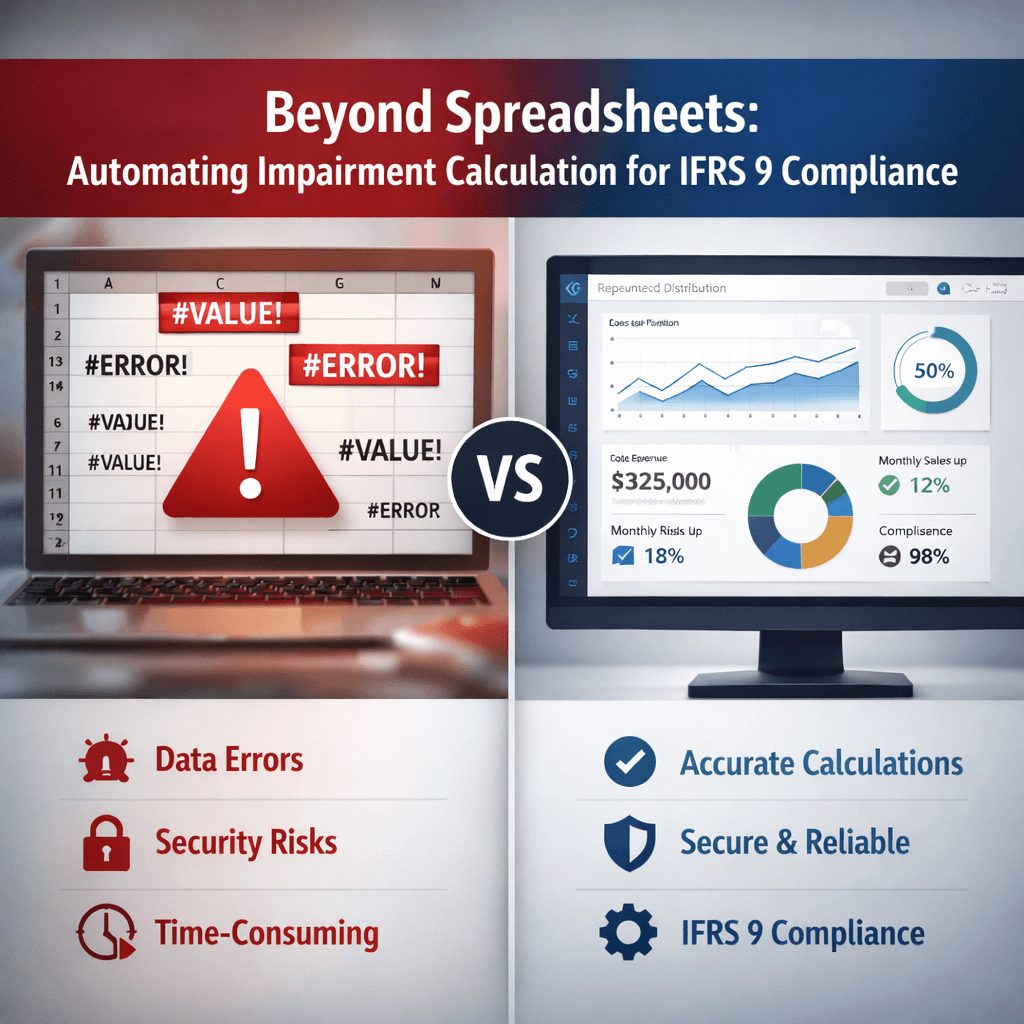
Non-Compliant IFRS 9 Compliance Software Security Risks
How financial institutions running outdated or non-compliant IFRS 9 compliance software are exposing themselves to data breaches, audit failures, and regulatory penalties in 2025 and beyond.
✓ Written by IFRS TECH’s advisory team · ✓ Serving GCC, Europe & APAC · ✓ Actuaries + CPAs + CFAs
TL;DR
Non-compliant IFRS 9 compliance software carries security vulnerabilities most finance teams don’t discover until an audit or a breach forces the issue. This article covers how weak IFRS 9 compliance software tools create data exposure risk, why legacy platforms fail on audit trails, and what a secure IFRS 9 setup actually requires. If your team runs ECL models on outdated or under-secured tools, this is required reading before your next regulatory review.
A bank’s IFRS 9 compliance platform holds some of its most sensitive financial data: expected credit loss models, loan staging outputs, probability of default calculations, and forward-looking macro assumptions. In 2024, the average cost of a breach in the financial sector hit $6.08 million — 22% above the global average across all industries. And financial institutions now account for 27% of all breaches worldwide, more than any other sector.
Most of those breaches don’t start with a dramatic hack. They start with a tool that wasn’t built to handle the data it’s been given.
Non-compliant IFRS 9 compliance software isn’t just a reporting problem. It’s a security problem. And the two are more connected than most teams realize.
- How non-compliant IFRS 9 tools create exploitable security gaps
- Why audit trails in weak platforms can’t catch breaches in time
- What regulators in the GCC and Europe are doing about it right now
IFRS TECH works with banks and financial institutions across the GCC, Europe, and APAC on IFRS 9 software selection, implementation, and security alignment.
What Non-Compliant IFRS 9 Compliance Software Actually Costs You
Here’s the thing most risk teams get wrong. They look at non-compliant IFRS 9 compliance software as a reporting gap. Something to fix before the next audit. What they’re missing is that a non-compliant platform is also an unsecured one.
When software doesn’t meet IFRS 9’s data governance requirements, it almost always means the same underlying problems: poor access controls, no change logging, weak encryption on model outputs, and no validation layer between user input and financial data storage. Those aren’t just compliance gaps. They’re attack surfaces.
And those attack surfaces are being used. 46% of financial firms reported a breach in the last 24 months as of end-2024. That’s close to one in two.
The cost isn’t just the breach itself. Regulatory penalties for compliance-related failures in financial services hit $4.6 billion globally in 2024, with bank-specific fines surging 522% year over year to $3.65 billion. TD Bank’s $3.09 billion AML penalty that year was the single largest under the Bank Secrecy Act. None of those institutions woke up one morning and decided to be non-compliant. They had systems that couldn’t keep up.
See how IFRS TECH’s advisory team approaches IFRS 9 security and compliance alignment for banks in the GCC and beyond →
How Security Vulnerabilities Enter IFRS 9 Compliance Software Tools
You might think security vulnerabilities are a technology problem. They are. But in the context of IFRS 9 compliance software tools, they’re also a process problem and a procurement problem.
Most banks didn’t buy a bad tool. They bought a tool that was fine for 2018 and didn’t update it.
Weak Access Controls in Legacy Compliance Platforms
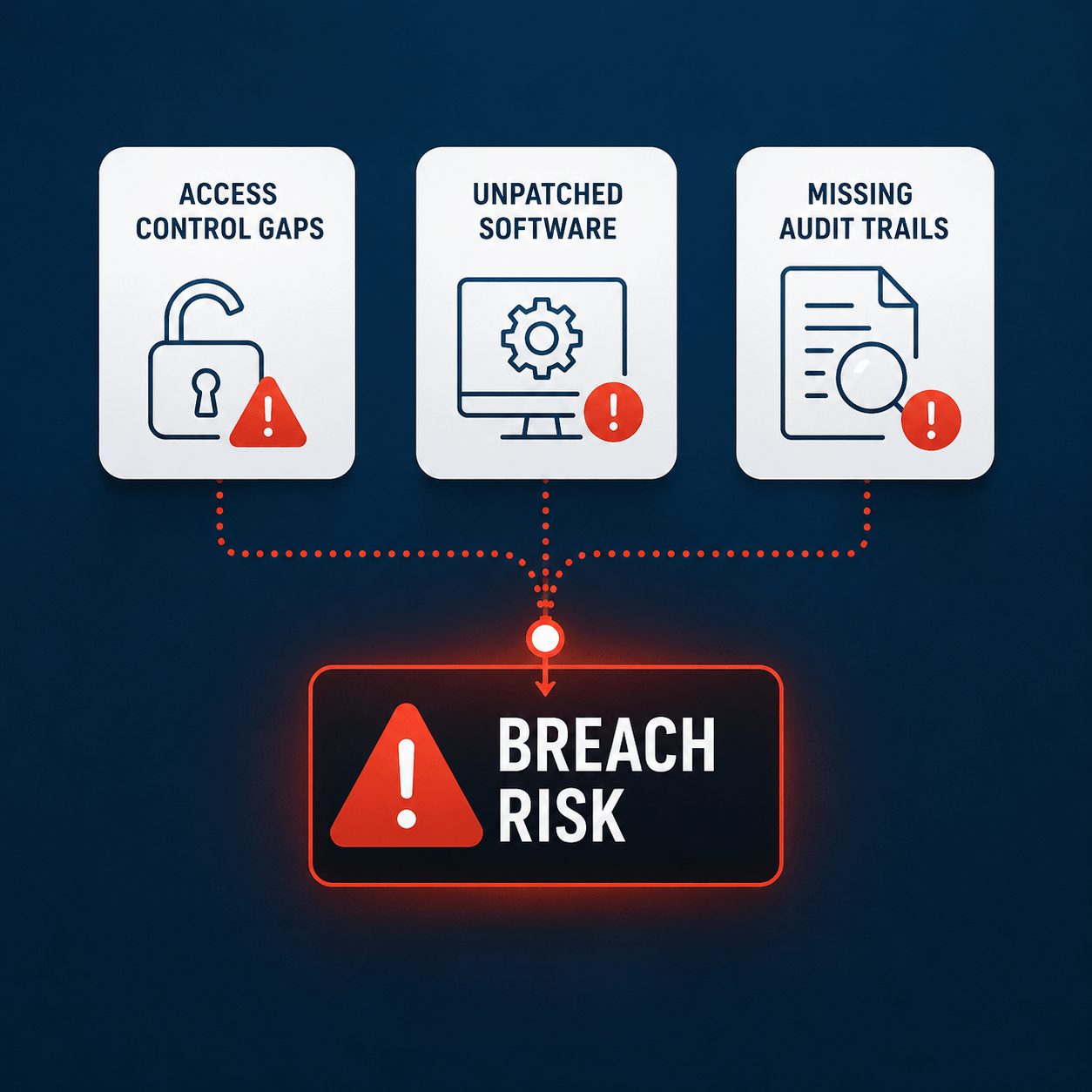
The simplest vulnerability in any compliance platform is also the most common: too many people have access to too much data. 80% of financial organizations flagged overprovisioned third-party access as a top security concern heading into 2025.
In IFRS 9 tools, this means analysts who should only view stage 2 loan data can export the full ECL model. Vendors who do system maintenance have admin rights that were never revoked. Contractors from a 2022 implementation project still have active credentials.
That’s not hypothetical. The Desjardins breach, which exposed 9.7 million records over 26 months, happened because a single employee had access they shouldn’t have had — and no system flagged the data movement until it was too late.
Unpatched Software Vulnerabilities and Version Lag
A 68% increase in supply chain breaches was recorded across financial services in 2024. Many of those breaches started with a known vulnerability in third-party software that wasn’t patched. Equifax had a patch available for the Apache Struts flaw that exposed 147 million records. They just didn’t apply it for two months.
IFRS 9 compliance tools software built on older frameworks often carries the same risk. Vendors who aren’t actively maintaining their platforms leave financial institutions exposed to CVEs (Common Vulnerabilities and Exposures) that were published and patched months ago — in versions their clients never installed.
When was your IFRS 9 platform last updated? Do you know which version you’re running?
Poor Audit Trails That Let Breaches Go Undetected
This is the one that keeps auditors up at night. A platform without a complete, tamper-resistant audit trail doesn’t just fail the IFRS 9 disclosure requirements under IFRS 7. It means that when a breach or manipulation does occur, you may not find out for months.
The Desjardins breach lasted 26 months before detection. The reason wasn’t that the warning signs weren’t there — it’s that the monitoring systems couldn’t surface them. That’s what a poor audit trail does. It doesn’t just fail compliance. It actively hides problems.
Quick self-assessment: Does your IFRS 9 platform have a problem?
- Can you produce a full audit trail for any ECL model change in the last 12 months?
- Do you know which users have export rights to your loan staging data?
- When did your vendor last push a security patch — and did you apply it?
- Are any third-party integrations in your compliance platform currently unreviewed?
If you answered “I’m not sure” to any of these, your current setup carries more risk than you’ve priced in.
What Data Breaches in Non-Compliant Compliance Software Look Like
Data breaches in IFRS 9 environments don’t look like Hollywood hacks. They look like a misconfigured export permission. A model output file sitting in an unsecured shared drive. A vendor integration that passes ECL data through an unencrypted API endpoint.
They’re quiet. That’s what makes them dangerous.
ECL Model Data Exposed Through Inadequate Encryption
Expected credit loss outputs are among the most commercially sensitive data a bank produces. They reflect not just historical credit performance but forward-looking economic assumptions, management overlays, and portfolio-level risk positions. If that data leaks — to a competitor, to a threat actor, or through a misconfigured system — the damage goes well beyond the breach itself.
Many IFRS 9 ECL software for banks platforms, especially older or lower-cost ones, don’t apply encryption at rest to model outputs. They encrypt the database. They don’t always encrypt the intermediate files, the export formats, or the API responses that feed downstream reporting tools.
That gap is where most quiet breaches happen.
Regulatory Reporting Gaps That Invite Scrutiny
Regulators in the GCC, UK, and EU aren’t just looking for the right numbers in your IFRS 9 regulatory reporting. They’re looking at how you produce those numbers. A platform that can’t demonstrate a clean data lineage from source system to disclosure — who touched what, when, and with what authority — is a platform that will fail an advanced audit.
And those audits are getting more frequent. The EU’s Digital Operational Resilience Act (DORA), enforceable from January 2025, now requires financial institutions to demonstrate that their critical software systems can withstand operational stress. Non-compliant IFRS 9 software that can’t document its own data flows is already out of step with DORA’s requirements, before a regulator even looks at the IFRS outputs themselves.
The link between IFRS 9 regulatory reporting vendors and system security is no longer optional. Regulators have made it structural.
Why Basic IFRS 9 Compliance Tools Software Falls Short on Security
Here’s a counterintuitive point: some of the most widely used tools for IFRS 9 compliance were never designed as compliance tools at all.
Excel wasn’t. Generic BI platforms weren’t. Even some purpose-built tools launched before 2018 weren’t designed with the data security requirements that came with IFRS 9’s full implementation. They were designed to calculate. Not to govern.
Spreadsheet-Based Tools and the Audit Vulnerability Problem
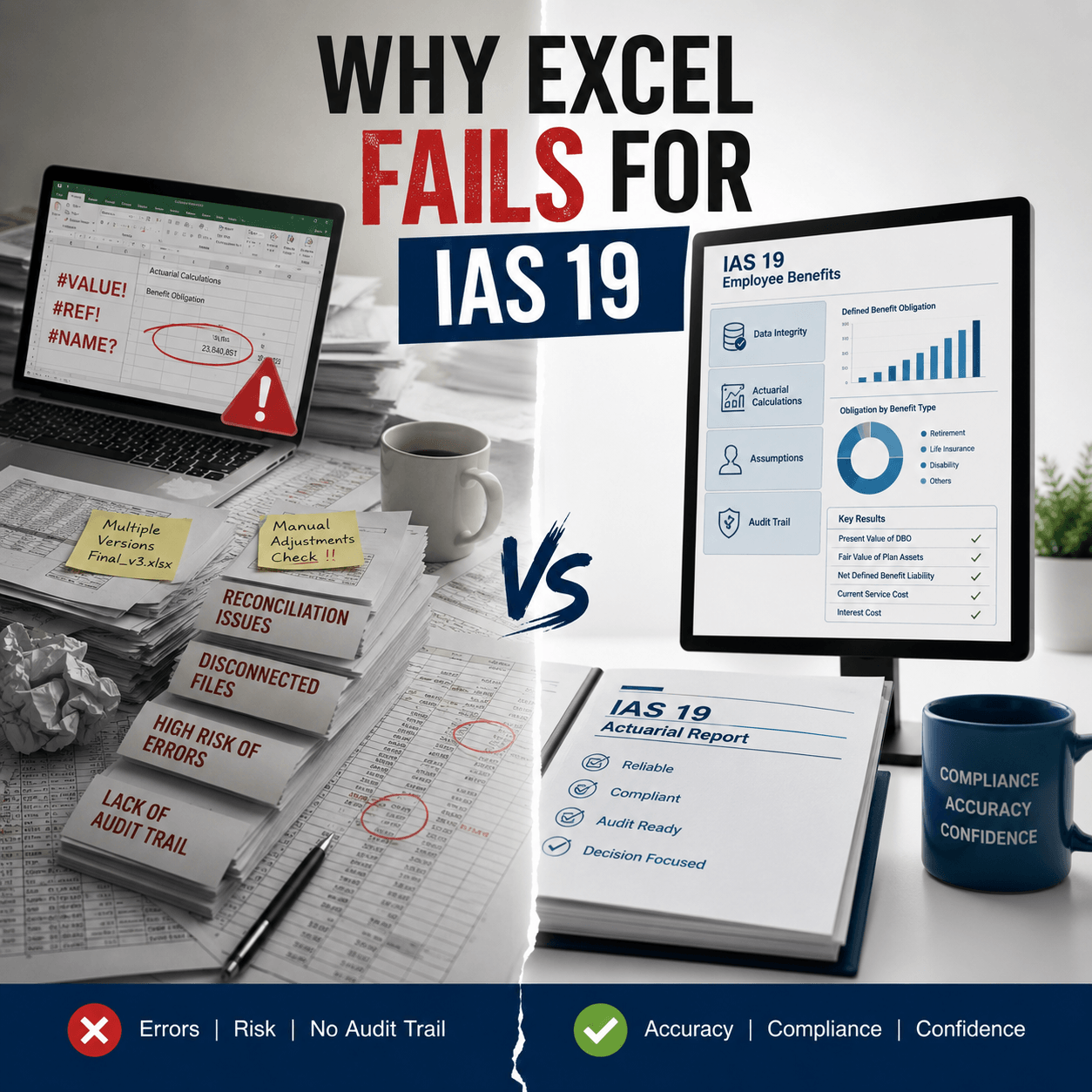
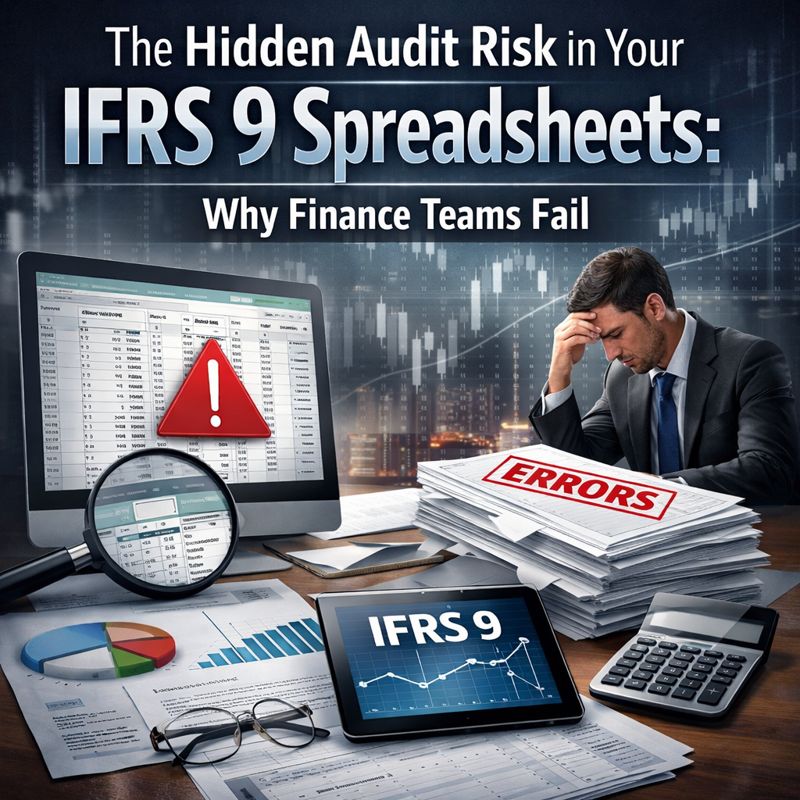
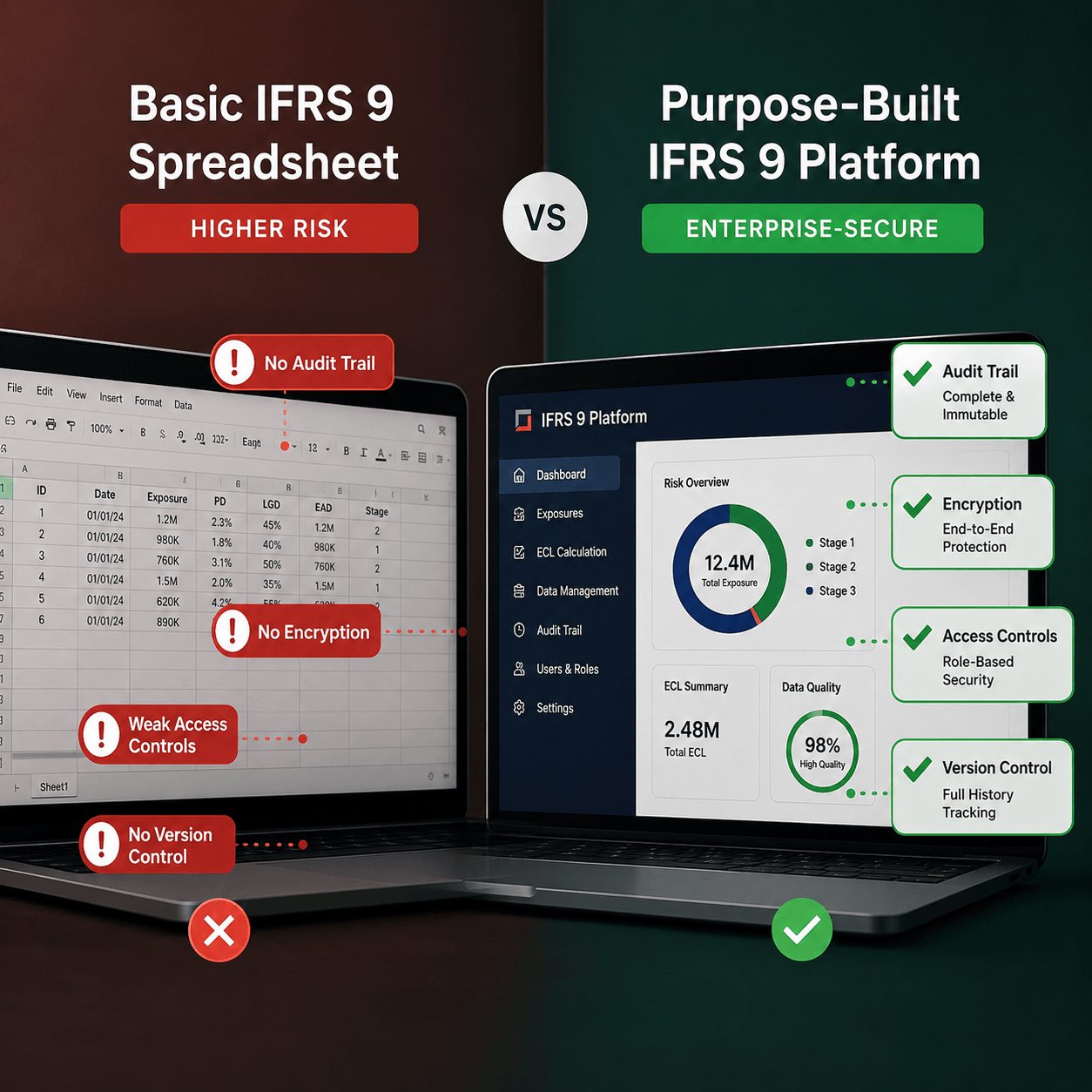
The hidden audit risks in IFRS 9 spreadsheets are well-documented. But the security risks are talked about less. A spreadsheet-based ECL model running on shared network drives has no user-level access logging, no change versioning, no encryption of formula logic, and no protection against silent data manipulation.
It’s not just an audit problem. It’s a data integrity problem. And in 2025, it’s a regulatory problem too.
Gartner’s 2024 research found that 45% of large enterprises underestimated the cost of updating their systems for accounting standard changes. Many of those same institutions are still running IFRS 9 calculations on tools built before the standard’s full adoption. The IFRS 9 impairment spreadsheet risk isn’t theoretical — it’s sitting in the finance team’s shared folder right now.
Scaling Vulnerabilities in Non-Compliant IFRS 9 Systems
As portfolios grow, the security risk in under-built IFRS 9 platforms scales faster than the portfolio itself. More data, more users, more integrations with external data feeds — but the same access model, the same logging limitations, and the same encryption gaps that existed at day one.
Scaling a weak system doesn’t make it stronger. It makes the blast radius bigger.
A bank that ran IFRS 9 on a basic platform for a $2 billion loan book and then grew to $8 billion without upgrading its compliance infrastructure didn’t just multiply its IFRS 9 complexity. It multiplied its exposure. Every new data feed, every new user, every new vendor integration added to the attack surface without adding to the security perimeter.
That’s why enterprise IFRS 9 ECL software selection should treat security architecture as a primary requirement, not a vendor checkbox.
IFRS TECH has supported over 40 financial institutions across the GCC, Europe, and APAC in assessing and replacing non-compliant IFRS 9 platforms. View our IFRS 9 advisory services.
Download: IFRS 9 Software Security Checklist
A practical 12-point checklist for evaluating whether your current IFRS 9 compliance tools meet 2025 security and audit standards. Used by risk and finance teams across GCC banks and European financial institutions.
The Regulatory Fallout: What Happens When Auditors Find the Gaps
Penalties for compliance failures across financial services hit $4.6 billion globally in 2024. Then in H1 2025 alone, global financial crime enforcement fines surged 417% year-over-year, reaching $1.23 billion in just six months. These aren’t distant risks. This is the enforcement environment your IFRS 9 platform is operating in right now.
When an audit finds that your IFRS 9 compliance software tools can’t produce a complete data lineage, can’t confirm who accessed what model on which date, or can’t demonstrate that ECL outputs haven’t been manually altered without authorization — the regulator’s question isn’t “how do we help you fix this?” It’s “how long has this been the case?”
Full stop. That’s the moment the conversation changes.
How Regulators in the GCC and Europe Are Responding
SAMA in Saudi Arabia has stepped up ECL model reviews and validation requirements since 2023. The Central Bank of the UAE has aligned its IFRS 9 oversight with DORA-style operational resilience expectations. In Europe, the EBA found in a 2024 study that 12% of banks still need to reclassify investment securities under updated IFRS 9 guidance — which means 12% of banks are producing IFRS 9 outputs from platforms that may already be misaligned with current standards.
And 93% of financial services organizations report difficulty staying compliant. That figure shouldn’t read as reassuring. It reads as an industry where non-compliance is the norm, and regulators know it.
The right response isn’t to hope your platform isn’t the one that gets scrutinized. It’s to know whether it would survive that scrutiny.
How to Spot Whether Your IFRS 9 Software Has a Security Problem
Not every security issue is visible. But most have early signals if you know where to look.
Start with access. Pull the current user list for your IFRS 9 platform. How many users have admin or export rights? How many of those were added in the last 18 months and never reviewed? If your platform can’t produce that list in under five minutes, that’s already a problem.
Next, test the audit trail. Pick any ECL calculation from 90 days ago. Can you show the exact inputs, who approved them, which macro scenario was applied, and whether any manual override was entered? A genuine audit trail answers all of those questions in one query. A paper trail that was assembled after the fact does not.
Then check the integration map. Your IFRS 9 software is probably connected to your core banking system, your risk data warehouse, and possibly three or four vendor data feeds. Do you know the security status of each of those connections? Because a 68% rise in supply chain breaches in 2024 means the weakest link in your IFRS 9 environment is most likely a third-party connection, not your internal systems.
Finally, ask when your platform vendor last issued a security patch and whether you applied it. If the answer involves checking with someone in IT who isn’t sure — you have your answer.
The IFRS 9 compliance process architecture at most institutions was designed for reporting accuracy. Security was an afterthought. That design assumption doesn’t hold in 2025.
What Secure IFRS 9 Compliance Software Tools Actually Include
Purpose-built IFRS 9 compliance software tools designed for the current regulatory environment include several things that basic or non-compliant platforms don’t.
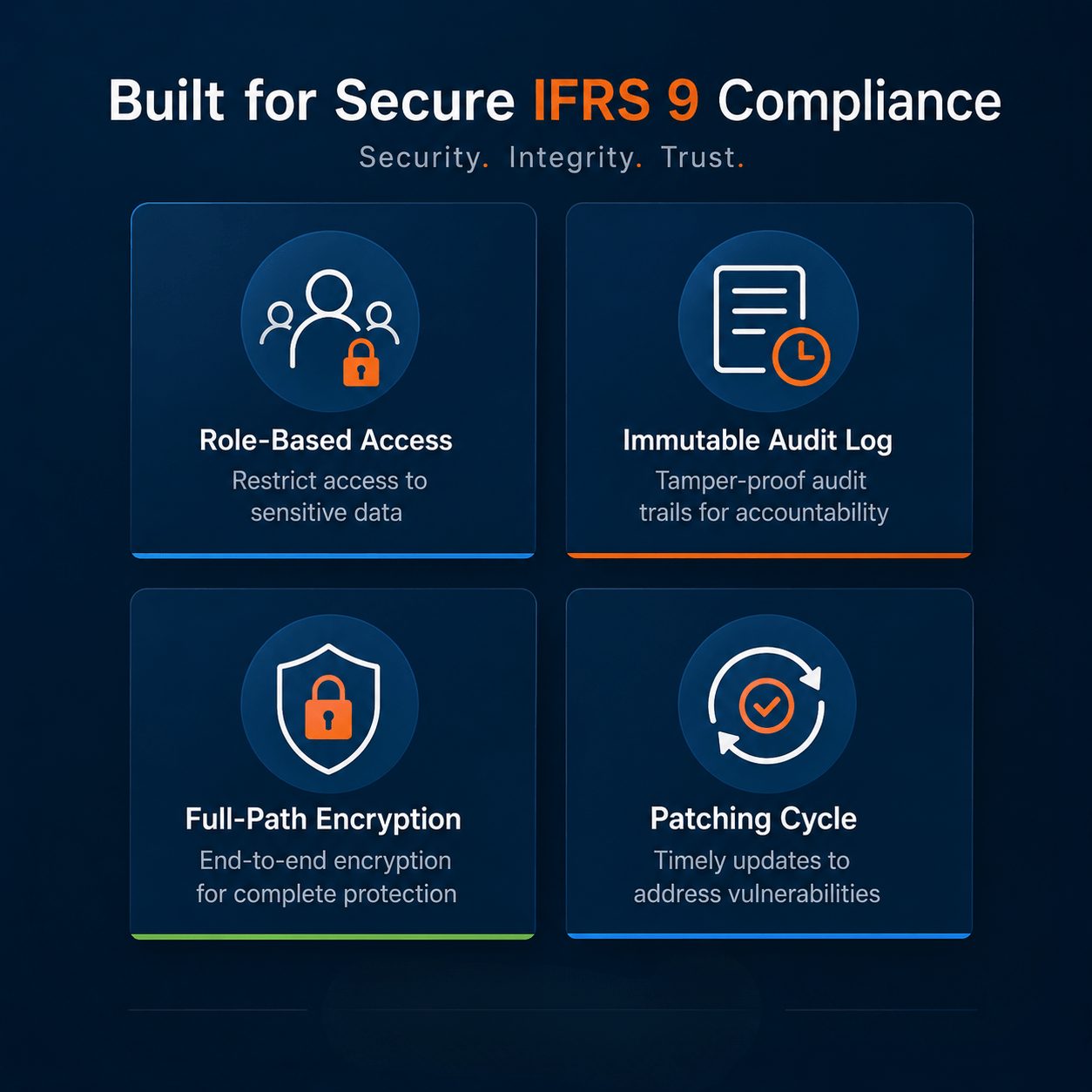
Role-based access control at the field level, not just the system level. This means an analyst running scenario models can’t accidentally export the full loan book. It means a vendor completing a system integration can’t read ECL outputs that have no relevance to their work. Access is scoped to function, not to trust.
Immutable audit logging. Every model run, every parameter change, every export, and every user action is logged in a way that can’t be edited after the fact. Not because regulators require it — though they increasingly do — but because without it, you genuinely cannot know what happened to your IFRS 9 data at any given point.
Encryption at rest and in transit for all model data, including intermediate outputs and API responses. Not just the database. The full data path.
And regular, documented patching cycles with version control. If your IFRS 9 software solutions vendor can’t tell you when the last security release was and what it addressed, that’s worth asking before your next audit rather than after.
IFRS 9 technology solutions in risk management have matured significantly since 2018. There’s no reason to run your compliance environment on a platform that hasn’t.
What You Now Know
- Non-compliant IFRS 9 compliance software isn’t just a reporting gap. It’s a live security vulnerability — weak access controls, unpatched code, and broken audit trails create exploitable attack surfaces that regulators and threat actors both know how to use.
- The regulatory environment has shifted. With $4.6 billion in global financial penalties in 2024, a 417% surge in enforcement fines in H1 2025, and DORA now enforceable in Europe, the cost of running a non-compliant platform is no longer theoretical.
- Secure IFRS 9 software exists and is deployable. Role-based access, immutable audit trails, full-path encryption, and active patching are baseline requirements for any IFRS 9 compliance tools software worth using in 2025. If your current platform doesn’t have them, you’re already behind.
Your Non-Compliant IFRS 9 Platform Is a Risk You Can Measure Right Now
The security vulnerabilities in non-compliant IFRS 9 compliance software aren’t abstract. They map to specific gaps: who can access your ECL data, whether your audit trail is genuine, and whether your vendor’s last security patch is running on your system. Every one of those gaps is a question you can answer today.
Most teams don’t ask until a regulator does. That’s the wrong order of operations.
IFRS TECH works with banks and financial institutions across the GCC, Europe, and APAC on platform assessment, gap analysis, and transition to secure, purpose-built IFRS 9 solutions for financial institutions. We don’t sell software. We help you choose the right one and make sure it’s built to withstand the scrutiny you’ll face in 2025 and beyond.
If your current setup couldn’t survive a regulator’s access control review today, the time to address that is now — not at the next audit cycle.
See how IFRS TECH’s advisory team audits IFRS 9 platform security and replaces non-compliant setups before regulators find them first →
Serving GCC, Europe & APAC | Actuaries + CPAs + CFAs | 40+ institutions supported
Frequently Asked Questions
What security vulnerabilities are most common in non-compliant IFRS 9 compliance software?
The most common issues are weak or overprovisioned access controls, missing immutable audit trails, unencrypted model output files, and unpatched third-party integrations. These gaps often exist in platforms that were built for IFRS 9 reporting accuracy but weren’t designed with a security-first architecture. Legacy tools and spreadsheet-based IFRS 9 compliance methods carry the highest risk.
How do data breaches in non-compliant compliance software affect regulatory standing?
A breach that exposes ECL model data or loan staging information can trigger a dual regulatory response: one for the data security failure and one for the underlying IFRS 9 compliance gap. Regulators increasingly treat weak IFRS 9 software tools as evidence of broader governance failure. Penalties can include fines, mandatory remediation programs, and heightened supervisory scrutiny.
What’s the difference between IFRS 9 compliance software tools and a secure platform?
A basic IFRS 9 compliance tool handles calculation and reporting. A secure platform adds role-based access at the field level, immutable audit logging, full-path encryption, and documented patching cycles. Without those features, your tools support IFRS 9 compliance software requirements on paper but not in practice — and not under audit conditions.
Are GCC-based banks facing the same IFRS 9 security risks as European institutions?
Yes. SAMA has intensified ECL model reviews since 2023, and GCC regulators are aligning with global standards on data governance and operational resilience. Banks running non-compliant IFRS 9 software in Saudi Arabia, the UAE, and across the GCC face the same audit vulnerabilities as their European counterparts — with the additional complexity of regional regulatory overlap.
How do I know if my current IFRS 9 platform has compliance or security gaps?
Start by pulling the full user access list, testing the completeness of your audit trail on a historical ECL run, and asking your vendor for the date of the last security patch. If any of those questions takes more than a day to answer, or if the answers reveal gaps, your platform likely needs a formal security assessment against current IFRS 9 compliance requirements.