TL;DR
Choosing the wrong IFRS 9 solutions for financial institutions doesn’t just slow down your team. It creates audit failures, reporting delays, and regulatory risk that compound over time. This article walks you through the most critical vendor red flags to catch before you commit, including poor support signs, scalability issues, opaque ECL calculations, and weak data integration. You’ll also find a practical vendor evaluation checklist, key questions to ask during demos, and guidance on IFRS 9 technology solutions that meet modern compliance standards. Read this before you sign anything.
You’re about to commit to a multi-year vendor relationship. The wrong IFRS 9 solutions for financial institutions can cost you far more than the license fee. Bad vendor choices lead to failed audits, reporting delays, and regulatory scrutiny. They create hidden costs that don’t show up until it’s too late to switch.
This article breaks down the most critical red flags to look for before you sign. You’ll also find a practical checklist, key vendor questions, and a clear picture of what strong IFRS 9 compliance solutions for financial institutions actually look like.
What Are IFRS 9 Solutions for Financial Institutions?
IFRS 9 solutions for financial institutions are software platforms that automate expected credit loss (ECL) calculations, manage credit risk staging, and produce compliant regulatory disclosures. They replace manual spreadsheets and reduce human error in a high-stakes reporting environment.
Key Features of IFRS 9 Compliance Tools
Strong IFRS 9 technology solutions include automated PD, LGD, and EAD modeling, transparent staging logic, forward-looking scenario analysis, and full audit trail functionality. They connect directly to core banking systems and generate IFRS 7 disclosures automatically.
Why Financial Institutions Need IFRS 9 Solutions
IFRS 9 regulatory reporting demands forward-looking provisioning that manual processes can’t handle reliably. Regulators require full traceability from exposure data to final provisions. Auditors expect documentation that explains every ECL movement. The right solutions for IFRS 9 make that possible without creating a bottleneck.
To understand how impairment modeling tools support compliant provisioning, see ifrs 9 impairment modeling tools.
Top Red Flags When Selecting IFRS 9 Solutions
Here’s the thing: most vendors look credible on the surface. The problems appear during implementation or at your first audit. Knowing what to look for now saves you a very expensive lesson later.
Lack of Transparent ECL Calculations
If a vendor can’t show you a clear calculation path from facility data to final provision, walk away. Black-box ECL engines protect the vendor, not your institution.
Poor Model Documentation and Audit Trails
A vendor without model documentation isn’t audit-ready. When your auditors ask why provisions moved, you need to show them a clear, timestamped record. Poor documentation means you’re guessing when it matters most.
Limited Validation and Governance Controls
Model validation is not optional under IFRS 9. If the vendor can’t show approval workflows, parameter change tracking, or governance dashboards, that’s a serious red flag in selecting IFRS 9 solutions for financial institutions.
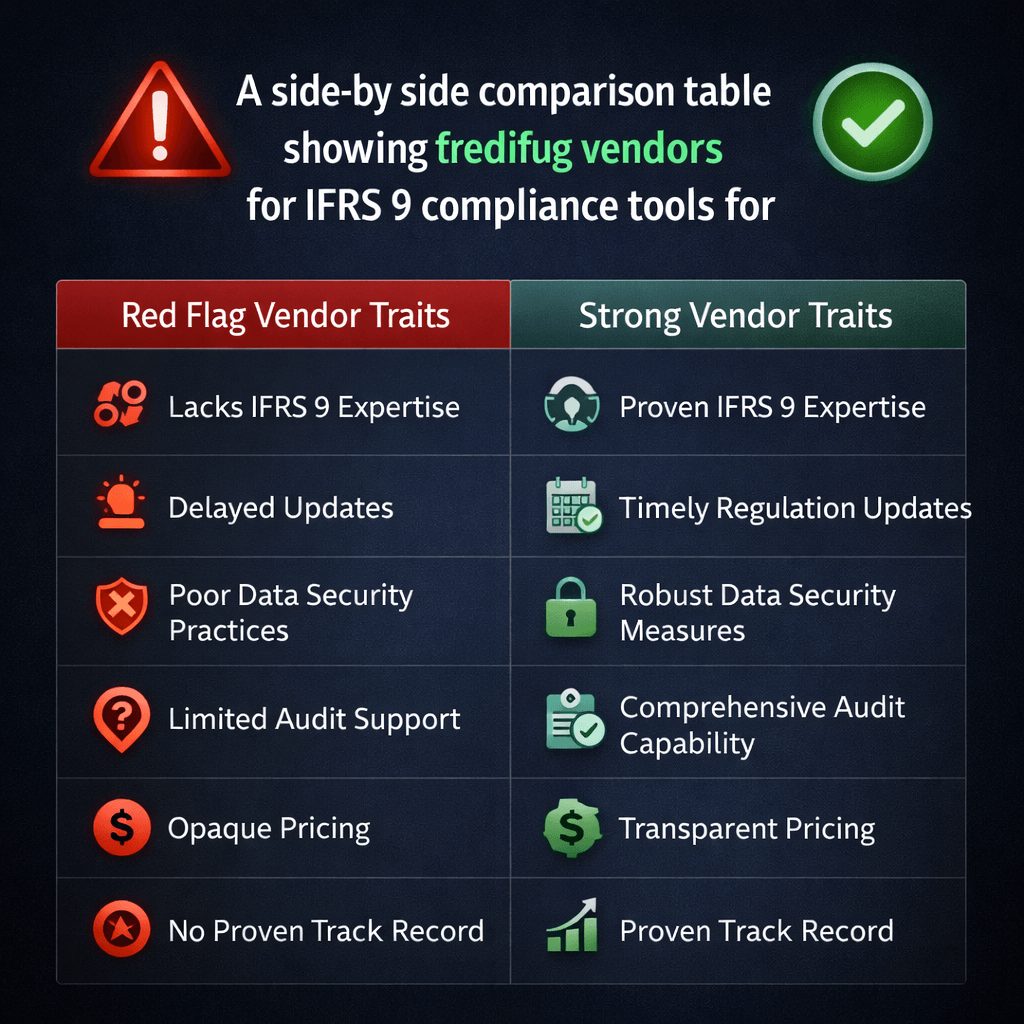
Use this quick comparison to assess IFRS 9 solutions for financial institutions side by side.
Weak Data Integration and Management
Data quality drives ECL accuracy. A vendor with weak integration capabilities forces your team into manual data preparation, which creates errors and delays. That’s not compliance. That’s risk in disguise.
Inconsistent Data Sources
Vendors that rely on manual CSV uploads or batch file processing create stale data. For accurate ECL, your institution needs real-time or near-real-time data flows. Inconsistent sources lead to inconsistent provisions.
Limited Data Automation Capabilities
If the platform still requires manual transformation steps between your core banking system and the ECL engine, it hasn’t solved your problem. Look for API-native connections that remove manual touchpoints entirely.
Poor Data Governance Framework
In 2024, several Dutch banks reported Stage 2 exposure increases driven by missing client data and SICR framework updates, not actual credit deterioration, as per zanders. Without strong data governance, your staging classifications can move for the wrong reasons.
Inflexible ECL Modeling Capabilities
IFRS 9 models aren’t static. Regulations change, economic conditions shift, and your portfolio grows. A vendor locked into rigid model structures will create problems every time you need to adapt.
Limited Support for PD, LGD, and EAD Models
Any credible IFRS 9 solutions vendor must support probability of default, loss given default, and exposure at default modeling with full parameter visibility. If the vendor bundles these into a single opaque output, you’ve lost control of your own ECL.
No Scenario Analysis or Forecasting Flexibility
Forward-looking information is at the core of IFRS 9 ECL. Vendors that offer only a single economic scenario or no probability-weighting capability are not equipped for the standard. Scenario analysis is a requirement, not a luxury.
For a detailed look at what good compliance software includes, visit ifrs 9 compliance software tools.
Scalability and Performance Issues
Scalability issues in IFRS 9 compliance vendors are one of the most overlooked red flags. A platform that works at launch can grind to a halt as your loan book grows. You need a vendor that has proven performance at your scale, not a demo environment.
Inability to Handle Large Data Volumes
Ask vendors directly: how many facilities does your system process per hour? If they can’t give you a specific number tied to a real client scenario, that’s institution scalability risk you don’t want to take on.
Slow Processing and Reporting Delays
Quarter-end is not the time to discover your ECL run takes 18 hours. Slow processing is a symptom of poor architecture. Look for vendors who can demonstrate real-time or near-real-time calculation speeds with live client data.
Lack of Regulatory Compliance Updates
IFRS 9 isn’t frozen in time. Regulators continue to issue guidance, and banks must stay current. Poor adaptability to regulatory changes is one of the clearest signs of a weak vendor. If they’re slow to update their platform, you’re the one who pays the price.
Delayed IFRS 9 Updates
Ask any vendor: what’s your typical timeline to update the platform after regulatory guidance changes? If the answer involves a support ticket and a six-month roadmap, your institution is the one absorbing compliance risk while waiting.
Poor Adaptability to Regulatory Changes
Deloitte’s 2024 IFRS results update noted that post-model adjustments for UK banks continued to decrease after peaking at up to 40% during Covid, as per deloitte. This shows how fast the regulatory environment moves. Your vendor needs to keep up.
Inefficient Reporting and Disclosures
IFRS 9 regulatory reporting is not just a numbers exercise. Boards, auditors, and regulators all require clear disclosures. Weak reporting tools create friction at every layer of your organization.
Limited Financial Reporting Outputs
If you can’t generate IFRS 7 reconciliation tables, staging breakdowns, and ECL movement analysis directly from the platform, you’re rebuilding those reports manually in Excel. That defeats the purpose of buying IFRS 9 technology solutions in the first place.
Weak Audit and Compliance Reporting
Auditors need read-only system access to verify calculations independently. If auditors can’t trace a provision back to source data without vendor assistance, you have a solution red flag on your hands. That dependency costs you time and credibility every audit cycle.
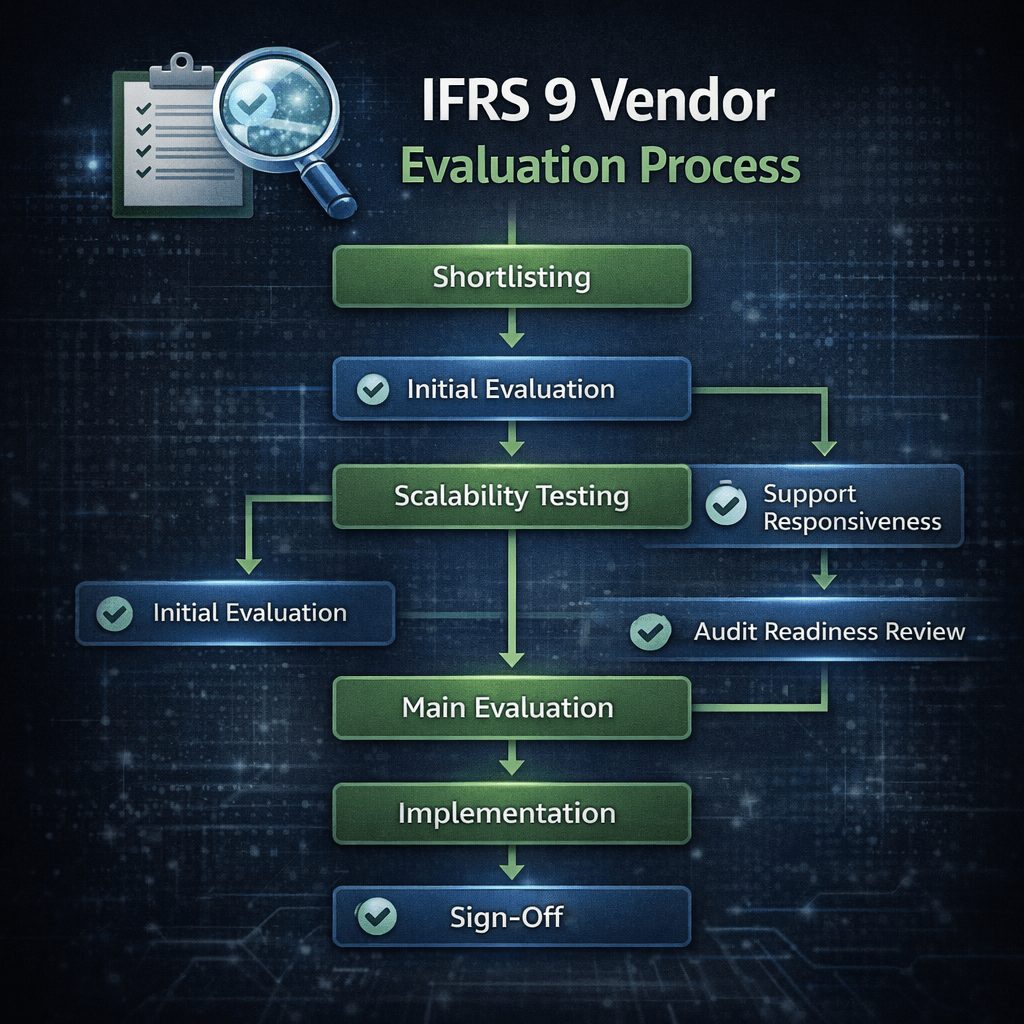
Follow this process to choose the right IFRS 9 solutions for financial institutions.
How to Evaluate IFRS 9 Solutions Effectively
Evaluating vendors for IFRS 9 institution software requires a structured approach. Don’t rely on demos alone. The criteria for avoiding red flags in IFRS 9 regulatory tools go beyond feature lists.
Key Questions to Ask Vendors
These questions cut through the marketing to surface real decision criteria:
- Scalability: How many facilities have you processed in a single run for a live client?
- Support responsiveness: What’s your SLA for critical issues? Can we talk to a current client?
- Regulatory updates: How quickly did you update after the last major IFRS 9 guidance change?
- Audit trail: Can an auditor independently verify any provision in your system without vendor help?
- Integration: Do you support REST API connections to our core banking system?
- Transparency: Can we drill from a portfolio-level ECL down to the individual facility cash flows?
Must-Have Features Checklist
This is the checklist for spotting IFRS 9 solution red flags in a vendor demo:
- Full PD, LGD, and EAD visibility at every calculation step
- Automated staging with configurable SICR triggers
- Multiple macroeconomic scenarios with probability weighting
- API-native connection to core banking systems
- Real-time or near-real-time data synchronization
- Built-in IFRS 7 disclosure generation
- Immutable audit trail with user and timestamp records
- Governance dashboard with approval workflows
- Scalability benchmarks from live client environments
- Documented support SLAs with escalation paths
Build vs Buy: Which Approach Is Better?
Building an in-house IFRS 9 ECL engine requires IFRS 9 expertise, development resources, and ongoing maintenance. Most institutions underestimate the total cost and overestimate their team’s capacity to maintain regulatory alignment.
Buying a purpose-built solution gives you faster deployment, proven accuracy, and dedicated regulatory support. That said, you still need to apply the red flag criteria above to every vendor you evaluate. Not all bought solutions are good ones.
Common IFRS 9 Implementation Challenges
Even good vendors run into challenges during implementation. Knowing what to expect helps you assess whether a vendor is being realistic or is selling you an unrealistic timeline.
Data Quality and Availability Issues
Historical data gaps are common in institutions that haven’t tracked default and recovery data systematically. A strong vendor will help you assess data gaps upfront and build a realistic migration plan, not promise a clean go-live.
Complexity in Expected Credit Loss Models
ECL models for complex portfolios require regular back-testing and validation. A 2024 Dutch banking study showed management overlays decreased from 11% in 2023 to 8%, as per zanders. That trend toward cleaner model-driven provisions demands more, not less, model sophistication.
System Integration Challenges
Integration between your core banking system and your IFRS 9 platform is where many implementations stall. Vendors who rely on flat file transfers or batch processes add latency to your data and risk to your reporting cycle. API-native integration is the standard you should demand.
Best Practices for Selecting IFRS 9 Solutions
Best practices for IFRS 9 scalability assessment and vendor evaluation don’t end with the checklist. They run through implementation, go-live, and every reporting cycle after that.
Aligning Technology with Risk Strategy
Your IFRS 9 compliance solutions should connect directly to your broader credit risk strategy. If the platform can’t feed into your risk reporting dashboards or portfolio management tools, it creates a silo that limits its value over time.
Ensuring Strong Governance and Controls
Model governance isn’t a one-time setup. Your team needs to review parameter changes, track assumption overrides, and maintain documentation that satisfies both internal audit and external regulators. Make sure the vendor builds this into the platform, not onto a separate manual process.
Prioritizing Automation and Accuracy
The more manual your ECL process is, the more it’s exposed to human error. Avoiding common mistakes in IFRS 9 vendor choices means prioritizing platforms that automate data ingestion, staging, calculation, and reporting from end to end. Manual workarounds aren’t a feature; they’re a vendor failure.
Final Checklist Before Choosing an IFRS 9 Solution
Use this before you finalize any vendor evaluation for IFRS 9 institution software:
- Transparency: Can you trace any ECL to its source data in three clicks or fewer?
- Governance: Does the platform have approval workflows and timestamped parameter logs?
- Scalability: Has the vendor processed portfolios at your scale in a live environment?
- Support SLA: Is there a documented response time for critical issues, with references?
- Regulatory updates: Has the vendor updated the platform within 60 days of the last regulatory guidance?
- Integration: Does the vendor support direct API connections to your core banking system?
- Scenario modeling: Can you run at least three macroeconomic scenarios with probability weighting?
- Disclosure generation: Are IFRS 7 reports produced automatically without Excel rebuilding?
- Audit readiness: Can auditors access and verify calculations independently, without vendor help?
- Pricing model: Is pricing transparent, with no hidden fees for regulatory updates, extra users, or support escalations?
Frequently Asked Questions
What red flags indicate a weak IFRS 9 provider?
The clearest red flags include opaque ECL calculations, slow regulatory update cycles, batch-only data processing, no documented support SLAs, and an inability to show scalability evidence from live client environments. If a vendor avoids specifics during a demo, take that as a warning.
How do I identify poor support signs in IFRS 9 technology solutions?
Ask for the support SLA in writing. Ask how many dedicated staff handle critical issue tickets and whether you’ll have a named customer success manager. Poor support signs include vague SLAs, shared ticket queues with no escalation path, and no post-go-live check-ins built into the contract.
How do I spot scalability issues in IFRS 9 compliance vendors?
Request a live performance demonstration using a dataset close to your portfolio size. Ask for references from clients with a comparable number of facilities. Scalability issues often only appear under production load, so insisting on real-world benchmarks is the only reliable test.
What pricing models should I expect from IFRS 9 vendors?
Pricing typically follows three models: per-facility or portfolio-volume pricing, flat annual license fees, or modular pricing based on the features you activate. Watch for hidden fees tied to regulatory updates, support escalations, or additional users. Strong vendors include regulatory updates in the base license and price by institution size, not per-ticket usage.
Can I replace my current IFRS 9 solution without disrupting reporting cycles?
Yes, with the right approach. Most institutions run parallel calculations for one quarter before switching over. This lets your team confirm the new platform produces results consistent with your prior methodology. A vendor offering a structured migration plan and parallel-run support is a good sign of implementation maturity.
How quickly should IFRS 9 solutions deploy?
Purpose-built platforms typically deploy in 6 to 12 weeks for standard portfolios. Deployments stretching beyond 6 months usually signal a platform not designed for your institution type or a vendor overpromising and under-delivering. Ask for a week-by-week implementation plan before you sign.
What makes Rust IFRS 9 Software different from other IFRS 9 solutions for financial institutions?
Rust IFRS 9 Software is an ECL-only engine built for transparency and speed. It connects API-native to core banking systems including Temenos, Flexcube, Finacle, SAP, and Oracle. It deploys in 6 to 8 weeks with prebuilt staging rules and PD term structures. Every ECL calculation is auditable from portfolio level down to individual facility cash flows.
Choose IFRS 9 Solutions for Financial Institutions That Earn Your Confidence
The vendor you choose today will shape every audit, every quarter-end, and every regulatory submission for years ahead. Weak support, poor scalability, and opaque ECL models are avoidable risks, but only if you know what to look for before you commit.
Apply the checklist in this article to every vendor conversation. Demand live evidence, not demo environments. Ask the hard questions about support SLAs, regulatory update timelines, and integration architecture.
Rust IFRS 9 Software, offered through IFRSTech.com, is built specifically for financial institutions that need transparent ECL calculations, API-native integration, and audit-ready reporting, all deployed in weeks rather than months.
If you’re ready to see what compliant, scalable IFRS 9 solutions for financial institutions actually look like, talk to Prima Consulting to schedule a personalized demo today.