TL;DR
Your IFRS 9 impairment modeling tools depend entirely on the quality of data feeding them. When that data is incomplete, siloed, or inconsistent, ECL calculations go wrong at every stage: PD estimates drift, LGD figures distort, and stage allocations misclassify real credit risk. This piece covers the key data quality risks that cause impairment miscalculations, how integration problems in IFRS 9 compliance tools compound those errors, and what controls actually work. Read on to see which gaps are putting your institution’s provisions and regulatory standing at risk.
Data Quality Risks in IFRS 9 Impairment Modeling Tools
Your IFRS 9 impairment modeling tools are only as reliable as the data feeding them. Most banks and financial institutions know this in theory. In practice, though, data quality issues slip through unnoticed until they cause real damage. Miscalculated expected credit loss (ECL) estimates, failed audits, regulatory scrutiny, and inflated or understated provisions are often not model failures at all. They’re data failures.
This piece breaks down the key data quality risks that compromise IFRS 9 impairment modeling tools, how those risks affect ECL accuracy, and what your institution can do about it.
IFRS 9 Impairment Modeling Tools: Data Quality Risks
What Is IFRS 9 Impairment Modeling?
IFRS 9 impairment modeling is the process banks use to estimate ECL on financial assets. The framework replaced the IAS 39 incurred loss model with a forward-looking approach. That shift added complexity but improved accuracy when done right.
The model works in three stages.
- Stage 1 covers assets with no significant credit risk increase.
- Stage 2 applies to those showing significant credit risk increase (SICR).
- Stage 3 covers credit-impaired exposures.
Each stage requires different probability of default (PD), loss given default (LGD), and exposure at default (EAD) inputs, all relying on clean, complete data.
Why Data Quality Matters in IFRS 9 ECL Models
Poor data quality doesn’t just affect one calculation. It cascades. A single error in a PD time series can distort lifetime ECL across thousands of exposures.
According to the ECB, roughly 25% of loan loss coverage in EU banks’ Stage 1 and Stage 2 performing loan books was attributable to overlays in IFRS 9 impairment models as of year-end 2023. That figure signals how often institutions are compensating for data gaps with manual adjustments rather than fixing the underlying problem.
Clean data isn’t just a technical goal. It’s a regulatory requirement. Without it, your IFRS 9 impairment modeling tools can’t do their job.
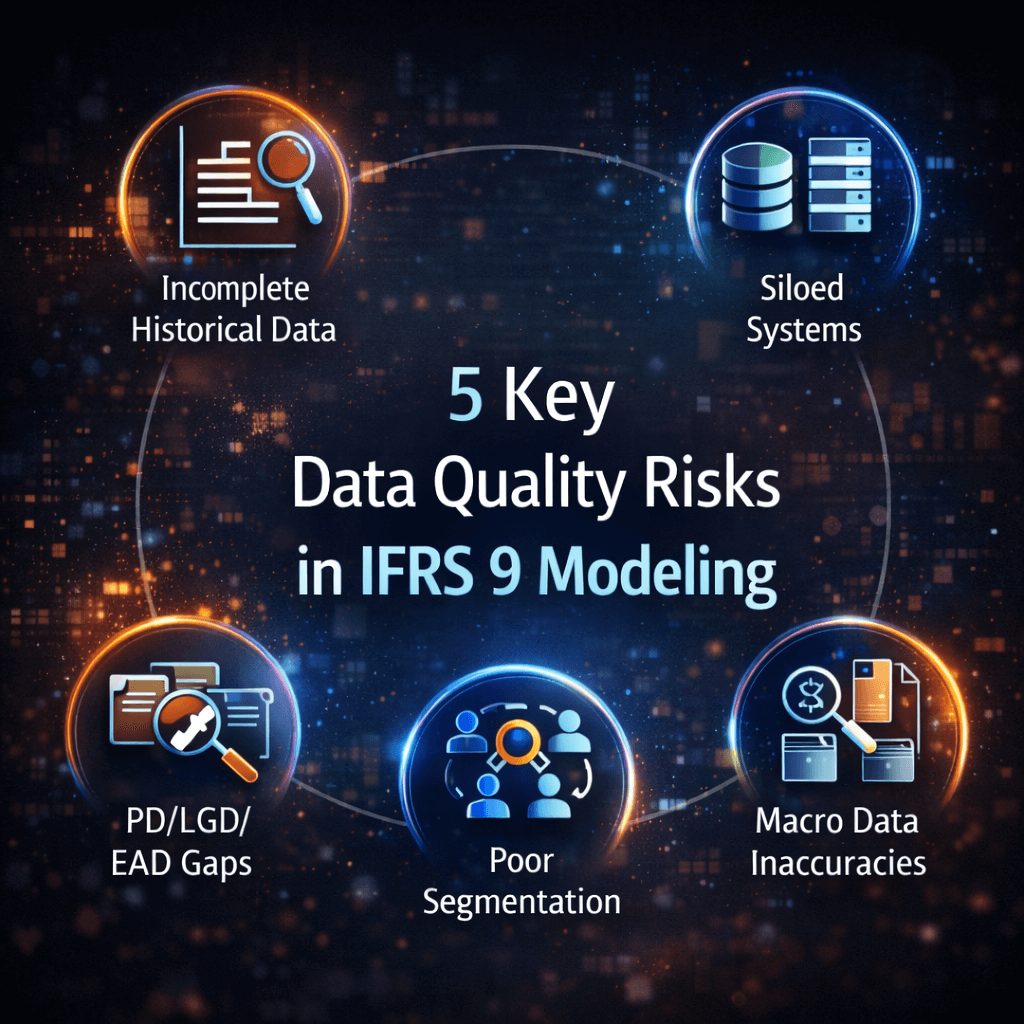
Key Data Quality Risks in IFRS 9 Modeling
Incomplete Historical Credit Data
Accurate PD calibration depends on long, clean histories of defaults and recoveries. Most banks in emerging markets, including those in the GCC region, don’t have decades of granular data to draw from. Low-default portfolios are especially problematic here.
When historical data is thin, institutions are forced to make assumptions. Those assumptions introduce model risk from the very first step. The result is PD estimates that don’t reflect real portfolio behavior, leading to ECL figures that understate or overstate provisions.
Inconsistent Data Across Systems
Most banks operate across multiple platforms: core banking systems, credit risk platforms, and finance systems. Each one can define data fields differently.
Definition mismatches, timing gaps between system updates, and aggregation errors all create inconsistencies that are hard to catch in time. These siloed integrations are one of the most common root causes of ECL model failures. When your IFRS 9 ECL software is pulling conflicting data from three different sources, the output will reflect that conflict.
Poor Portfolio Segmentation Data
Segmentation is critical to IFRS 9 compliance. Loans need to be grouped by meaningful risk drivers, not just product type or geography. Without granular segmentation data, institutions end up with groups that don’t reflect actual credit behavior.
That matters because ECL calculations within each segment assume homogeneous credit characteristics. Poorly segmented portfolios produce loss estimates that are off for almost every sub-group within them.
Data Gaps in PD, LGD, and EAD Models
PD, LGD, and EAD are the three core inputs to any ECL calculation. All three are sensitive to data quality.
Missing collateral valuations distort LGD. Stale credit utilization rates produce unreliable EAD. Incomplete transition matrices weaken PD projections over lifetime horizons. Any of these gaps creates a compounding risk: one bad input skews the others.
Banks that adopted IFRS 9 early reported that historical data collection for defaults, trends, and macroeconomic variables was the single biggest obstacle, per Moody’s analysis.
Inaccurate Forward-Looking Macroeconomic Data
IFRS 9 requires incorporating forward-looking information into ECL estimates. That means linking macro variables like GDP growth, unemployment, and interest rate forecasts to credit risk metrics.
The challenge is that macro data integration is technically complex. Nonlinear relationships between macro variables and credit performance are easy to misspecify. Scenario weighting decisions add another layer of judgment. When those inputs are inaccurate or poorly linked to model parameters, the forward-looking adjustments produce noise, not signal.
How Data Issues Affect Expected Credit Loss (ECL)
Errors in Stage Allocation
Stage allocation is the first place where data problems become visible in ECL outputs. SICR thresholds trigger the shift from Stage 1 to Stage 2, and that shift has a significant provisioning impact.
If the data feeding SICR criteria is inconsistent or delayed, borrowers get misclassified. Some Stage 2 exposures remain in Stage 1, understating provisions. Some Stage 1 exposures get incorrectly pushed to Stage 2, inflating them. Either way, financial reporting accuracy suffers.
Incorrect Probability of Default Estimates
PD estimates built on thin or inconsistent historical data don’t just affect one loan. They affect every facility in a segment.
A 5% error in a PD estimate can translate to a significant percentage variance in ECL provisions across a portfolio. For a mid-sized bank, that could mean millions in misstated provisions. Regulators view this kind of error seriously, particularly when it results in under-provisioning.
Distorted Loss Given Default Calculations
LGD is particularly sensitive to collateral data. If collateral valuations are stale, missing, or applied inconsistently across the portfolio, LGD figures will be wrong.
Recovery rate assumptions are another vulnerability. Banks without robust recovery history databases are forced to use industry benchmarks that may not reflect their specific portfolio. That’s a data gap, not a model choice, and it shows up in distorted ECL figures.
Impact on Financial Reporting and Compliance
The downstream effects of data-driven ECL errors are serious. Inaccurate provisions misstate balance sheets and income statements. Auditors flag data quality issues during model reviews. Regulators, particularly in jurisdictions where IFRS 9 compliance is actively supervised, can require restatements.
Tools for IFRS 9 compliance are now a growing market. DataIntelo reports that Europe held approximately 38% of the global IFRS 9 compliance software market share in 2024, valued at around USD 0.82 billion, with North America at 32% (USD 0.69 billion) growing at a CAGR of 11.8%, and Asia Pacific at 20% (USD 0.43 billion). That growth reflects how seriously institutions are taking compliance infrastructure.
Still, software alone doesn’t solve the problem. Clean data inputs remain the foundation.
Common Data Sources for IFRS 9 Impairment Models
Loan and Credit Portfolio Data
Loan origination data, repayment histories, utilization rates, and delinquency records form the backbone of any IFRS 9 ECL calculation. These are sourced from core banking systems and need to be complete, timely, and consistently formatted.
Any gaps here, missing fields, outdated entries, or inconsistent coding, create downstream errors in PD and EAD calculations.
Risk and Rating System Data
Internal credit ratings and risk scores feed directly into PD models. When rating systems don’t update regularly or use different methodologies across business units, the ECL inputs they produce are unreliable.
This is a common source of inconsistency in banks operating across multiple segments or geographies.
Macroeconomic Forecast Inputs
Macro data comes from internal economics teams or third-party providers. The quality of the data and its relevance to the specific portfolio both matter.
Using generic macro forecasts for a portfolio concentrated in a single sector or region creates a linkage mismatch. The macro variable might be technically accurate but not reflective of the credit risk drivers for that portfolio.
External Credit Bureau Data
Bureau data supplements internal records, especially for retail portfolios. It provides behavioral data on borrowers that internal systems may not capture.
The risk here is data vintage. Bureau data that’s a few months old during a fast-moving credit cycle can lead to SICR misclassification and inaccurate ECL staging.
Controls to Improve Data Quality in IFRS 9 Tools
Data Validation and Governance Frameworks
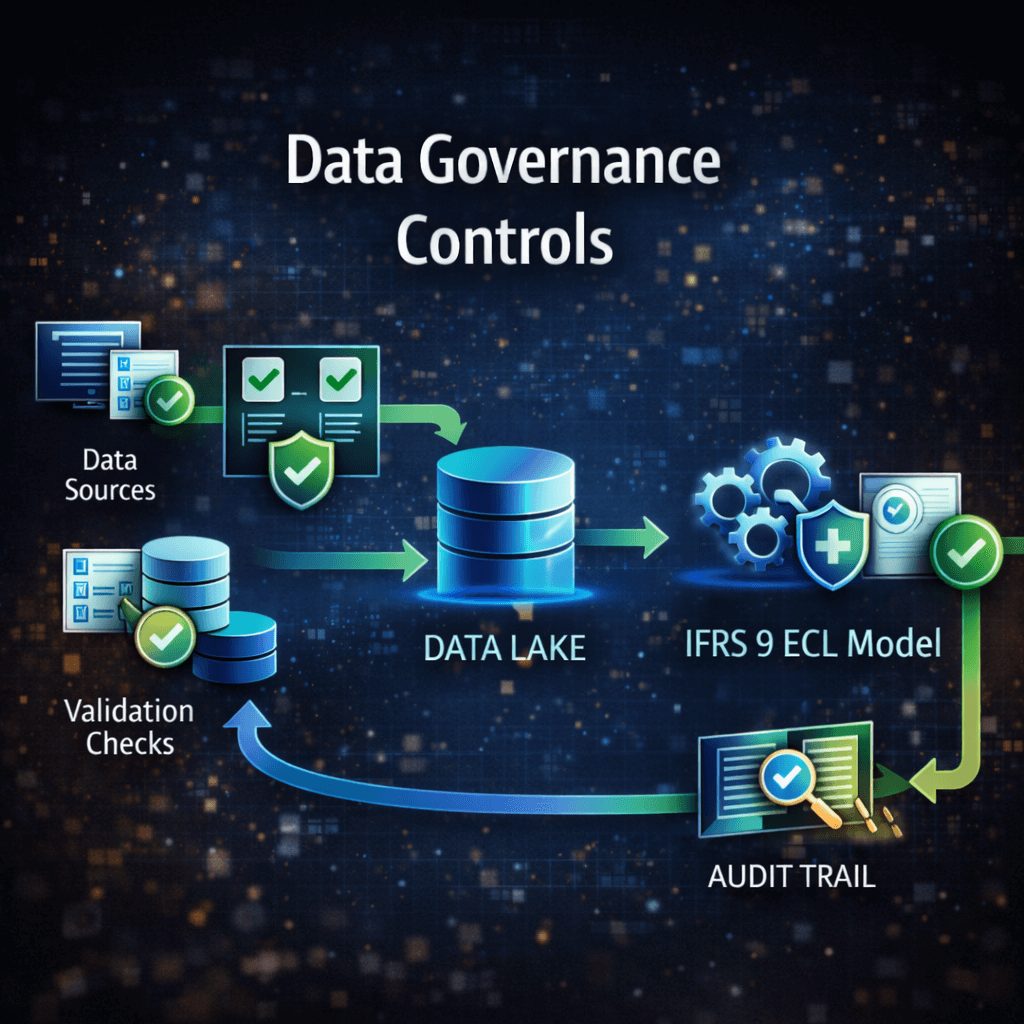
A governance framework defines who owns each data element, how it’s validated, and what happens when something fails. Without this, data quality is reactive. You find out something’s wrong when ECL outputs look strange, not before.
The framework should include defined data owners across finance, risk, and IT, documented validation rules, and clear escalation paths for data issues.
Automated Data Quality Monitoring
Manual data checks don’t scale. As portfolios grow and reporting cycles accelerate, automated monitoring is the only viable approach.
Automated checks flag completeness issues, outliers, and rule violations in real time. They reduce the reconciliation burden during reporting cycles and give model validators a cleaner starting point. This is where modern IFRS 9 ECL software creates real operational value.
Model Validation and Audit Trails
Model validation isn’t a one-time exercise. IFRS 9 models need to be reviewed regularly for parameter drift, segmentation changes, and macro linkage accuracy.
Audit trails document every data input, transformation, and output. They’re critical for regulatory reviews and for internal governance. Without them, it’s nearly impossible to trace the source of an ECL discrepancy.
As discussed in our analysis of ifrs 9 compliance software tools, automated workflows with embedded audit trails significantly reduce both the operational burden and the risk of undetected data errors in IFRS 9 processes.
Centralized Data Management Systems
Siloed systems are the root of many data quality problems. Centralizing data into a single source of truth, often a data lake or data warehouse, removes definition mismatches and timing gaps between systems.
A centralized layer also makes macro linkages more consistent. When the same data feeds every model scenario, scenario weighting becomes more defensible to auditors and regulators.
How Automation Reduces IFRS 9 Data Risks
Integrated Data Pipelines for ECL Modeling
Integrated pipelines pull from source systems, apply validation rules, and load clean data into the ECL model automatically. They remove the manual extract-transform-load steps where most errors occur.
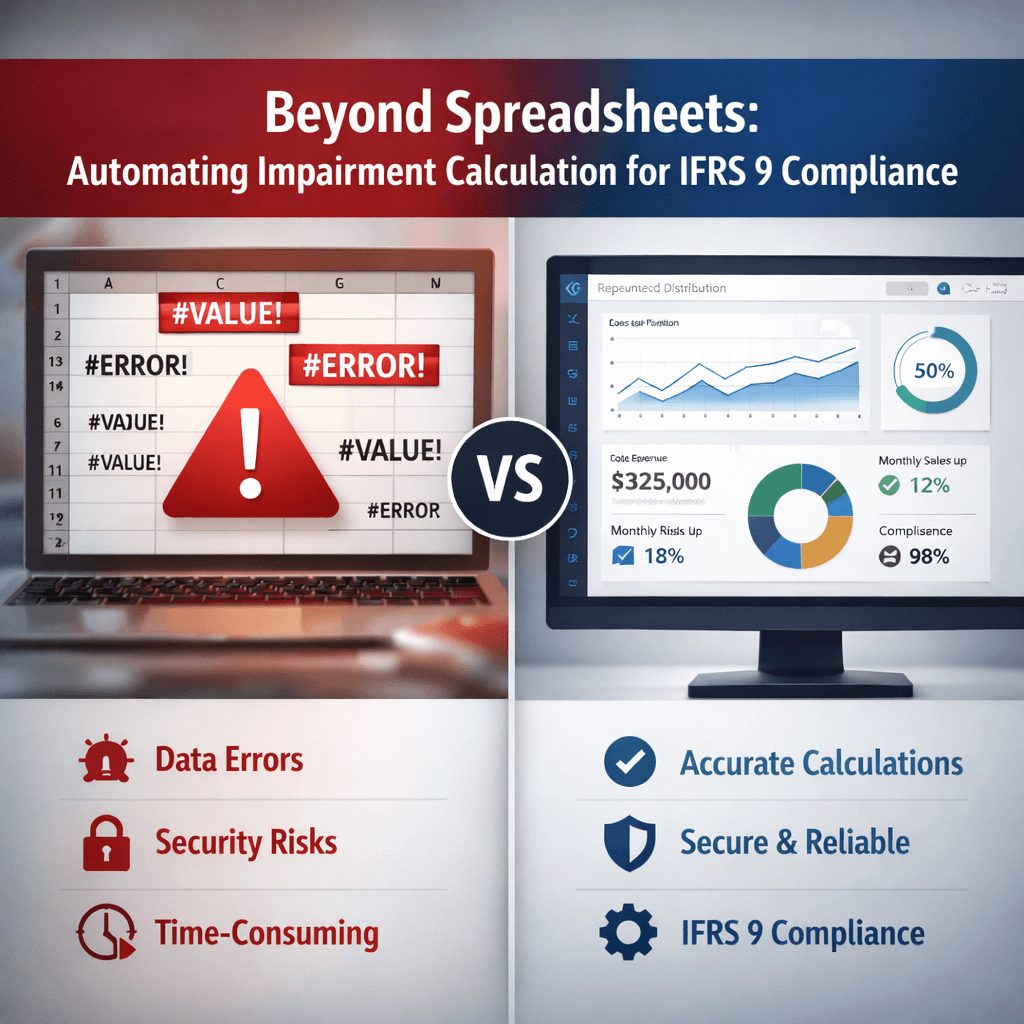
This is one of the clearest differences between spreadsheet-based approaches and purpose-built IFRS 9 impairment modeling tools. Automated pipelines don’t just save time. They reduce the surface area for data errors.
Automated Workflow and Data Controls
Version control, access controls, and approval workflows prevent unauthorized changes to model inputs. Formula drift and data overrides, which are common failure modes in spreadsheet environments, become significantly less likely in controlled automated systems.
These controls also create defensible documentation for regulators. When a regulator asks why an overlay was applied or a threshold was changed, you can point to a documented workflow rather than trying to reconstruct a decision from version history.
Real-Time Data Reconciliation
Real-time reconciliation catches discrepancies between source systems and the ECL model as they happen. That’s a meaningful improvement over batch reconciliation processes that only surface problems after the reporting cycle has begun.
When reconciliation is automated and continuous, the data feeding your IFRS 9 ECL software stays aligned with source systems. ECL outputs become more reliable, and the end-of-period scramble to explain variances shrinks considerably.
Best Practices for Managing IFRS 9 Data Quality
Establishing Strong Data Governance
Data governance starts with clarity. Every data element feeding your IFRS 9 impairment modeling tools needs a defined owner, a documented source, and a validation rule.
Governance committees that include representation from risk, finance, and IT tend to catch cross-functional data issues earlier. A risk manager knows what the data should look like from a modeling standpoint. A finance team member knows what the reporting requirements are. IT knows what the systems can actually deliver.
Implementing Data Quality Metrics and KPIs
You can’t manage what you don’t measure. Data quality KPIs for IFRS 9 should cover completeness rates, timeliness, consistency across systems, and accuracy relative to defined benchmarks.
Tracking these metrics over time reveals where problems are worsening before they affect ECL outputs. That’s the shift from reactive to proactive data management.
Regular Model and Data Audits
Model audits should include a review of data inputs, not just model parameters. Audits that focus exclusively on methodology miss data-driven errors that accumulate over time.
Back-testing is an important part of this. Comparing model outputs against actual credit outcomes gives you an empirical basis for assessing whether your data and models are working together the way they should.
When selecting or upgrading your IFRS 9 regulatory reporting infrastructure, it’s also worth reviewing the ifrs 9 solutions for financial institutions. Making the wrong tool choice compounds data quality problems rather than solving them.
Checklist: Reducing Data Quality Risks in IFRS 9 Tools
- Audit all data sources feeding IFRS 9 ECL software for completeness and consistency
- Establish data ownership across finance, risk, and IT for every ECL input
- Deploy automated validation checks in your IFRS 9 impairment modeling tools
- Consolidate siloed data into a centralized repository with version control
- Review SICR thresholds and stage allocation logic against current portfolio conditions
- Document audit trails for all model inputs, transformations, and overlay decisions
- Back-test ECL outputs against actual default and recovery outcomes quarterly
- Validate forward-looking macro linkages for nonlinearity and portfolio relevance
- Define KPIs for data quality and report them to governance committees monthly
- Schedule annual pre-reporting model validations that include data quality reviews
Why Data Quality Defines IFRS 9 Model Performance
Data quality isn’t a secondary concern in IFRS 9 impairment modeling. It’s the deciding factor. The most sophisticated IFRS 9 impairment modeling tools still produce unreliable ECL outputs when fed with incomplete, inconsistent, or outdated data.
Stage misclassifications, distorted PD and LGD estimates, and inaccurate forward-looking adjustments all trace back to data problems that governance frameworks and automated controls can prevent.
Institutions that treat data quality as a core part of their ECL process, not an IT problem or a one-time cleanup, are the ones that pass audits, satisfy regulators, and produce provisions that reflect real credit risk.
If your institution is evaluating its current IFRS 9 tools and data infrastructure, Prima Consulting works with banks and financial institutions to build robust data governance frameworks and optimize IFRS 9 compliance processes.
Contact Prima Consulting to find out how to reduce data quality risks across your IFRS 9 impairment modeling tools and improve the reliability of your ECL outcomes.