Non-life insurers across the GCC who still build claims triangles by hand are carrying reserve error they cannot see, and IFRS 17 disclosure now puts that error on the record every quarter.
TL;DR
Software IFRS 17 replaces the spreadsheet-driven reserving that most non-life insurers still run today. The right ifrs17 solution builds claims triangles, applies triangle methods, and produces IBNR estimates that feed straight into your disclosures. This article covers why manual IBNR breaks at scale, what reserving automation actually changes, and how to judge a reserving software comparison for insurers. Read on, then book a Delta demo to see it on your own triangles.
Why Software IFRS 17 Beats Manual Claims Triangles
Here’s the part most vendor pages won’t say plainly. Your reserving methodology is probably fine. Your delivery method is the problem.
A non-life actuary building a chain ladder in Excel is doing real work. But the spreadsheet has no memory, no version control, and no audit trail worth the name. One pasted column in the wrong place and the ultimate shifts by millions. Nobody notices until the auditor does.
Software IFRS 17 exists because the standard changed what reserving has to produce. Under IFRS 4, an aggregate best estimate was often enough. Now you need a current-value liability, a risk adjustment, and a movement analysis that ties back to prior periods. Try doing all three by hand every quarter across ten lines of business. It doesn’t scale.
KPMG built an accelerator tool for exactly this reason, noting that some IFRS 17 close processes hide hundreds of individual tasks behind a single reporting cycle. Each one has to be right, and on time, every close.
What Manual IBNR Actually Costs at Scale
Think about a mid-size motor and medical insurer in the UAE. Claim inflation in medical lines can move fast, sometimes within a single quarter. A manual triangle catches that late because someone has to spot the pattern, rebuild the factors, and re-run the sheet.
Reserving automation flags the development anomaly before it distorts your IBNR. Software IFRS 17 does that watching for you. That’s not a nice-to-have when your combined ratio depends on getting the number close.
And the cost of getting it wrong isn’t just the reserve. It’s the restatement, the audit scrutiny, and the board conversation you did not want to have.
How Does an IFRS17 Solution Handle Reserving Differently?
A real ifrs17 solution does four things a spreadsheet cannot do reliably.
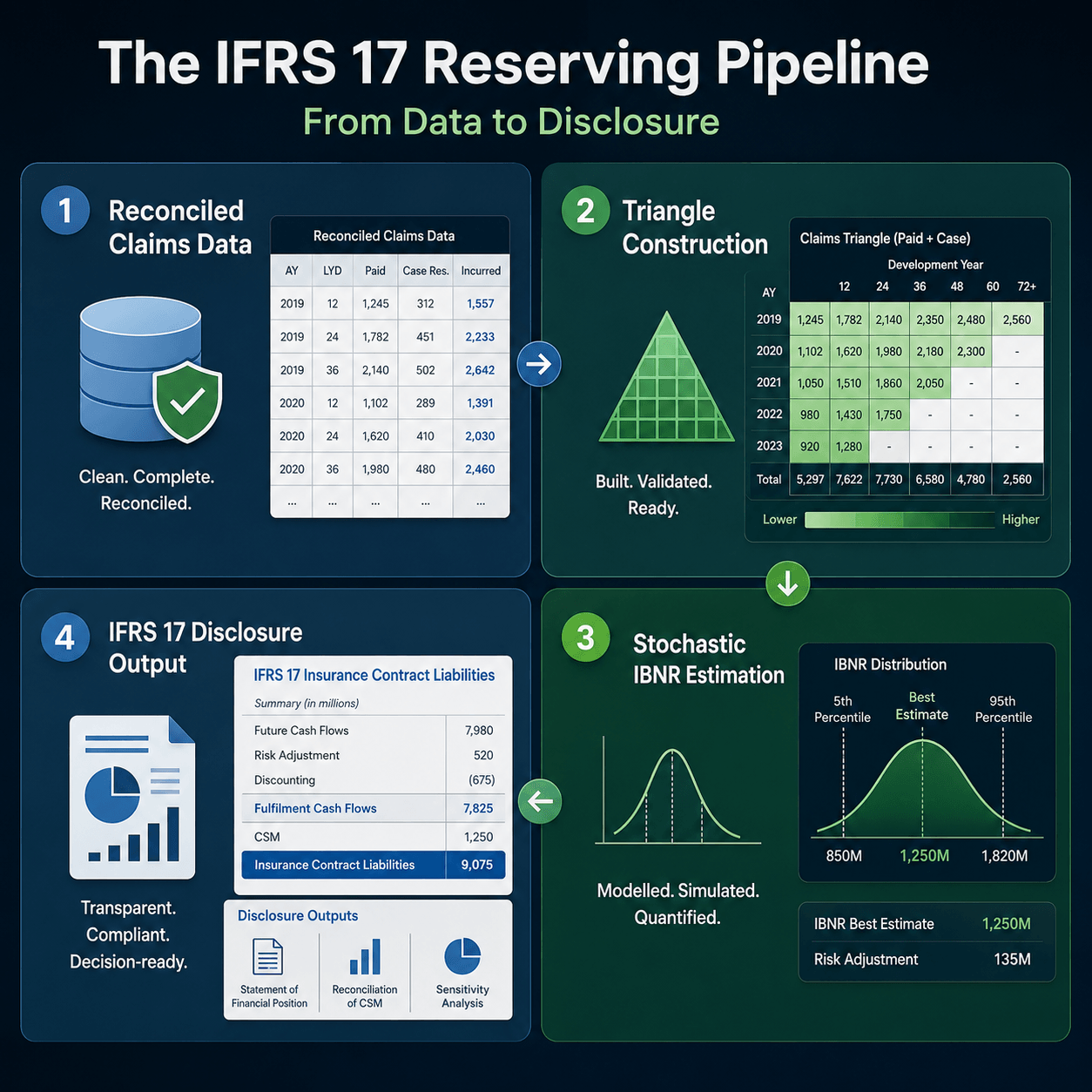
It builds development triangles straight from reconciled claims data, so the input layer stops being a copy-paste exercise. It applies triangle methods consistently, the same chain ladder or Bornhuetter-Ferguson logic every period, no silent formula drift. It generates a stochastic IBNR distribution, not just a point estimate, which is what the risk adjustment needs. And it keeps version control, so you can compare this quarter’s reserves to last quarter’s and explain the movement.
That last one matters more than people expect. IFRS 17 makes movement analysis a disclosure requirement, not an internal nicety.
Where Actuarial and Finance Teams Stop Fighting
Ask yourself two questions. Do your actuarial and finance teams use different versions of the same loss triangle in the same reporting period? Has your close cycle grown longer since 2023, even with the same data volume?
If either answer is yes, the fix is a shared reserving engine, not another reconciliation meeting.
When both teams pull from one governed triangle, the finance close stops waiting on the actuarial re-run. The reserving software becomes the single source, and the IFRS 17 sub-ledger reads from it directly. Prima Consulting’s work on insurance reserving software keeps coming back to this one point: version control is the difference between a clean close and a scramble.
What the Numbers Say About IFRS 17 and Reserving Software
The spend is real, and so is the pain behind it.
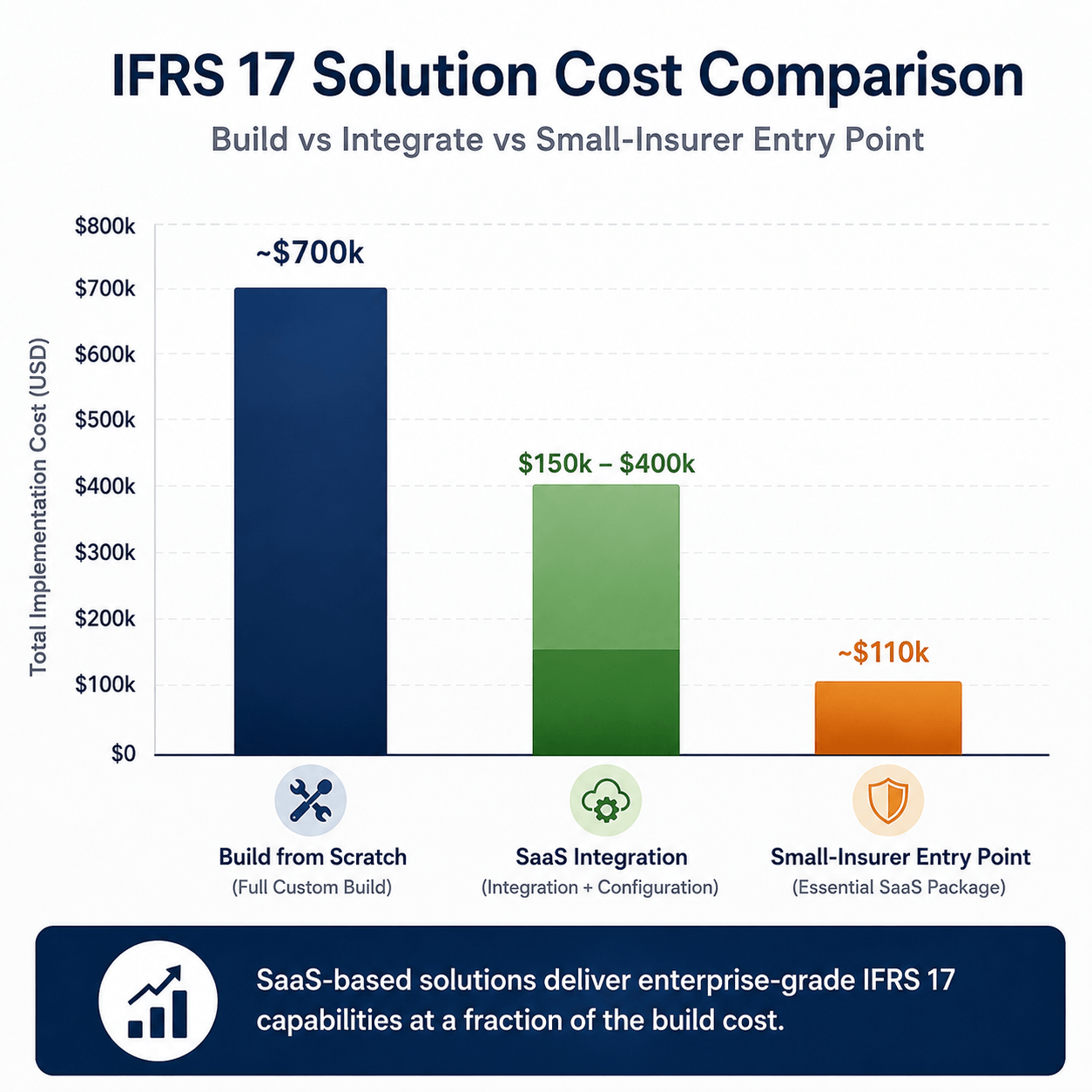
For smaller insurers, Deloitte’s 2025/26 Africa Insurance Outlook puts average IFRS 17 implementation cost at around US$110,000 for systems, software, and training. That’s the low end. Mid-size insurers with messier portfolios often land in the USD 150,000 to 400,000 range for a full SaaS integration, still well under the roughly $700,000 ceiling of building from scratch.
Time is the other cost. Pre-built ifrs17 solution vendors have squeezed what used to be a 12-month build into a 3 to 5 month onboarding. When the next reporting deadline is fixed, that gap decides whether you make it.
EY’s panel of 50 insurers reporting year-end 2024 under IFRS 17 shows how far this has already gone. This is the operating reality now, not a future project.
KPMG’s Real-time IFRS 17 review of 55 insurers’ 2025 statements found firms refining risk adjustment techniques as they mature. Refinement needs software you can actually adjust, not a sheet you’re scared to touch.
I’ll admit a limit here. I don’t have clean public data on how many GCC non-life insurers still run reserving fully in Excel. From the RFPs we see, it’s more than the market likes to admit.
Reserving Software Comparison: What Actually Matters for Insurers
Most reserving software comparison for insurers gets stuck on feature checklists. Wrong lens. Here’s what separates a tool that survives an audit from one that just prints reports.
- Triangle construction from source data. If you still export, reshape, and paste, the software isn’t doing the hard part. It should build triangles from reconciled claims directly.
- Stochastic output, not just a point estimate. The risk adjustment under IFRS 17 needs a distribution. A tool that only gives you a best-estimate number leaves you finishing the job by hand.
- Version control and full audit trail. Every reserve movement traceable to who changed what, when, and why. This is the single feature auditors care about most.
- Direct feed into the IFRS 17 sub-ledger. Reserving that produces a number finance then re-keys is half a solution.
- Actuary in the loop at sign-off. Automation should govern the workflow, not replace judgment. The best platforms keep a human review gate before anything is signed.
Notice what’s not on that list. Dashboards. They’re useful, but a pretty dashboard on top of weak triangle logic is lipstick. Judge the engine first.
This is where enterprise non life tools separate from lightweight ones. Software IFRS 17 built for a single line falls over when you throw ten at it. The enterprise non life tools worth shortlisting handle cohort grouping, multi-line triangles, and disclosure output as one flow.
For non-life specifically, the enterprise tools that handle this well tie reserving to the wider close. Our breakdown of an IFRS 17 general insurance solution walks through where close automation actually removes manual steps for P&C teams.
One Thing IFRS 17 Changed That Trips People Up
You might think reserving cohorts under IFRS 17 work the same as before. They don’t.
The standard says contracts in a group can’t be issued more than a year apart. For P&C insurers, that pushes you toward policy-year cohorts instead of the accident-year approach many teams grew up on. Different data cut, different triangle logic. A reserving tool that doesn’t support cohort-level grouping will fight you every close.
IFRS Tech
Want to see how Delta builds your triangles and IBNR distribution? Book a free product demo.
No obligation · Live walkthrough · GCC, Europe & APAC
Reserving Automation and the Non-Life Close Cycle
So where does reserving automation actually save time? Not where most people guess.
The saving isn’t in running the model. A good actuary runs a chain ladder fast either way. The saving is in everything around it: pulling clean data, keeping method consistent across lines, producing disclosure-ready output, and explaining movements to finance without a week of back-and-forth.
That’s the whole game. The model was never the bottleneck. The plumbing was, and software IFRS 17 fixes the plumbing.
Delta IFRS 17 was built to manage IBNR reserves alongside the cashflow and CSM machinery, so the reserving output doesn’t sit in an island. If you want the deeper vendor view, our guide to actuarial SaaS providers for IBNR compliance lays out what to probe in a demo.
One proof point from the field. Teams that move off spreadsheets into a governed reserving engine routinely cut close cycles sharply, and the reason is boring: nobody’s hunting for the right version of the triangle anymore. Want the shortlist logic? See how we frame IFRS 17 vendors for scalable compliance.
What You Now Know
- Manual claims triangles carry hidden reserve error, and IFRS 17 disclosure now exposes it every quarter.
- A real ifrs17 solution builds triangles from source data, produces a stochastic IBNR distribution, and keeps version control the auditor can follow.
- The win from reserving automation is in the plumbing around the model, clean data in and disclosure-ready output, not the model run itself.
Choosing Software IFRS 17 That Holds Up
Software IFRS 17 isn’t a report generator. It’s the reserving backbone that decides whether your close is clean or chaotic. If your triangles live in Excel and your actuarial and finance teams argue over versions, you already know where next quarter’s pain comes from.
The insurers who fix this don’t wait for a restatement to force the move. They pick a reserving software comparison lens built on triangle construction, stochastic IBNR, and audit trail, then they pressure-test it on their own data before signing.
So do that. Put your messiest line of business in front of a Delta demo and watch it build the triangle live. If it can’t handle your worst data, it won’t survive your close.
Free Product Demo
See Delta build your reserving triangle live, on your own data.
IFRS Tech’s advisors walk you through Delta IFRS 17 reserving, IBNR, and disclosure output. First demo is always free, no pitch, just the product.
FAQ
What is software IFRS 17 for reserving?
Software IFRS 17 is a platform that builds claims triangles, applies triangle methods, and produces IBNR estimates that feed straight into IFRS 17 disclosures. It replaces manual spreadsheet reserving with a governed engine that keeps version control and a full audit trail across every reporting cycle.
How is an ifrs17 solution different from Excel reserving?
An ifrs17 solution builds triangles from reconciled source data, generates a stochastic IBNR distribution for the risk adjustment, and tracks every reserve movement. Excel gives you a point estimate with no memory and no audit trail, which is where hidden reserve error and restatement risk creep in.
What does IFRS 17 reserving software cost?
Small non-life insurers often start near US$110,000 for systems, software, and training. Mid-size firms with complex portfolios typically land in the USD 150,000 to 400,000 range for a full SaaS integration, still below the roughly $700,000 ceiling of building an in-house engine from scratch.
Does reserving automation replace the actuary?
No. Reserving automation governs the workflow and removes manual data and version handling, but the best platforms keep the actuary in the loop at sign-off. Judgment on method and assumptions stays human. The software handles the plumbing so the actuary focuses on the number.
Which insurers need enterprise non-life tools most?
Non-life and medical insurers with multiple lines and fast-moving claim inflation gain the most from enterprise non-life tools. When claim patterns shift within a quarter, reserving automation flags the anomaly before it distorts IBNR, which manual triangles routinely catch too late.