Cloud vs On-Premise IFRS 16 Compliance Software Tools
Finance and lease accounting teams evaluating deployment options for IFRS 16 compliance software tools, within a 3-to-6-month decision window before year-end reporting.
✓ Written by IFRS Tech’s advisory team · ✓ Serving GCC, Europe & APAC · ✓ Actuaries + CPAs + CFAs
TL;DR
Choosing the wrong deployment model for your IFRS 16 compliance software tools doesn’t just create headaches. It compounds every quarter. This article covers the real cost differences between cloud and on-premise approaches, security comparisons for IFRS 9 compliance tools, and integration realities that most vendors won’t tell you upfront. You’ll also see where tools supporting IFRS 9 compliance fall short when standards shift. Read this before you sign anything.
The Decision That Actually Costs Finance Teams Money
Most finance teams get this backwards. They spend weeks comparing feature lists and pricing tiers. They skip the question that matters: what happens when the standard changes and your software doesn’t?
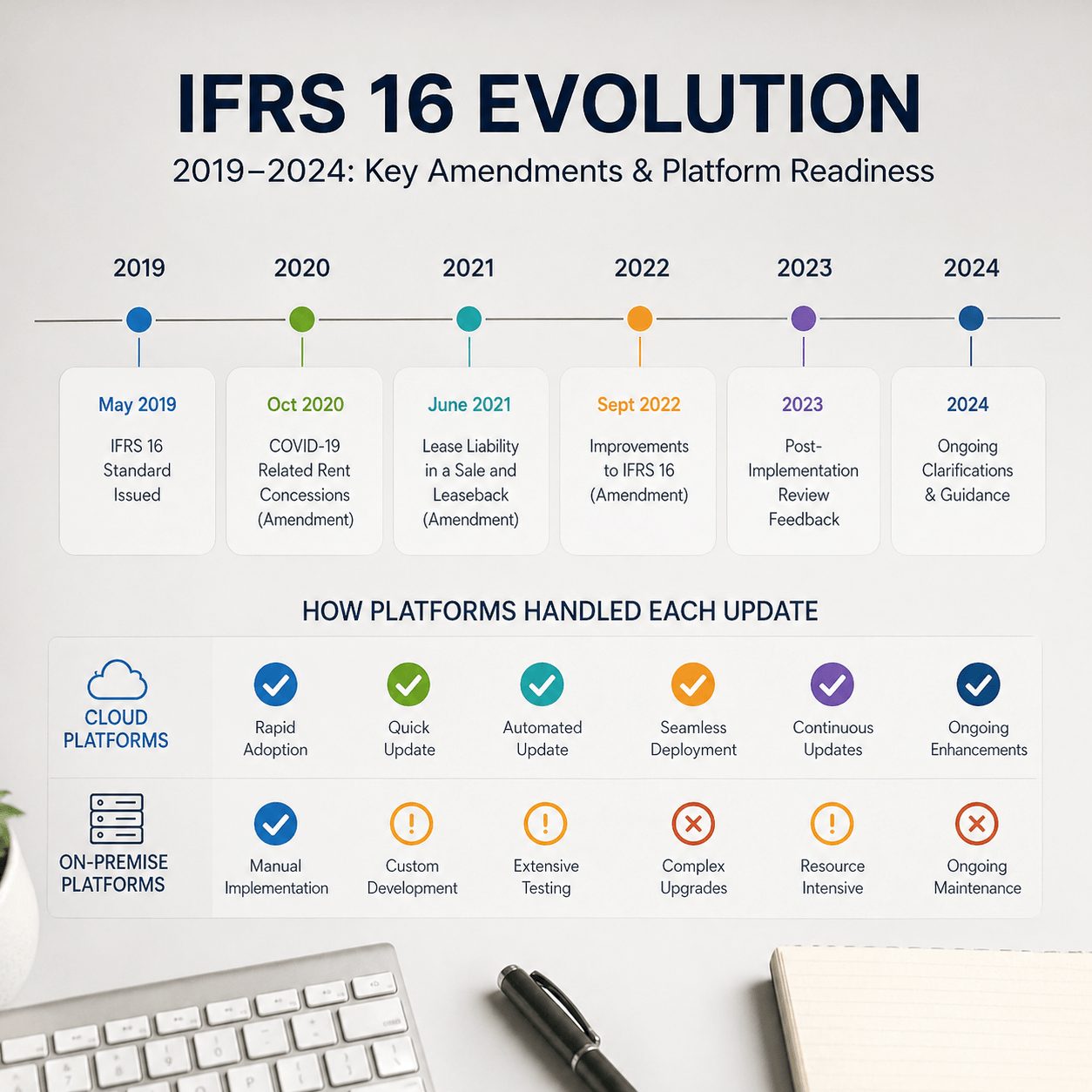
IFRS 16 took effect in 2019. It was complex. It was disruptive. And in 2024, the IASB confirmed an ongoing post-implementation review signaling further changes ahead. If your compliance platform requires six months of IT lead time to absorb an update, that’s not a technical problem. That’s a business risk sitting quietly in your balance sheet.
This is a consideration-stage decision. You’re not asking “what is IFRS 16.” You’re asking “which deployment model actually fits how we operate.” The answer depends on your lease volume, your IT capacity, your data governance requirements, and your tolerance for vendor dependency. None of that is one-size-fits-all.
What this article covers:
- Real security and flexibility comparisons between cloud and on-premise IFRS compliance tools
- The hidden cost components that make on-premise more expensive than the quote suggests
- Integration realities for teams using IFRS 9 compliance services alongside IFRS 16 tools
Before going further: how many leases does your organization manage? Under 200? Cloud is almost certainly right for you. Between 200 and 2,000? You’re in the zone where both models are viable and the details matter. Above 2,000, especially with complex lease modifications or multi-jurisdictional reporting? That’s where on-premise or hybrid options deserve a hard look. Keep that number in mind as you read.
What Drives the Cloud vs On-Premise Choice for IFRS 16 Compliance Software Tools?
There’s no universally correct answer here, and any vendor who tells you otherwise is selling something.
That said, the data tilts toward cloud for most mid-market organizations. KPMG’s 2024 Technology in Finance survey found that 71% of finance teams using cloud-based tools reported faster compliance reporting cycles. That’s not a marginal edge. That’s the difference between a smooth year-end close and a crisis.
But speed isn’t the only variable. Your IT team’s capacity, your data residency requirements, and how deeply your lease data connects to other systems all affect which model actually works in practice.
Cloud IFRS 16 Compliance Software: What It Actually Gives You
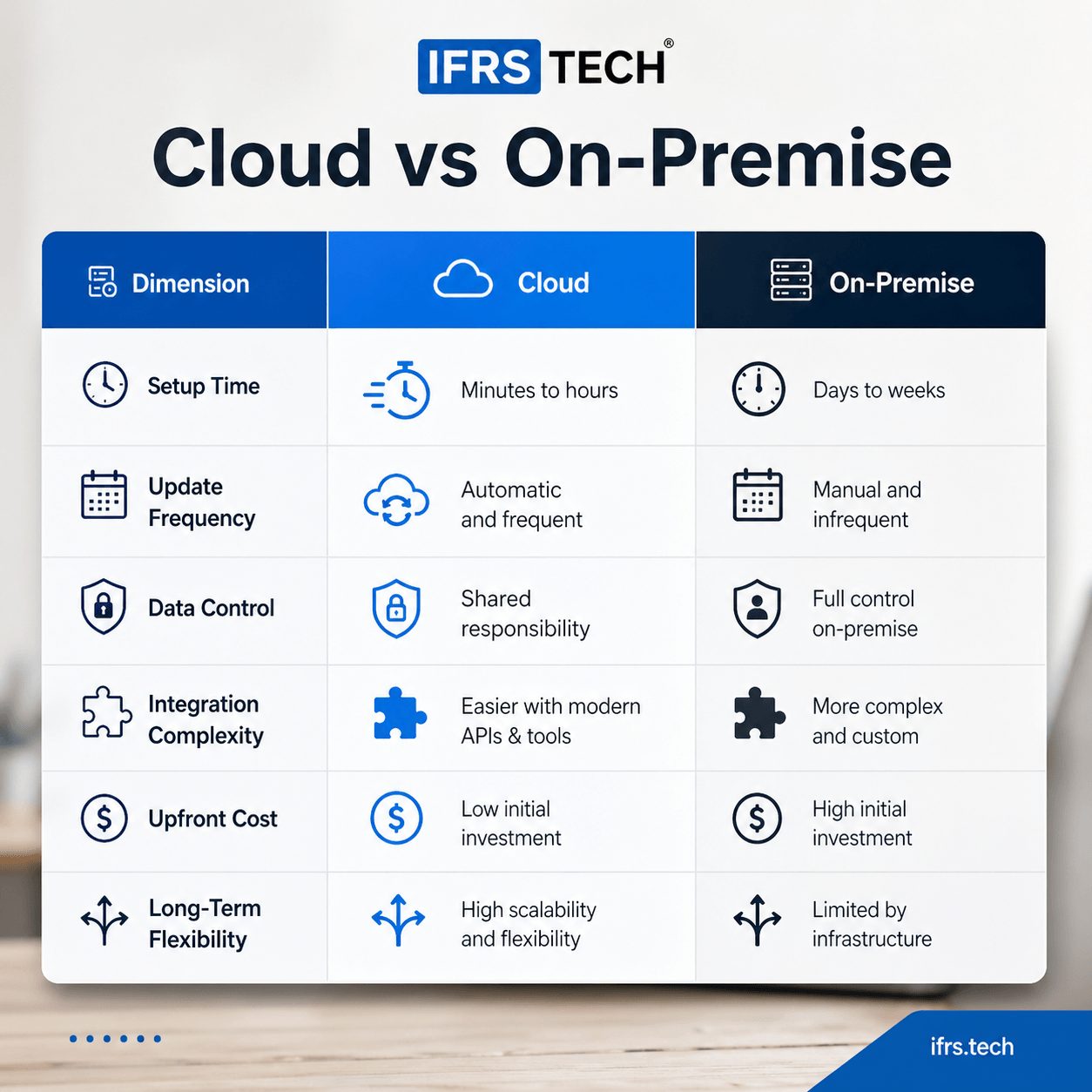
The core value proposition is simple: cloud platforms take the infrastructure problem off your desk. Updates, patches, IFRS standard changes: the vendor handles them. You don’t need a project plan every time the IASB revises a disclosure requirement.
For teams managing IFRS 16 lease accounting software providers, cloud deployment also means faster onboarding. You’re typically live in weeks, not quarters. That matters when you’re facing a hard reporting deadline.
The flexibility is genuine, too. Multi-currency, multi-entity, and multi-jurisdiction configurations that would require months of custom development on-premise are usually available as configuration options in cloud platforms. For organizations operating across GCC, Europe, and APAC simultaneously, that’s not a minor convenience.
And the honest admission: I don’t have long-term comparative data on cloud platform uptime for IFRS 16-specific tools specifically. Vendor SLAs typically promise 99.9%, but real-world performance during peak reporting periods, Q4 close and audit prep specifically, is harder to verify independently. Ask for it during procurement.
On-Premise IFRS 16 Tools: Control That Comes at a Price
On-premise exists for a reason. Some organizations genuinely need it. Banks under strict local data sovereignty rules in certain GCC markets can’t always push lease data to third-party cloud infrastructure. Large conglomerates with 5,000+ leases, custom workflow requirements, and deep ERP integration may find that a dedicated on-premise deployment performs better under load than a shared SaaS environment.
But let’s be direct: most organizations choosing on-premise do so out of habit, not necessity.
According to Deloitte’s 2024 CFO Survey, 67% of finance leaders cited regulatory compliance as their top technology investment driver. That same survey noted a strong pivot toward cloud-based compliance tooling. The direction of travel is clear. On-premise is increasingly a specialized choice, not a default.
Security Comparisons for IFRS 9 Compliance Tools: Who Really Wins?
This is the section where on-premise advocates usually feel vindicated. And they’re partially right.
On-premise means your data never leaves your network. For organizations managing IFRS 9 compliance tools alongside IFRS 16, where financial instrument data and lease data intersect, keeping everything behind your own firewall has genuine appeal. You control access. You control audit trails. You control the recovery plan.
But here’s what that narrative misses.
Where Cloud Platforms Get Security Right
Major cloud providers, Microsoft Azure, AWS, and Google Cloud, operate security infrastructure that most organizations couldn’t replicate internally at any reasonable budget. IBM’s 2024 Cost of a Data Breach Report put the global average breach cost at $4.88 million. The organizations hit hardest weren’t using cloud platforms. They were running legacy on-premise systems with under-resourced security teams.
Cloud vendors invest in certifications that matter for finance teams: ISO 27001, SOC 2 Type II, and in some cases FedRAMP or equivalent regional equivalents for GCC deployments. Replicating that compliance posture on-premise requires dedicated security staff, continuous audits, and ongoing investment. Most finance departments don’t have that.
Where On-Premise Still Has an Edge
Sovereign data requirements are real. Several GCC regulators require that financial data remain in-country. Some European entities under GDPR have specific restrictions on data transfers that make certain cloud deployments legally complicated. If you’re operating in markets with those constraints, on-premise or a regionally-hosted private cloud isn’t a preference. It’s a requirement.
For a deeper look at how deployment choice intersects with compliance risk, the IFRS 16 compliance software risk guide covers the regulatory exposure points in more detail.
The honest answer on security: cloud wins for most organizations on both cost and capability. On-premise wins in specific regulated contexts. Know which context you’re in before choosing.
Not sure which deployment model fits your organization? IFRS Tech’s advisory team has built a 12-point readiness checklist that covers data sovereignty, lease volume thresholds, ERP compatibility, and total cost inputs. It takes five minutes to work through and saves months of back-and-forth with vendors.→ Access the checklist via ROU 360 IFRS 16 Lease Accounting Software
How Flexible Are Tools Supporting IFRS 9 Compliance When Standards Change?
This is the question most evaluation teams forget to ask.
They compare current features. They don’t ask what happens in 18 months when the IASB publishes an amendment, or when their portfolio crosses a threshold that triggers new disclosure requirements. Flexibility in IFRS 16 compliance options isn’t a marketing claim. It’s a specific technical characteristic. And it varies enormously between platforms.
Real Flexibility vs. Marketed Flexibility
Cloud platforms typically push updates automatically. When IFRS 16 disclosure requirements shift, and the post-implementation review underway in 2024 suggests they will, a cloud-based platform can absorb those changes without a major implementation project. That’s genuine flexibility.
But not all cloud platforms are built the same. Some are SaaS in name only: heavily customized deployments that technically run on hosted infrastructure but require the same update cycle as on-premise software. Ask the vendor directly: when IFRS 16 was amended in 2020 for COVID-19 rent concessions, how quickly was the update available and what did clients need to do to apply it? That answer tells you everything.
On-premise tools supporting IFRS 9 compliance face the same challenge. A customized on-premise deployment may handle your current requirements perfectly. But adding new asset classes, new jurisdictions, or new reporting formats typically means a development cycle. Budget for it.
For organizations evaluating IFRS 16 software options, lease classification logic is one area where flexibility matters most, especially for variable payment structures and short-term lease elections that differ by jurisdiction.
Cost Comparisons in IFRS 16 Compliance Implementations: The Numbers You Don’t See Upfront
Every on-premise quote looks cheaper than cloud on day one. It rarely stays that way.
Cloud Total Cost of Ownership
Cloud pricing is predictable: typically a per-user or per-lease subscription. You know your annual cost. You can model it. Implementation costs are lower because there’s no infrastructure to build. You’re usually live faster, which means your team spends less time on parallel running of old and new systems.
The risk: pricing can increase at renewal. Lock-in is real. Moving off a SaaS platform after three years of data accumulation is painful. Model your exit costs before you sign. Vendors won’t offer this information proactively.
On-Premise Total Cost of Ownership
On-premise has a higher upfront cost: licensing, infrastructure, implementation, and configuration. But the number that gets underestimated most often is ongoing maintenance. Servers age. Security patches require IT resources. When IFRS standards update, someone has to manage that update cycle internally.
PwC’s 2024 Global Risk Survey found 52% of organizations reported compliance risk as their primary concern, up from 44% in 2022. Outdated on-premise IFRS tools are a direct contributor to that risk. If your platform is running a version two amendments behind current IFRS, that’s not just a technical debt. It’s an audit exposure.
One specific number worth knowing: EY’s 2024 Global Financial Reporting Survey found 58% of companies managing 500+ leases required custom workflows that standard SaaS platforms couldn’t deliver without modification. If you’re in that 58%, on-premise or a heavily configured cloud deployment may genuinely be your only option. If you’re not, it probably isn’t.
For organizations assessing platform economics, the IFRS 16 reporting platform review covers vendor-specific pricing structures in more detail.
IFRS Tech works with finance teams across GCC, Europe, and APAC managing lease portfolios ranging from 50 to 15,000+ leases. The pattern is consistent: organizations under 500 leases that chose on-premise in 2020 have spent significantly more on maintenance and updates than their cloud-deployed peers. Above 500 leases with complex structures, the picture is more mixed. Deployment model choice at that scale genuinely depends on integration architecture, not just cost.
Build vs Buy for IFRS 16 Software: Why Most Teams Choose Wrong
You might think the build vs buy question is separate from cloud vs on-premise. It isn’t.
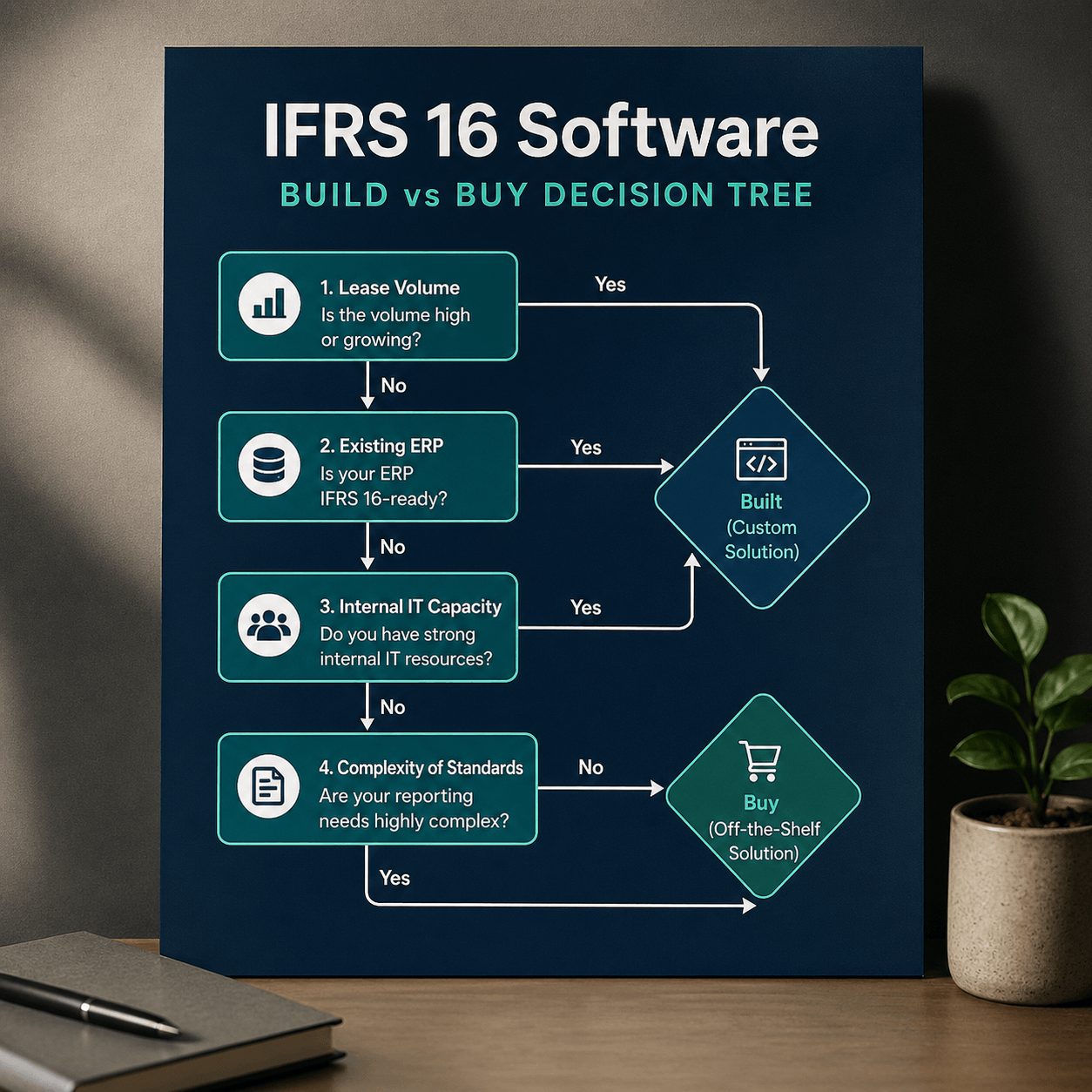
Building a custom IFRS 16 compliance tool in-house, hosted on your own infrastructure, is a form of on-premise deployment. And it’s almost always a mistake for compliance software specifically. Here’s why: IFRS standards change. When they do, your internally built tool needs internal developers to update it. Those developers are typically not IFRS specialists. You end up with an accounting standards problem being solved by a software engineering team, and those conversations go badly.
Buy wins here. Full stop.
The only exception: organizations with existing, mature treasury or ERP platforms that have strong IFRS 16 modules built in, with a vendor-managed update track. SAP, Oracle, and a handful of others offer this. If you’re already on that infrastructure, extending it may be more sensible than adding a separate point solution. But “build from scratch” is rarely the right call for compliance tooling in 2025.
Integration Options for IFRS 9 Compliance Services: The Deciding Factor Nobody Talks About
Ask any CFO or controller who has gone through an IFRS 16 implementation what caused the most pain. Most won’t say “feature gaps.” They’ll say “getting the data to flow correctly.”
Integration is where cloud vs on-premise decisions get complicated. Cloud IFRS 16 tools typically offer pre-built connectors for major ERP platforms: SAP S/4HANA, Oracle Fusion, and Microsoft Dynamics. But “pre-built connector” doesn’t mean “plug and play.” It means the connector exists and will require configuration to match your data model. Budget for it.
On-premise tools offer deeper ERP integration in theory. In practice, that depth requires your IT team to build and maintain the integration layer. When the ERP upgrades, the integration may break. When the IFRS tool updates, same risk.
For organizations running both IFRS 16 and IFRS 9 compliance tools, which is common in banks and financial institutions across GCC, the integration question doubles. Lease data from IFRS 16 feeds into IFRS 9 financial instrument disclosures in specific ways. If those two platforms don’t share a consistent data architecture, you’re reconciling manually at year-end. That’s where errors happen and where auditors ask questions.
Integration options for IFRS 9 compliance services aren’t just a technical consideration. They’re a financial reporting integrity question. Get your IT architect and your external auditor in the same room before you finalize the deployment model. That conversation usually changes the outcome.
How to Choose IFRS Compliance Services That Won’t Fail You at Year-End
Here’s the thing: most vendor evaluations focus on what a platform does today. The better question is what it does when things go wrong.
Five Questions to Ask Before You Commit
- When was the last time you updated your IFRS 16 calculation engine, and what triggered it? If the answer is vague, that’s a red flag.
- What’s your SLA for compliance-critical updates when IASB publishes amendments? “As soon as possible” isn’t an SLA.
- Can you show me a client with a lease portfolio similar to mine and walk me through how they handled a mid-year lease modification? Named references, not anonymous case studies.
- What does offboarding look like? How do I extract my data if I leave? Vendors who resist this question are telling you something important.
- How do your IFRS 16 and IFRS 9 modules share data? If they don’t have a clean answer, you’re looking at manual reconciliation in your future.
And beyond the vendor conversation: make sure your internal team has clarity on who owns the compliance platform. In most organizations, it sits between finance and IT with neither owning it fully. That ambiguity is where implementation projects stall and where year-end problems start.
IFRS Tech’s advisory team works specifically on the finance-technology intersection for IFRS compliance. If you want a second opinion before committing to a deployment model, that’s exactly what the ROU 360 IFRS 16 Lease Accounting Software advisory process is built for.
What You Now Know
- Cloud wins on speed, automatic updates, and total cost for most organizations managing under 2,000 leases. But “cloud” covers a wide range of actual deployment quality, so interrogate the update history before signing.
- On-premise makes sense for organizations with strict data sovereignty requirements, complex custom workflows, or 5,000-plus leases with deep ERP dependencies. Not as a default, and not out of IT preference.
- Integration architecture between IFRS 16 and IFRS 9 compliance tools is the most underweighted factor in deployment decisions. Get that question answered early, or pay for it at year-end.
The Right Model Is the One You’ll Actually Maintain
Cloud or on-premise: the IFRS 16 compliance software tools debate doesn’t have a universal answer. But it does have a universal failure mode: choosing based on upfront cost alone, without modeling the update cycle, the integration overhead, or the year-end support requirements. Organizations that make that mistake don’t fail immediately. They fail two years in, when the first major amendment hits and the platform can’t absorb it cleanly.
The finance teams that get this right ask harder questions earlier. They talk to their auditors before selecting a platform, not after. They model exit costs alongside entry costs. And they treat the deployment decision as a five-year commitment, not a one-year spend.
If you’re still in the evaluation phase, use the questions in this article as your shortlist. If you’re past that and already running a platform that isn’t keeping pace with standard changes, that’s worth addressing before the next reporting cycle.
See how IFRS Tech’s lease accounting team handles deployment selection for complex portfolios →
IFRS Tech’s ROU 360 platform is built for organizations that need IFRS 16 compliance tooling to keep pace with standard changes, without a six-month IT project every time the IASB publishes an amendment. Available in cloud and hosted configurations, with pre-built connectors for SAP, Oracle, and Dynamics.