TL;DR
Deciding between build vs buy IFRS 9 software TCO requires looking beyond initial costs to maintenance, staffing, and regulatory adaptation expenses over five years. Building custom IFRS 9 technology solutions costs $150,000 to $300,000 upfront but generates $430,000 to $650,000 in total cost of ownership through technical debt, personnel turnover, and ongoing regulatory updates. Vendor solutions complete implementation in 3 to 6 months versus 6 to 18 months for custom builds, reducing time-to-compliance while distributing IFRS 9 implementation costs predictably across subscription models. Hidden expenses in build scenarios include model validation, audit documentation, and knowledge gaps when developers leave. Most mid-market banks find vendor platforms deliver superior TCO when accounting for integrating IFRS 9 software with core banking systems, impairment testing automation, and credit risk management capabilities that custom builds struggle to match without sustained actuarial investment. Read on to compare direct costs, implementation timelines, and risk trade-offs that shape your decision.
Expected credit loss calculations under IFRS 9 demand precision, transparency, and speed that most banks struggle to achieve with legacy tools. Financial institutions face a critical choice between building custom enterprise IFRS 9 ECL software selection internally or purchasing vendor solutions. This decision shapes compliance costs, operational efficiency, and regulatory readiness for years ahead. The total cost of ownership extends far beyond initial price tags to include maintenance, integration, staffing, and hidden risks that surface only after implementation. Banks evaluating IFRS 9 software evaluation criteria need clarity on what drives long-term value versus short-term savings.
Build vs Buy IFRS 9 Software TCO: What Drives Total Cost
Total cost of ownership for IFRS 9 compliance spans initial development or licensing fees, ongoing maintenance, integration expenses, staffing requirements, and regulatory adaptation costs.
Banks often underestimate the cumulative burden of maintaining custom systems or overlook hidden vendor dependencies in purchased solutions.
TCO analysis must account for both quantifiable expenses like developer salaries and licensing fees, plus harder-to-measure costs such as opportunity cost, technical debt, and compliance risk exposure.
The build approach demands sustained investment in specialized talent who understand both IFRS 9 requirements and software architecture.
Development teams need actuarial knowledge to model PD LGD modeling and EAD calculations accurately while maintaining systems that evolve with regulatory guidance.
That said, vendor solutions shift certain costs to subscription models but introduce dependencies on external roadmaps and support availability. Neither path eliminates expense, rather each redistributes where and when costs appear across the implementation lifecycle.
What Is IFRS 9 ECL Software and Why Banks Need It
IFRS 9 introduced forward-looking expected credit loss provisioning that replaced the incurred loss model under IAS 39. Banks must now calculate provisions based on probability of default, loss given default, and exposure at default across three stages of credit deterioration.
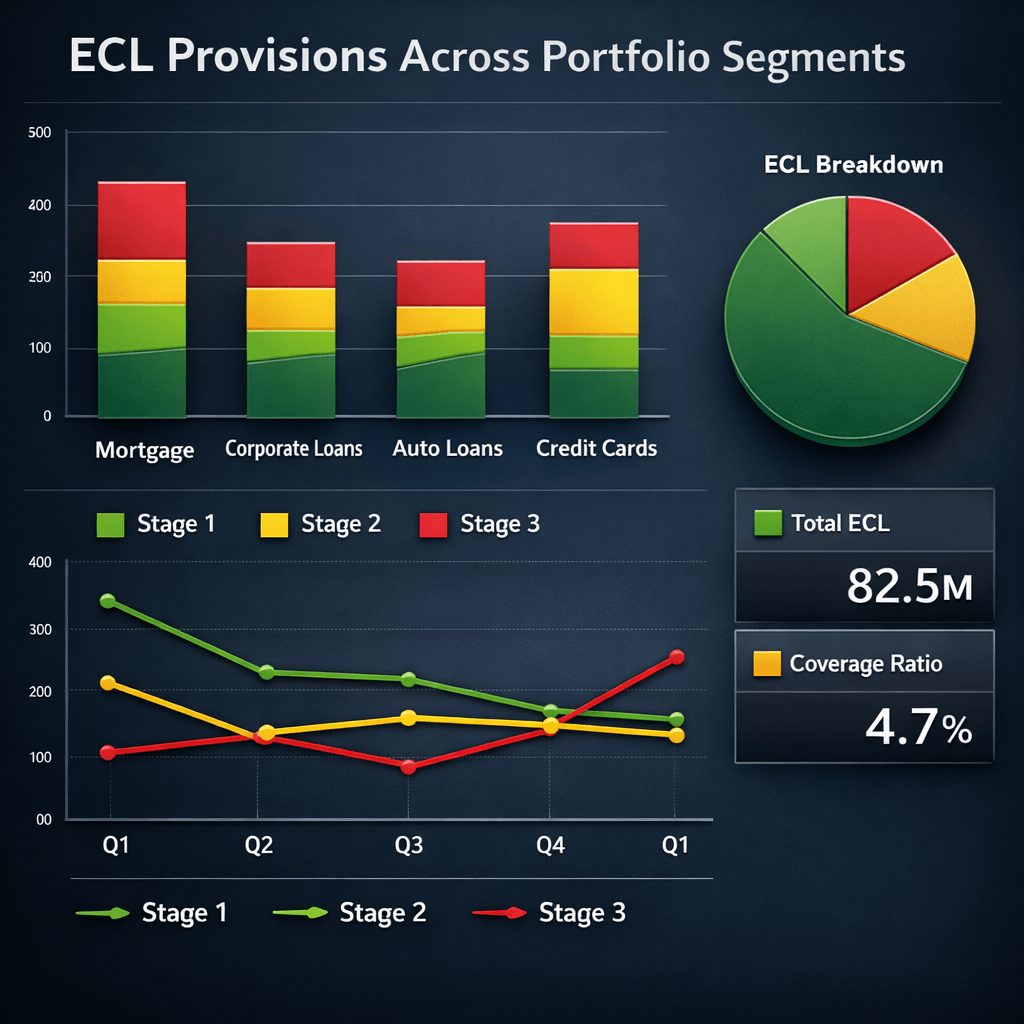
Stage 1 exposures require 12-month ECL while Stage 2 and Stage 3 demand lifetime expected losses, creating calculation complexity that manual methods cannot handle at scale.
Expected credit loss software automates the staging classification, applies forward-looking scenarios, generates discounted cash flow calculations, and produces audit-ready documentation.
These systems integrate exposure data from core banking platforms, apply probability models to thousands or millions of facilities, and reconcile results back to general ledgers without manual intervention.
Financial institutions need these capabilities to meet regulatory reporting deadlines while maintaining transparency that auditors and regulators demand from ECL methodologies.
Cost to Build IFRS 9 Software In-House
Building custom IFRS 9 impairment software for banks typically requires 6 to 18 months of concentrated development effort depending on portfolio complexity and internal capabilities.
A mid-sized regional bank needs a core team of at least three senior developers, one data engineer, one actuarial specialist, and one project manager dedicated full-time to initial build phases.
At average market rates, this team costs between $150,000 and $300,000 in direct salary expenses before considering benefits, infrastructure, or management overhead.
Initial development represents only the starting point for build costs. The system requires ongoing maintenance to address bugs, adapt to regulatory updates, handle data model changes, and scale as loan portfolios grow.
Most banks allocate 15 to 20 percent of initial development costs annually for maintenance, meaning a $250,000 initial build generates $37,500 to $50,000 in recurring costs each year.
These figures exclude opportunity costs when development teams focus on compliance infrastructure instead of revenue-generating projects or strategic initiatives.
Development Time and Internal Resource Costs
Development timelines stretch when teams encounter unanticipated complexity in staging logic, scenario modeling, or attribution calculations.
Banks frequently underestimate the effort required to handle edge cases like purchased credit-impaired assets, contagion staging across related exposures, or cooling-off periods after credit quality improvements.
Each additional requirement extends timelines and multiplies resource consumption beyond initial estimates.
Internal resources face ongoing demands beyond pure development work. Teams must document methodologies for auditors, validate models against historical performance, respond to regulatory inquiries, and train finance users on system operation.
These activities consume developer time that organizations often fail to budget, creating hidden costs that compound over multi-year periods.
Model Validation, Audit, and Governance Costs
Regulators expect banks to validate IFRS 9 models independently from development teams, requiring additional actuarial resources to backtest PD curves, verify LGD assumptions, and stress-test ECL outputs. Validation exercises occur at initial implementation and then periodically as portfolios evolve or economic conditions change materially. Banks building in-house must staff these validation functions internally or hire external consultants at premium rates.
Audit processes demand extensive documentation of calculation methodologies, parameter selection rationale, and model governance procedures.
Custom-built systems rarely generate this documentation automatically, forcing teams to manually prepare audit evidence each reporting period.
A regional bank with $8 billion in assets reduced its IFRS 9 month-end close process from 12 days to 4 days after implementing specialized ECL compliance software, eliminating two full-time equivalents of manual work and dropping audit findings related to ECL calculations from seven to zero.
This demonstrates how documentation burdens in custom systems translate directly to staffing costs and audit risk exposure.
Cost to Buy IFRS 9 Software From Vendors
Vendor IFRS 9 solution demonstration typically shows licensing models ranging from annual subscriptions to perpetual licenses with maintenance agreements.
Mid-market institutions pay between $50,000 and $200,000 annually depending on portfolio size, user count, and feature requirements.
Enterprise banks with complex multi-country operations face higher tiers, while smaller community banks access entry-level packages at reduced rates.
Implementation services add to initial costs as vendors configure systems to match bank-specific requirements, integrate with existing platforms, and train finance teams.
Standard implementations complete in 3 to 6 months compared to 6 to 12 months for custom builds, reducing time-to-compliance substantially.
Implementation of prebuilt IFRS 9 compliance software templates can be completed in 6 to 8 weeks compared to 6 to 12 months for legacy or heavily custom systems, supporting faster ROI and lower upfront development costs in a buy scenario.
Licensing, Support, and Upgrade Costs
Annual licensing fees represent predictable recurring costs that finance teams can budget reliably across multi-year planning horizons.
These fees typically include technical support, software updates, and regulatory enhancements as standards evolve. Vendors absorb development costs for new features and compliance changes, distributing these investments across their entire customer base rather than forcing individual banks to fund each enhancement.
Support agreements provide access to specialists who understand IFRS 9 requirements deeply and can troubleshoot calculation issues quickly.
Banks avoid maintaining internal expertise on software internals while still receiving answers to complex modeling questions.
On the flip side, some vendors charge separately for premium support tiers or limit included support hours, creating potential cost escalation if banks require extensive assistance during implementations or quarter-end closes.
Data Integration and Infrastructure Expenses
Connecting vendor solutions to core banking systems, data warehouses, and general ledgers requires integration work regardless of build or buy decisions.
That said, modern vendors offering API-native architectures reduce integration complexity substantially compared to legacy platforms requiring batch file exchanges.
Direct API connections eliminate manual data transfers, reduce error rates, and enable real-time synchronization between systems.
Infrastructure costs depend on deployment models, with cloud-hosted solutions shifting server expenses to vendors while on-premise installations require banks to provision hardware, storage, and backup systems.
Cloud deployments offer elastic scaling that accommodates portfolio growth without upfront capacity planning, while on-premise options give banks complete control over data residency and security configurations for institutions with strict regulatory requirements.
Build vs Buy IFRS 9 Software: Direct Cost Comparison
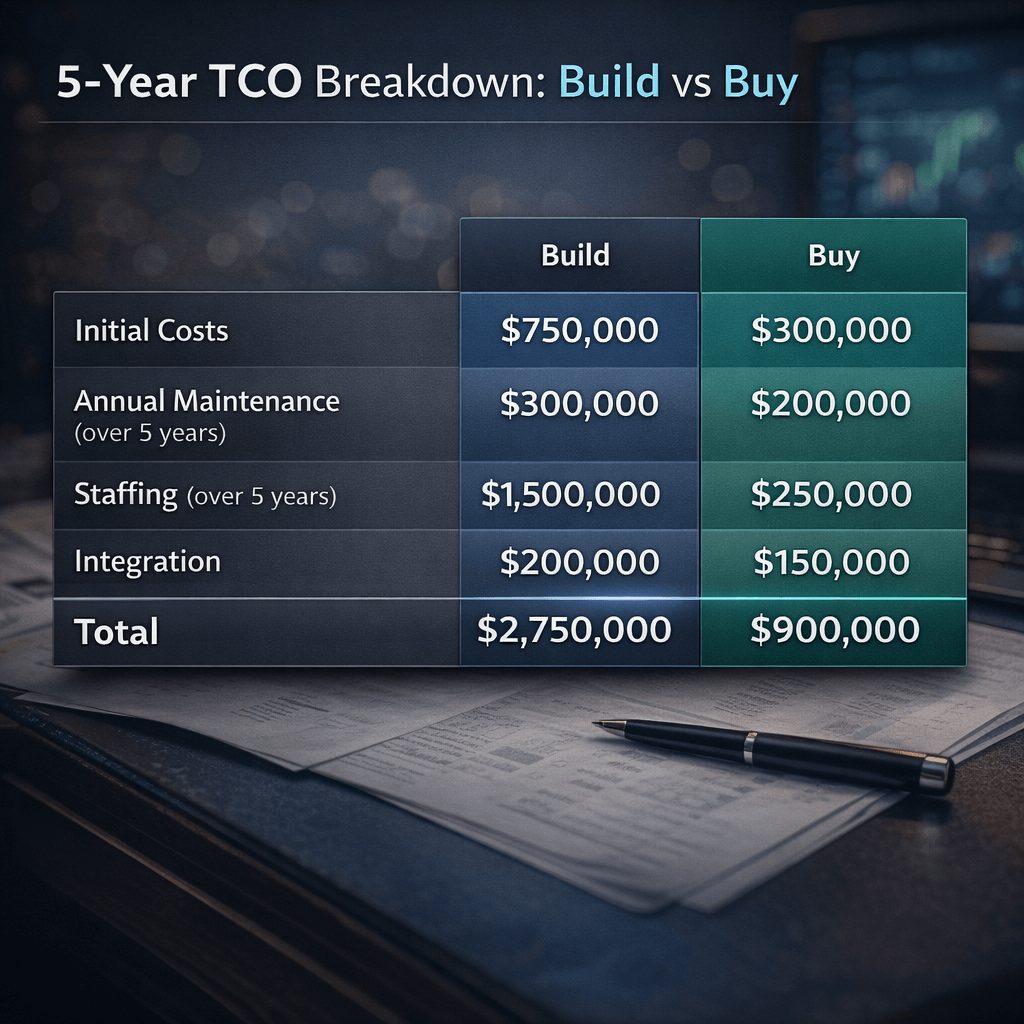
Direct cost comparison between build and buy scenarios reveals different expense profiles over typical five-year planning periods.
A $250,000 initial build investment plus 15 percent annual maintenance totals approximately $437,500 over five years before accounting for enhancement requests or major regulatory changes.
Vendor solutions at $100,000 annually total $500,000 over the same period including licensing, support, and standard upgrades.
These baseline figures shift significantly when banks account for staffing differences. The build scenario requires retaining specialized developers, actuaries, and data engineers with IFRS 9 expertise throughout the system’s operational life.
Losing key personnel creates knowledge gaps that force expensive rehiring or consultant engagements to maintain continuity.
Vendor solutions reduce this dependency since multiple customer-facing teams share institutional knowledge about system operation and best practices.
Banks using automated IFRS 9 ECL software can reduce month-end close times by 40 to 60 percent, with tasks previously taking 5 days reduced to 2 days, allowing teams to shift from data preparation to higher-value analysis and reducing manual errors and audit risks.
This efficiency gain translates to permanent headcount savings or capacity reallocation toward strategic projects that custom-built systems rarely achieve without sustained optimization investment.
Hidden and Ongoing Costs in IFRS 9 Software Decisions
Hidden costs emerge most prominently in the build scenario through technical debt accumulation. Development teams taking shortcuts to meet deadlines create code that becomes progressively harder to maintain, extend, or debug as systems mature.
Technical debt compounds like financial debt, requiring ever-larger investments to implement new features or fix emerging issues that could have been avoided with better initial architecture.
Regulatory change management creates another hidden cost stream. IFRS 9 continues evolving through implementation guidance, local regulatory interpretations, and industry practice developments.
Custom systems require dedicated development sprints to implement each change, while vendor solutions distribute these updates across customer bases as part of standard maintenance.
A single significant regulatory update can consume months of development time in custom systems.
Impact on PD, LGD, and ECL Model Accuracy
Model accuracy depends heavily on the sophistication of calculation engines and the flexibility to implement complex scenarios.
Custom systems offer theoretical flexibility to model any methodology precisely as banks envision, yet most development teams lack the deep actuarial expertise to implement advanced techniques correctly.
Small errors in PD curve construction, LGD recovery modeling, or discount rate application compound across thousands of facilities to create material provision misstatements.
Vendor solutions benefit from continuous refinement across hundreds of implementations where actuarial specialists identify and resolve edge cases that individual banks might miss.
Best IFRS 9 software features include pretested calculation methodologies that have been validated against diverse portfolio types and economic scenarios.
This collective intelligence reduces the risk of methodology errors that could trigger regulatory findings or financial restatements.
Bank Size, Portfolio Complexity, and TCO Impact
Smaller community banks with simple loan portfolios might justify Excel-based approaches or basic custom tools where calculation volumes remain manageable and regulatory scrutiny stays lighter.
As portfolios grow past several thousand facilities or introduce complexity through syndicated loans, multi-currency exposures, or sophisticated collateral arrangements, manual methods break down and custom tools require exponentially more development effort.
Mid-market banks typically find vendor solutions deliver the best balance between capability and cost, providing enterprise-grade functionality without enterprise-scale implementation burdens.
Regional institutions can deploy prebuilt IFRS 9 software vs Excel solutions that handle their complexity while avoiding the multi-year implementations that characterize large vendor suites.
1Large multinational banks face different economics where custom builds or heavily customized vendor platforms become justifiable given their unique requirements and available resources.
Common Mistakes in IFRS 9 Software Cost Analysis
Banks frequently underestimate ongoing costs when evaluating build scenarios, focusing primarily on initial development budgets while discounting maintenance, enhancement, and staffing expenses that persist indefinitely.
This optimism bias makes build options appear more attractive than realistic TCO analysis supports. Organizations fail to account for turnover risks when key developers leave and take institutional knowledge with them.
Another common error involves overestimating vendor lock-in risks while underestimating the lock-in that custom systems create.
Banks that build internally become locked into their own architecture, technical debt, and knowledge dependencies that can prove even harder to escape than commercial vendor relationships.
Modern vendors offering API integration and data export capabilities mitigate lock-in concerns substantially compared to legacy platforms.
Some institutions make vendor red flags IFRS 9 mistakes by selecting solutions based primarily on initial price rather than total functionality, implementation speed, and long-term support quality.
Choosing underpowered tools to save licensing fees creates expensive workarounds, manual processes, and eventual replacement costs that dwarf the initial savings. Proper evaluation of IFRS 9 software evaluation criteria balances cost against capability to find sustainable solutions.
Build vs Buy IFRS 9 Software: Risk and Control Trade-Offs
Control represents the primary advantage banks cite when choosing to build custom systems. Internal development theoretically allows organizations to implement exactly the features they want, change priorities instantly, and maintain complete sovereignty over their compliance infrastructure.
This control comes at the cost of total responsibility for functionality, performance, security, and regulatory adequacy without external validation or support.
Vendor solutions trade some control for reduced risk and accelerated capability delivery. Banks accept vendor roadmaps and feature priorities in exchange for proven functionality, continuous updates, and shared expertise from implementations across hundreds of institutions.
The best vendors offer configuration flexibility that meets most customization needs without full custom development, finding a middle ground between rigid standardization and expensive bespoke solutions.
Security and data privacy concerns factor prominently into control discussions. Banks handling sensitive customer information must ensure any solution meets regulatory requirements for data protection, encryption, and access controls.
Modern vendors offering on-premise deployment or private cloud hosting address these concerns while still delivering the benefits of packaged solutions. Organizations can maintain data sovereignty without building entire systems from scratch.
Scalability and Future Readiness of IFRS 9 Platforms
Scalability challenges manifest when portfolio growth or product expansion exceeds the capacity of existing IFRS 9 platforms. Custom-built systems often hard-code assumptions about portfolio size, calculation frequency, or data volumes that become constraints as banks grow.
Scaling custom systems requires refactoring code, optimizing databases, and sometimes complete rewrites that cost multiples of initial development investment.
Vendor platforms supporting hundreds of customers naturally invest in scalability since their business models depend on handling diverse portfolio sizes efficiently.
These systems incorporate optimization techniques, parallel processing capabilities, and database architectures proven across many implementations. Banks benefit from scalability investments that would be uneconomical for single-institution custom builds.
Future regulatory requirements remain uncertain, with potential changes to IFRS 9 staging criteria, scenario requirements, or disclosure formats emerging periodically.
Platforms designed for adaptability through configurable rule engines and flexible calculation frameworks adjust to new requirements more easily than hard-coded custom systems.
Organizations evaluating how to select IFRS 9 ECL software should assess architectural flexibility alongside current feature completeness.
Regulatory Change Management Under IFRS 9
Regulatory interpretation of IFRS 9 continues evolving as banks, auditors, and regulators gain implementation experience. Local banking authorities issue guidance that adds requirements beyond base IFRS standards, creating regional variations that software must accommodate.
In 2024, the average management overlay as a percentage of statistical ECL for Dutch banks decreased from 11 percent in 2023 to 8 percent, reflecting reduced need for manual adjustments due to improved macroeconomic conditions and portfolio health.
This trend underscores the value of robust software for minimizing ongoing manual interventions in ECL calculations.
Custom-built systems place full responsibility for tracking and implementing regulatory changes on internal teams. Organizations must monitor guidance from IASB, local regulators, industry groups, and audit firms to identify requirements affecting their implementations.
Each change requires development effort, testing, and validation before banks can certify compliance. This ongoing burden consumes resources perpetually without clear endpoint.
Vendor solutions include regulatory updates as part of standard maintenance, with specialist teams monitoring global guidance and implementing changes across customer bases systematically.
Banks receive tested updates rather than building interpretations independently, reducing both implementation effort and risk of non-compliant approaches.
Stage 2 coverage ratios for Dutch banks showed a sharp decrease in 2024 compared to prior years, driven by factors like lower manual overlays and healthier portfolios, continuing a trend since 2020. This highlights the potential TCO impact of tools that automate and stabilize staging and transfer processes.
How Long Does It Take to Build vs Buy IFRS 9 Software?
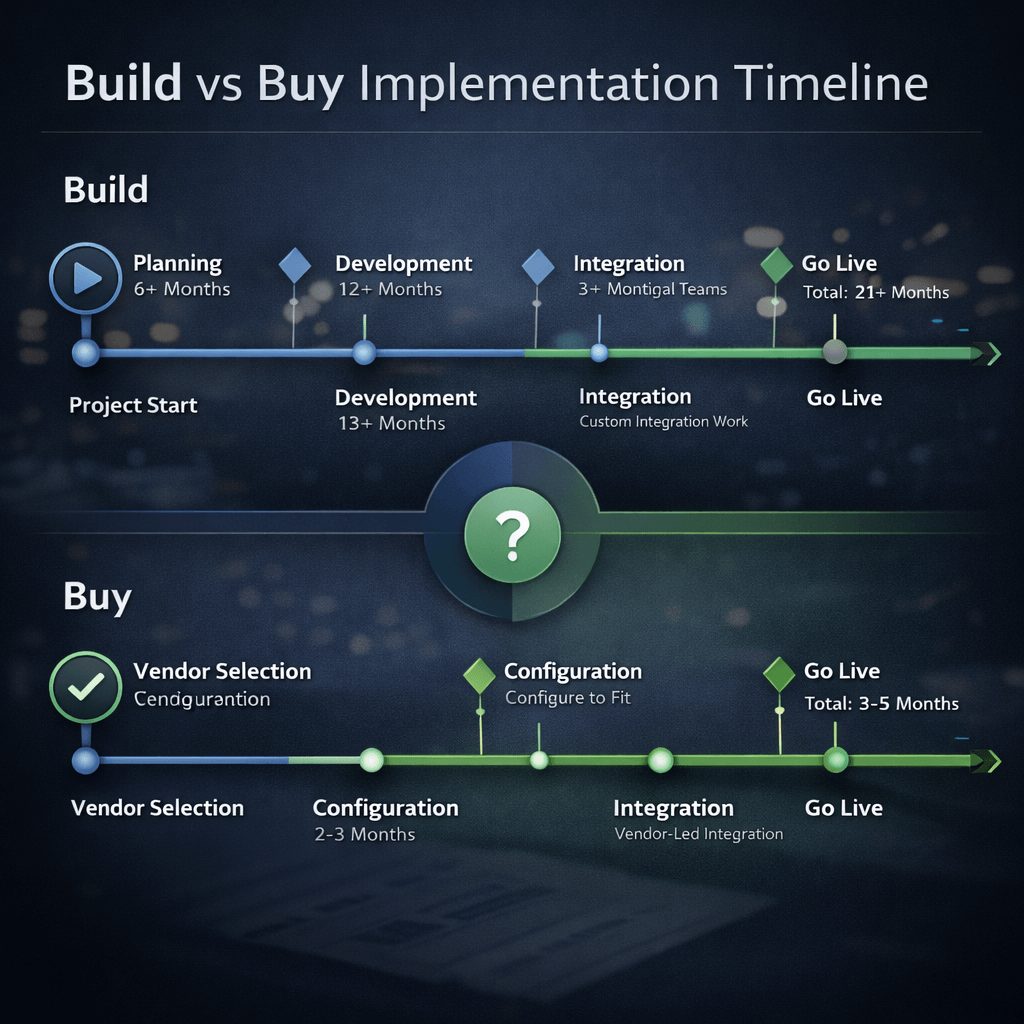
Build timelines typically span 6 to 18 months from project kickoff to production deployment, with simpler portfolios at the shorter end and complex multi-product institutions requiring extended periods.
These timelines assume dedicated teams working without major interruptions and encountering typical rather than exceptional technical challenges.
Delays commonly occur when teams discover unanticipated complexity in regulatory requirements or integration points.
Buy scenarios complete standard implementations in 3 to 6 months including configuration, integration, testing, and user training.
Accelerated implementations finish in 6 to 8 weeks when banks accept prebuilt templates with minimal customization.
This speed advantage allows institutions to achieve compliance faster, reduce project risk, and deploy resources to other priorities sooner than build scenarios permit.
Can Vendor IFRS 9 Software Adapt to Regulatory Changes?
Modern vendor platforms incorporate regulatory adaptation as core architectural principles through configurable rule engines, flexible calculation frameworks, and modular feature designs.
When regulators introduce new staging criteria or disclosure requirements, vendors update configuration options and calculation logic without requiring customers to modify their implementations fundamentally.
These updates deploy through standard release cycles that minimize disruption to bank operations.
The quality of regulatory adaptation varies significantly across vendors based on their technical architecture and commitment to standards compliance.
Banks evaluating enterprise-grade IFRS 9 solution options should verify vendor track records for implementing regulatory changes promptly and accurately.
Reference calls with existing customers provide insight into how vendors handle compliance updates in practice versus marketing claims.
Organizations concerned about vendor responsiveness to regulatory changes can negotiate service level agreements specifying maximum timeframes for implementing guidance updates.
These contractual protections ensure vendors prioritize compliance changes appropriately and give banks recourse if vendors fail to deliver required functionality within acceptable windows.
Such agreements provide additional risk mitigation beyond standard licensing terms.
When a Hybrid IFRS 9 Software Model Makes Sense
Hybrid approaches combine vendor core platforms with custom extensions for unique requirements that standard products cannot address adequately.
Banks might purchase vendor solutions for standard ECL calculations, staging logic, and regulatory reporting while building custom integrations, specialized analytics, or region-specific compliance features internally.
This strategy captures vendor efficiency for common functionality while preserving flexibility for differentiating capabilities.
The hybrid model works best when clear interfaces exist between vendor and custom components, typically through well-documented APIs that support extensions without modifying core vendor code.
Banks should verify that vendor architectures support extensibility before committing to hybrid strategies. Poorly designed integration points create maintenance burdens and upgrade complications that undermine hybrid model benefits.
Hybrid implementations require governance to manage the boundary between vendor and custom components effectively.
Organizations must decide which features to request from vendors versus build internally, how to handle version upgrades when custom code depends on vendor internals, and who owns support responsibility when issues span both environments.
Without clear governance, hybrid models devolve into the worst aspects of both build and buy approaches.
Build vs Buy IFRS 9 Software: Decision Checklist for Banks
Financial institutions evaluating enterprise IFRS 9 ECL software selection should start by assessing their portfolio complexity, compliance timeline urgency, internal technical capabilities, and budget constraints.
Banks with simple portfolios, strong development teams, ample timelines, and limited budgets might justify build approaches.
Most institutions find their circumstances favor vendor solutions that deliver faster, lower-risk implementations with predictable costs.
The decision process should include detailed build vs buy IFRS 9 software TCO modeling across five-year periods that accounts for all cost categories including initial development or licensing, ongoing maintenance, staffing, integration, training, and regulatory adaptation.
Organizations often discover that initial cost differences between build and buy narrow substantially when hidden costs receive proper consideration.
Sensitivity analysis testing different assumption scenarios helps identify which cost factors drive outcomes most significantly.
Banks should evaluate their risk tolerance for compliance failures, calculation errors, or implementation delays when weighing build versus buy trade-offs.
Custom development carries higher execution risk given the specialized expertise required and lack of external validation.
Vendor solutions reduce these risks through proven implementations and continuous customer feedback, though they introduce dependency risks that deserve evaluation. The appropriate balance depends on each institution’s risk appetite and strategic priorities.
Regulatory reporting deadlines often drive decision timelines, with institutions facing imminent compliance dates favoring vendor solutions that deploy faster than custom builds permit.
Banks with longer horizons can afford more deliberate build efforts if they possess requisite capabilities. That said, even institutions with extended timelines benefit from vendor speed by achieving compliance sooner and reallocating resources to revenue-generating activities rather than infrastructure development.
Provisioning calculation accuracy requirements shape solution choices significantly. Banks needing sophisticated scenario modeling, attribution analysis, or sensitivity testing capabilities might find vendor platforms deliver these features more reliably than custom builds.
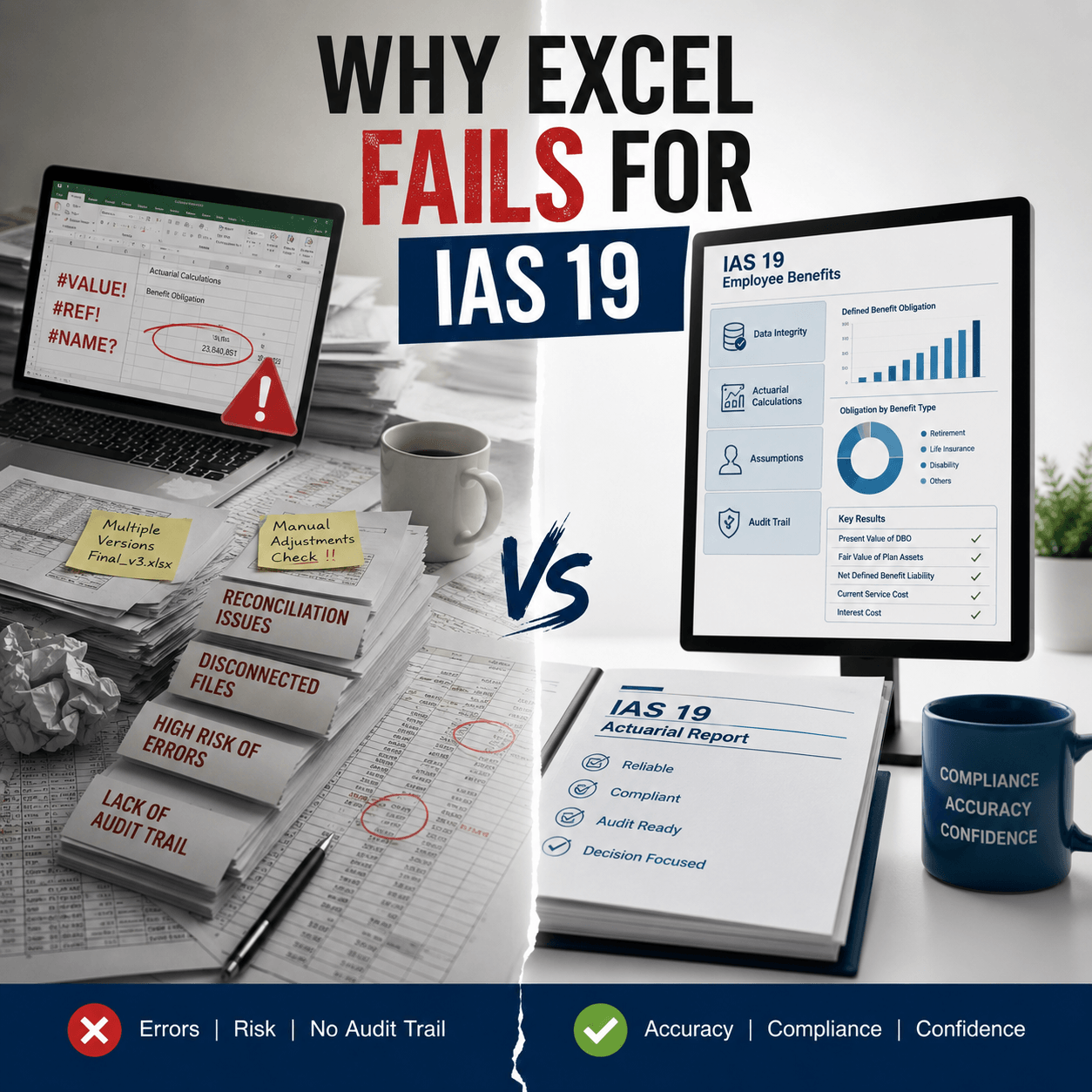
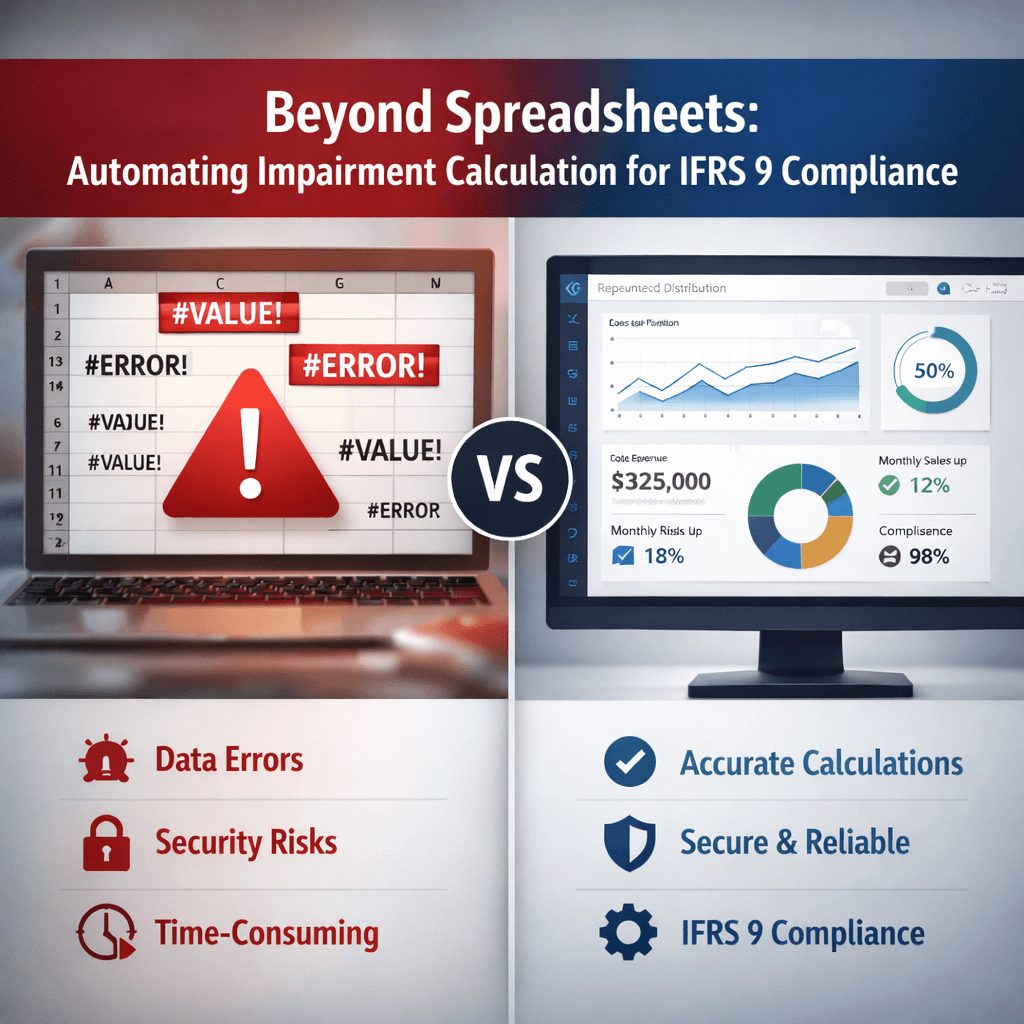
Organizations still relying on spreadsheets should understand the hidden audit risks in IFRS 9 spreadsheets before continuing with manual approaches.
Matching solution sophistication to actual requirements prevents both overspending and underperformance. Data requirements and API integration capabilities influence implementation complexity for both build and buy scenarios.
Banks with clean, accessible exposure data and modern core banking platforms integrate vendor solutions more easily than institutions with legacy systems and data quality issues.
Custom builds face identical integration challenges without the benefit of vendor experience resolving common data problems across multiple implementations.
Frequently Asked Questions
What is the typical cost difference between building and buying IFRS 9 software?
Initial costs for building custom IFRS 9 software range from $150,000 to $300,000 for mid-sized banks, while vendor solutions cost $50,000 to $200,000 annually. Over five years, build approaches total approximately $430,000 to $650,000 including maintenance at 15 to 20 percent annually. Vendor purchases total $250,000 to $1,000,000 over five years depending on pricing tier and implementation services. The build option appears cheaper initially but similar or more expensive long-term when accounting for maintenance, enhancements, and hidden costs.
How do implementation timelines compare between build and buy?
Custom builds typically require 6 to 18 months from project start to production deployment, with complexity, team experience, and portfolio characteristics driving variation. Vendor implementations complete in 3 to 6 months for standard deployments and 6 to 8 weeks for accelerated approaches using prebuilt templates. The buy option delivers compliance 50 to 70 percent faster on average, reducing time-to-value and project risk exposure substantially.
What are the main risks of building IFRS 9 software in-house?
Building in-house creates risks including technical debt accumulation, key person dependencies, regulatory interpretation errors, model validation challenges, and opportunity costs from diverting development resources away from strategic initiatives. Banks may underestimate complexity, miss regulatory requirements, or implement calculations incorrectly without external validation. Staffing turnover creates knowledge gaps that expensive consultants must fill to maintain system functionality.
Do vendor IFRS 9 solutions allow sufficient customization?
Modern vendor platforms offer extensive configuration capabilities through rule engines, parameter libraries, and workflow customization that meet most bank-specific requirements without custom development. Organizations can typically configure staging criteria, PD methodologies, LGD assumptions, scenario frameworks, and reporting templates to match their risk policies. Some vendors support custom code extensions through APIs for truly unique requirements, while others maintain stricter standardization.
How do regulatory changes affect build versus buy decisions?
Regulatory changes create ongoing costs for both approaches, yet the burden distribution differs significantly. Custom builds require internal teams to interpret guidance, design implementations, develop code, test changes, and validate results for each regulatory update. Vendor solutions include regulatory updates as part of standard maintenance, with specialist teams implementing changes once and deploying across customer bases. This shared approach reduces individual bank costs and implementation risks substantially.
What happens if we outgrow our chosen IFRS 9 solution?
Outgrowing solutions creates different challenges depending on the approach. Custom-built systems require refactoring, optimization, or complete rewrites to handle increased scale, consuming significant development resources. Vendor platforms designed for scalability typically accommodate portfolio growth through configuration changes, upgraded licensing tiers, or infrastructure scaling without fundamental reimplementation. Banks should evaluate scalability architecture during initial selection to avoid future constraints.
Can we switch from build to buy or vice versa later?
Switching approaches requires substantial effort regardless of direction. Moving from custom to vendor solutions demands data migration, process reengineering, and user retraining while retiring internal systems carefully to preserve audit trails. Switching from vendor to custom build requires recreating all functionality internally while maintaining compliance continuity. Organizations should treat initial build versus buy decisions as long-term commitments given switching costs and risks.
How do we evaluate vendor stability and long-term viability?
Vendor evaluation should examine financial stability, customer count, implementation track record, product roadmap clarity, technology architecture modernity, and commitment to IFRS 9 as a core business focus. Reference calls with existing customers reveal support quality, update frequency, and responsiveness to issues. Banks should verify that vendors maintain viable businesses beyond IFRS 9 to ensure long-term platform support and development investment.
What internal expertise do we need for build versus buy?
Building requires development teams with IFRS 9 domain expertise, actuarial modeling knowledge, database optimization skills, API integration experience, and financial services security understanding. Organizations need project managers, business analysts, quality assurance specialists, and model validation actuaries throughout development and operational phases. Buying reduces but does not eliminate expertise needs, requiring implementation teams, system administrators, and power users who understand IFRS 9 concepts sufficiently to configure and operate vendor platforms effectively.
How do we handle model validation for custom-built systems?
Model validation for custom systems requires independent actuarial review of methodologies, backtesting against historical default experience, stress testing under extreme scenarios, and documentation of all assumptions and limitations. Banks must establish validation governance separate from development teams to ensure objectivity. Many institutions hire external consultants to perform independent validation given the specialized expertise required and the need for credible third-party assessment that satisfies auditors and regulators.
What are the hidden costs in vendor solutions?
Vendor solutions carry hidden costs including customization fees beyond standard configuration, premium support tiers for faster response times, professional services for complex integrations, training for new users as teams change, data migration from legacy systems, and potential price increases at renewal. While these costs deserve scrutiny, organizations should weigh them against the hidden audit risks in IFRS 9 spreadsheets that manual approaches create. Careful contract review and reference calls with existing customers help identify potential cost escalations.
How does data quality affect implementation costs?
Poor data quality increases implementation costs dramatically for both build and buy scenarios. Banks must invest in data cleansing, transformation, and governance before implementing any IFRS 9 solution. Custom builds offer flexibility to work with imperfect data initially, yet this creates technical debt and accuracy risks. Vendor solutions typically enforce data quality standards that require upfront remediation but deliver more reliable results. Data preparation commonly consumes 30 to 50 percent of total implementation effort regardless of approach.
Can we use hybrid approaches combining build and buy?
Hybrid approaches work when banks purchase vendor core platforms for standard ECL functionality while building custom extensions for unique requirements. Success depends on clean architectural boundaries, well-documented APIs, and clear governance defining vendor versus custom responsibilities. Organizations should verify vendor support for extensibility and understand how customizations affect upgrade paths before committing to hybrid strategies. Poor implementation creates maintenance burdens worse than pure build or buy approaches.
What integration capabilities should we require?
Modern IFRS 9 platforms should offer API-first architectures supporting real-time data exchange with core banking systems, general ledgers, data warehouses, and analytics platforms. REST APIs with comprehensive documentation, bidirectional synchronization, error handling, and monitoring capabilities represent current best practices. Banks should avoid platforms requiring batch file exchanges, manual uploads, or proprietary integration methods that increase operational burden and error rates.
How do cloud versus on-premise deployments affect TCO?
Cloud deployments shift infrastructure costs to vendors through subscription pricing, eliminate hardware procurement and maintenance, provide elastic scalability, and simplify disaster recovery. On-premise installations require capital investment in servers and storage, internal IT staffing for operations, and capacity planning for growth. Cloud typically offers lower total cost for most institutions, yet banks with strict data residency requirements, existing infrastructure capacity, or regulatory constraints may prefer on-premise control despite higher costs.
What service level agreements should we negotiate?
SLAs should specify system availability percentages, maximum response times for support inquiries by severity level, timeframes for regulatory update delivery, and remedies if vendors fail to meet commitments. Banks should negotiate terms covering data security, backup frequency, disaster recovery objectives, and audit access rights. Clear SLA terms create accountability and provide recourse if vendor performance falls short of requirements.
How do we calculate ROI for IFRS 9 software investments?
ROI calculation should compare total costs against quantifiable benefits including reduced month-end close time, eliminated manual processes, decreased audit findings, avoided regulatory penalties, and redeployed staff capacity. Soft benefits like improved decision-making from better analytics, reduced compliance risk, and enhanced audit readiness also contribute value though harder to quantify precisely. Payback periods typically range from 18 to 36 months depending on bank size, portfolio complexity, and process efficiency gains achieved.
What training and change management do implementations require?
Successful implementations require comprehensive training covering IFRS 9 concepts, system operation, reporting procedures, and troubleshooting common issues. Finance users need hands-on practice with realistic scenarios, while IT teams require technical training on administration and integration maintenance. Change management should address process changes, role adjustments, and stakeholder communication to ensure organizational adoption. Inadequate training commonly causes implementation failures even when systems function correctly technically.
How do we ensure business continuity during implementation?
Business continuity requires parallel operation of existing and new systems during cutover periods, comprehensive testing with production data, rollback plans if issues emerge, and extended support during initial production cycles. Banks should maintain existing processes until new systems demonstrate stability across multiple reporting periods. Phased implementations introducing functionality incrementally reduce risk compared to big-bang cutovers replacing everything simultaneously.
What governance do we need for IFRS 9 software?
Governance frameworks should define roles and responsibilities for system administration, model ownership, parameter approval, assumption overrides, methodology changes, and audit response. Organizations need documented change control procedures, testing protocols, validation requirements, and escalation paths for issues. Strong governance ensures compliance continuity, maintains audit trails, and manages risks effectively throughout the system lifecycle.
How do we handle multi-currency and cross-border exposures?
IFRS 9 solutions must support multiple currencies, exchange rate management, and jurisdiction-specific regulations for banks operating internationally. Calculation engines should handle currency translation consistently across PD modeling, LGD calculations, and ECL provisioning. Organizations should verify vendor experience with multi-country implementations and confirm support for specific regulatory regimes affecting their operations before finalizing selections.
What happens when key vendor personnel leave?
Vendor personnel turnover creates less risk than internal team turnover since vendors maintain institutional knowledge across multiple staff members and document systems comprehensively for customer support. That said, relationship managers and implementation consultants leaving mid-project can disrupt timelines. Banks should verify vendor staffing depth, documentation quality, and knowledge management practices during due diligence to assess continuity risks.
How do we evaluate total cost of ownership accurately?
Accurate TCO evaluation requires comprehensive cost modeling across five-year periods including initial development or licensing, annual maintenance or subscriptions, internal staffing for administration and support, integration development and maintenance, training, regulatory update implementation, data quality improvements, infrastructure, and contingency for unexpected issues. Sensitivity analysis testing different assumptions helps identify cost drivers and risks. Comparing multiple scenarios with transparent assumptions yields more reliable TCO estimates than vendor-provided calculators alone.
What testing is required before going live?
Pre-production testing should cover calculation accuracy through parallel runs against existing methods, data integration completeness and accuracy, user acceptance of workflows and reports, performance under production data volumes, security and access controls, backup and recovery procedures, and audit trail functionality. Banks should test multiple reporting periods, diverse portfolio segments, and edge cases to validate system behavior comprehensively before trusting results for regulatory reporting.
How do we maintain compliance as IFRS 9 evolves?
Maintaining compliance requires monitoring regulatory guidance from IASB, local banking authorities, and audit firms to identify emerging requirements. Vendor customers receive updates through standard maintenance, while custom-built systems need dedicated resources tracking changes and implementing solutions. Both approaches require model validation as methodologies evolve and documentation updates for audit purposes. Organizations should budget ongoing compliance costs regardless of build or buy decisions.
What metrics should we track after implementation?
Post-implementation metrics should measure month-end close time reduction, manual process elimination, audit finding trends, calculation accuracy through backtesting, system availability and performance, user adoption rates, and support ticket volumes. Tracking these metrics demonstrates ROI, identifies optimization opportunities, and ensures systems deliver intended benefits. Regular metric reviews help organizations maximize value from IFRS 9 investments.
How do solutions handle sensitivity and scenario analysis?
Robust IFRS 9 platforms support multiple scenario definitions with different macroeconomic paths, probability weighting across scenarios, sensitivity testing of individual parameters like unemployment or GDP, attribution analysis showing provision drivers, and stress testing under extreme assumptions. These capabilities help banks understand ECL volatility, communicate results to boards and regulators, and make informed credit decisions. Organizations should verify scenario functionality matches their risk management and reporting needs during evaluation.
Can we integrate IFRS 9 software with existing risk systems?
Integration with credit risk, market risk, operational risk, and enterprise risk management systems creates comprehensive risk views and eliminates data duplication. Modern platforms should offer APIs supporting data exchange with diverse risk systems, common data models that facilitate integration, and flexible export capabilities for analytics platforms. Banks should map integration requirements explicitly during vendor evaluation to ensure technical compatibility.
What security and data protection features are essential?
Essential security features include encryption in transit and at rest, role-based access controls, audit logging of all user actions and system changes, multi-factor authentication, data masking for sensitive information, penetration testing results, and security certifications like SOC 2 Type II. Banks must verify vendor security practices meet their regulatory requirements and internal standards before deployment. Data residency controls ensure compliance with local regulations governing customer information storage and processing.
Financial institutions making enterprise IFRS 9 ECL software selection decisions must balance cost, capability, implementation speed, and long-term sustainability.
Most banks find vendor solutions deliver superior TCO when accounting for all costs including hidden expenses, staffing burdens, and regulatory adaptation requirements.
Custom builds serve specific scenarios where unique requirements justify development investment and ongoing maintenance commitments.
The global Financial Services Software market exceeded $9.7 billion in 2024 and is projected to reach $16.3 billion by 2030, indicating strong growth and investment in tools like risk and compliance software that can address IFRS 9 needs.
This market expansion reflects increasing recognition that specialized solutions deliver better outcomes than generic tools or custom builds for most institutions.
Organizations evaluating these decisions benefit from consulting with specialists who understand both IFRS 9 requirements and software implementation dynamics.
Prima Consulting provides guidance on IFRS 9 compliance strategies, software evaluation, and implementation planning that helps banks make informed choices aligned with their specific circumstances and strategic objectives.