TL;DR
Manual IAS 19 valuation risks extend far beyond simple spreadsheet errors. When finance teams rely on manual processes for employee benefits valuations, they face cascading delays that push reporting timelines from days into weeks, inconsistent assumptions that drift across periods, and audit scrutiny that compounds operational inefficiency. Data integrity gaps, key person dependency, and scattered documentation create hidden costs that stakeholders rarely measure. The real question isn’t whether your manual IAS 19 implementation challenges are manageable right now, it’s when complexity will exceed your process capacity. Understanding these systemic employee benefits valuation risks helps you make informed decisions about modernizing your approach before audit pressure or organizational growth forces the issue.
When your finance team is managing defined benefit obligations manually, something’s happening behind the scenes that you might not see until it’s too late. Spreadsheets multiply. Timelines slip. Assumptions drift. And your auditors start asking questions you can’t answer quickly.
This isn’t about bad people making mistakes. It’s about manual processes hitting their limits in a world where IFRS compliance demands precision and speed at the same time.
Let’s talk about what’s really happening when manual IAS 19 valuation becomes your bottleneck, and why the delays and inconsistencies matter far more than most finance teams realize.
Why Manual IAS 19 Valuation Still Persists
Legacy processes and spreadsheet dependence
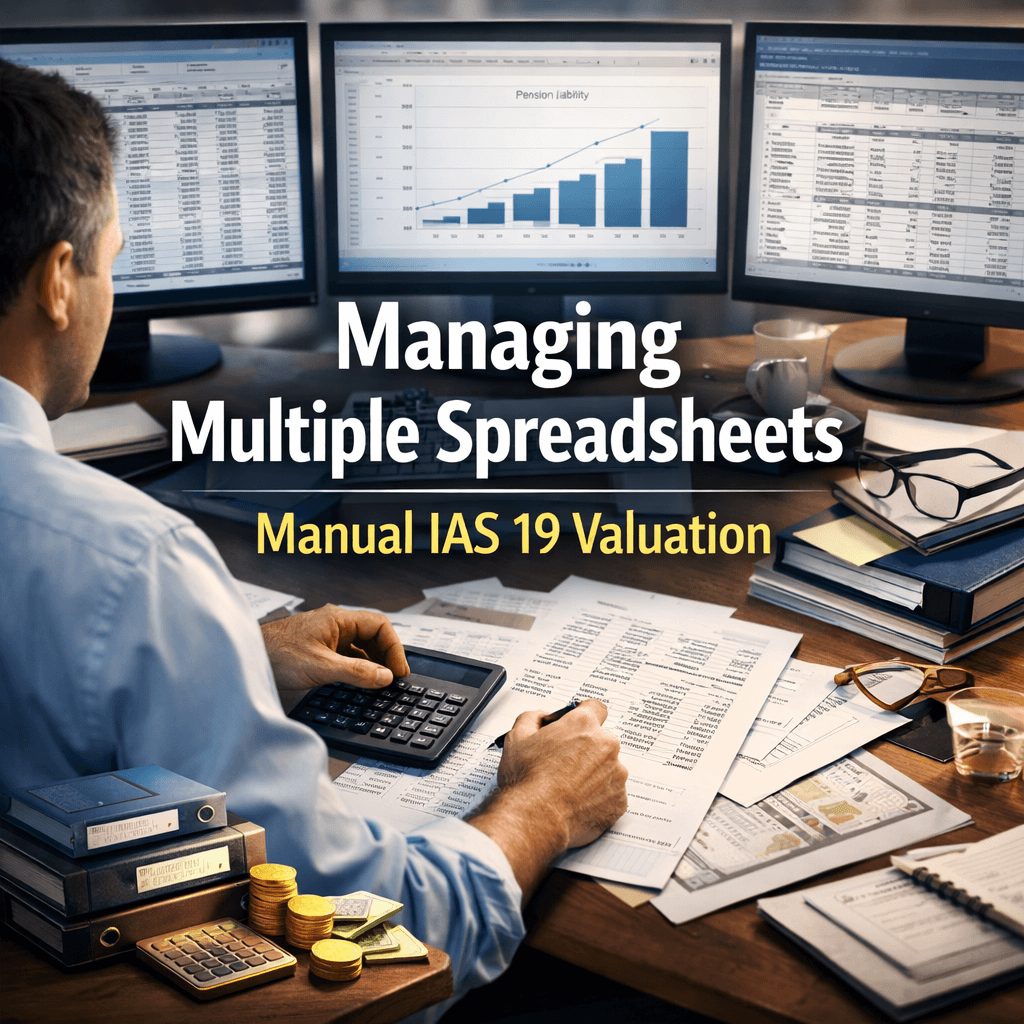
Many organizations inherited their IAS 19 valuation approach years ago when the process seemed manageable. A spreadsheet here, some email handovers there, and the calculation got done. But organizations grow. Plans change. Regulatory demands increase. Yet the underlying process stays locked in the same manual workflow.
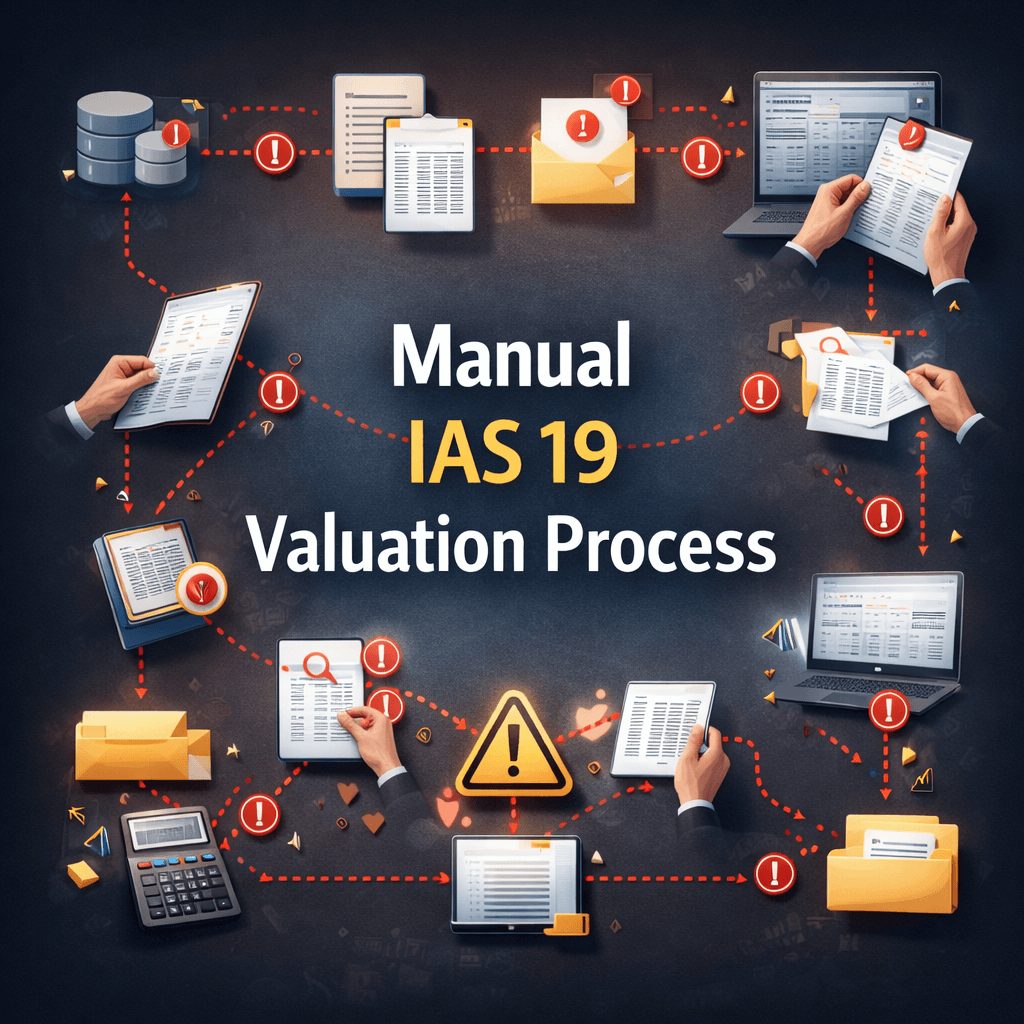
You still see it everywhere: HR provides employee data via spreadsheet. Someone manually imports it into an actuarial calculation file. Another team member reviews assumptions, maybe updating them once a year. Then a third group validates the output and prepares disclosure notes. Each handoff introduces friction. Each step takes time.
The problem isn’t that people don’t know better. It’s that replacing a process that’s been in place for a decade requires commitment, investment, and a willingness to change how teams work together.
Perceived cost savings vs real risk
When budgets tighten, automation looks expensive. A manual process that relies on existing staff and tools feels free. You’re not paying for new software or integration services. You’re just using what you already have.
But that math misses the hidden costs. An employee spending three weeks on IAS 19 calculations has opportunity cost. Rework from late assumption changes costs money. External actuarial fees stack up when your team can’t respond quickly to scenario requests. And restatements? Those are expensive in time, reputation, and auditor scrutiny.
The true cost of manual IAS 19 valuation isn’t in the spreadsheet itself. It’s in what doesn’t happen while your team is tied up maintaining that spreadsheet.
How Manual IAS 19 Valuation Causes Reporting Delays
Data collection and reconciliation bottlenecks
Before any calculation happens, data has to move from your HR system to an actuarial platform. In a manual process, this means someone extracts a report, checks it, maybe reconciles it by hand against another source, and then hands it over.
That’s not a quick task when you’re working with thousands of employee records. Someone’s reviewing joiner and leaver movements, checking salary data, verifying date-of-birth information. If any of those records don’t match expectations, you’re digging into spreadsheets to figure out what happened.
Interest rates rose significantly in 2021–2023 before gradually declining in 2024–2025, contributing to substantial volatility in discount rates based on government bond yields, which means assumption updates hit more frequently and create more rework cycles.
The worst part? You don’t know if there’s a problem until you’re well into the calculation phase. An employee record that wasn’t included gets discovered when the numbers don’t match last year’s report. A salary field that wasn’t updated throws off the calculation. Now you’ve got to go back, fix the data, and restart.
Rework caused by late assumption updates
In January, your team is finalizing assumptions for the year-end IAS 19 valuation. Current yield on high-quality corporate bonds shows a new rate. Your actuarial team recommends updating the discount rate. But the final decision on that rate doesn’t come until February, after your initial calculations are already underway.
Average discount rates under IFRS at year-end showed significant variation, with Switzerland declining from 2.13 percent to 1.45 percent, Germany from 3.66 percent to 3.36 percent, and the United States from 5.36 percent to 5.09 percent based on 2023 data, demonstrating how volatile these assumptions truly are.
In a manual process, that means starting over. You’ve got to manually update the discount rate across every calculation worksheet, rebuild the spreadsheets that depend on it, and regenerate the output reports. If there are salary growth assumption changes or demographic updates, each one requires the same rework cycle.
In a manual process, that means starting over. You’ve got to manually update the discount rate across every calculation worksheet, rebuild the spreadsheets that depend on it, and regenerate the output reports. If there are salary growth assumption changes or demographic updates, each one requires the same rework cycle.
That’s why I mentioned delay ranges of 15 to 30 days in many organizations. It’s not because the calculation itself takes weeks. It’s because the process around the calculation is fragmented. Changes pile up. Rework compounds. Timeline pressure builds.
Missed reporting and audit timelines
Your company’s month-end close has a hard deadline. The finance team needs your IAS 19 calculations by a specific date so they can finalize financial statements and prepare for audit. That deadline doesn’t move.
In a manual process, delays early in the cycle cascade forward. If data takes longer to reconcile than expected, or if assumption changes require rework, you’re either delivering incomplete numbers under pressure or pushing your close timeline forward. Neither option is good.
Auditors then see delays in your IAS 19 documentation. They ask for reconciliations. They want to see the assumption methodology. They’re looking for evidence that controls existed around the valuation process. In a manual environment where most of this lives in spreadsheets and emails, providing that documentation takes time. Your audit process stretches longer. Questions multiply.
Inconsistent Assumptions in Manual IAS 19 Valuation
Lack of centralized assumption control
Here’s what happens without a central place to manage assumptions: Your actuarial team recommends a mortality table. The finance team is working from an email with that recommendation. HR thinks they’re using a different source based on a conversation from six months ago. When someone pulls together all the disclosures, the assumptions don’t align.
Or you’ve got multiple people running IAS 19 calculations for different parts of your business. One group uses a 2024 mortality table. Another is still on 2023 data. They didn’t coordinate because there’s no system forcing coordination. Now your consolidated numbers are built on inconsistent assumptions.
Manual processes have no central source of truth for assumptions. They get documented in different places. Email updates don’t reach everyone. Spreadsheets get updated locally without propagating to other dependent models. Someone picks up an old version of a file by mistake.
Version control and documentation gaps
When your IAS 19 valuation lives in spreadsheets and email, version control is a problem. Did you save that file before you made changes, or is this the version with the new discount rate? Is this the final mortality table or a draft that got superseded last week?
Someone prints a spreadsheet. Someone else modifies a copy. A third person doesn’t realize two versions exist and works from the wrong one. Now you’ve got discrepancies in your documentation.
The documentation itself becomes inconsistent. One team member documents their methodology in a Word file. Another puts notes in spreadsheet cells. A third keeps changes in an email thread. When your auditors ask for the complete audit trail showing every assumption used and how it was justified, assembling that documentation is painful. Information is scattered across files, emails, and people’s personal notes.
Assumption drift across periods
You set your discount rate assumptions for 2024. The interest rate environment shifts. Your team should update the discount rate for 2025. But that update gets delayed because of the rework required to propagate it through all your calculation files.
By the time you’re running 2025 calculations, your assumptions are slightly stale. You’re using rates from mid-2024 when the environment has shifted substantially. That’s not huge if it’s delayed by a few weeks. But when manual processes create delays that span months, assumption drift becomes material.
You run calculations with assumptions that no longer reflect current market conditions. Your auditors scrutinize the assumption choices. Sensitivity analysis shows how different the numbers would be under current-market assumptions. Suddenly you’re in a position defending calculations based on outdated inputs.
Financial Impact of Errors in IAS 19 Valuation
Unexpected P&L and OCI volatility
When your IAS 19 calculations have inconsistent assumptions or include errors that go undetected until late in the process, the P&L and OCI impacts can be material. You’ve recorded pension expense based on one set of assumptions. Late corrections force adjustments that hit earnings or equity.
The variance analysis report that you present to management and the audit committee looks odd. Actuarial gains or losses swing unpredictably. Investors and stakeholders question whether your financial reporting is stable. They wonder if there are control issues around your accounting process.
Management decision-making depends on reliable financial data. When IAS 19 liabilities bounce around unexpectedly quarter to quarter, it creates uncertainty about your true economic position. That feeds into capital planning discussions, covenant calculations, and strategic decisions.
Restatements and audit adjustments
The worst outcome of manual IAS 19 valuation: your auditors identify errors during the audit itself. A control weakness. A calculation mistake. An assumption that doesn’t support its justification.
That triggers an audit adjustment. Sometimes it’s small enough to just flow through your final numbers. Sometimes it’s material enough to require a restatement. You’ve got to explain to your board and your investors why the numbers you already published needed correction.
Restatements damage credibility. Investors question whether other areas of your financial reporting might have similar issues. Your auditors increase their sample sizes and procedures in subsequent years. Audit costs go up. The company’s reputation takes a hit.
Management decision risk
When your IAS 19 information is unreliable, management makes decisions with a handicap. You’re evaluating whether to modify your pension plan. Should you increase contributions? Reduce benefits? The decision depends on accurate liability calculations and projections.
If those calculations contain errors or use outdated assumptions, you’re making multi-million-dollar decisions based on faulty information. You could increase funding unnecessarily. You could leave the plan underfunded. Either way, you’ve made a suboptimal choice based on unreliable IAS 19 data.
Audit Challenges Linked to Manual IAS 19 Valuation
Weak audit trails and justification issues
Your auditors need to verify that your IAS 19 calculations are complete and accurate. They’re looking for audit evidence that supports the numbers. In a manual process, finding that evidence is hard.
They ask to see the spreadsheet showing how you calculated service cost. You pull it out. But which version is this? Are all the cells referencing the right input data? Has someone modified formulas since the original calculation? How do you prove which version was actually used in your financial reporting?
They ask for documentation supporting your discount rate assumption. You hand over an email from your actuarial firm recommending the rate. That’s evidence the rate was considered. But it doesn’t document your methodology for rate selection, how you evaluated alternative rates, or your control process for ensuring consistency period to period.
Your auditors need justification for every significant assumption. In a manual environment where assumptions live in spreadsheets and emails, assembling that justification takes time.
Increased audit queries and delays
Every audit query requires someone to drop what they’re doing and assemble information. Your auditors ask about the sensitivity of liabilities to discount rate changes. You need to run scenario analysis showing liability impacts at different rates. That’s a manual effort. Someone rebuilds a calculation file, adjusts the assumption, generates new numbers, documents the results.
If that information should have been ready as part of your normal IAS 19 process but wasn’t, you’re creating the analysis under time pressure. You’re more likely to make mistakes. The audit drags on as you handle one query after another.
Your auditors also become more skeptical when they see control weaknesses. If version control is loose, they increase their sample testing. If assumptions aren’t well documented, they do more validation work. They’re compensating for system weaknesses with additional manual procedures.
Higher audit effort and fees
All those additional procedures cost money. Your auditor charges for every hour spent chasing down information, verifying calculations, and testing controls. Manual IAS 19 processes create audit inefficiency. Auditors can’t rely on system controls. They can’t run automated tests. They’re doing manual work because you are.
That increases audit fees year over year. It also increases the risk that auditors will propose significant deficiencies in your internal control over financial reporting if the environment is weak enough.
Operational Risks Hidden in Manual IAS 19 Processes
Key person dependency
Your organization has someone who knows how to run the IAS 19 calculations. That person has built up the spreadsheet model over years. They know all the quirks. They know what adjustments are needed. They handle the annual update.
What happens when that person leaves? Or gets promoted? Or takes a long-term absence? The knowledge walks out the door with them. Nobody else fully understands the spreadsheet logic. The next person to run the valuation is slower. They might miss adjustments that the original person always made intuitively.
That’s operational risk. The process is dependent on one person’s knowledge and memory. You don’t have documented procedures. You don’t have system controls. You’ve got a key person risk that your company isn’t even measuring properly.
Limited scalability during workforce changes
Your organization goes through a major restructuring. You acquire another company. You need to run IAS 19 calculations for multiple plans or multiple geographies. Your manual process wasn’t built for scale.
Suddenly you’re not managing one spreadsheet. You’re managing five. You’re coordinating assumption changes across multiple models. You’re ensuring that consolidation eliminations are handled correctly. The complexity jumps. The manual process that worked for one plan breaks down under the strain.
Your team needs to hand the work to external consultants. That costs money. It also means losing direct control over your IAS 19 process. You’re dependent on someone outside the organization.
Data integrity and control failures
In a manual environment, data validation is inconsistent. One person checks employee counts against HR records. Another person validates salary data but maybe not as thoroughly. A third person skips validation entirely because they’re under time pressure.
That creates gaps. Incomplete employee records don’t get flagged. A salary field that’s missing gets missed. A joiner or leaver movement doesn’t reconcile. These problems get discovered late if discovered at all.
Data integrity failures cascade. A wrong employee count throws off your actuarial calculations. An incorrect salary inflates service cost. A missing employee affects your demographic assumptions. You’re building your entire IAS 19 valuation on a foundation that’s not solid.
Manual vs Automated IAS 19 Valuation
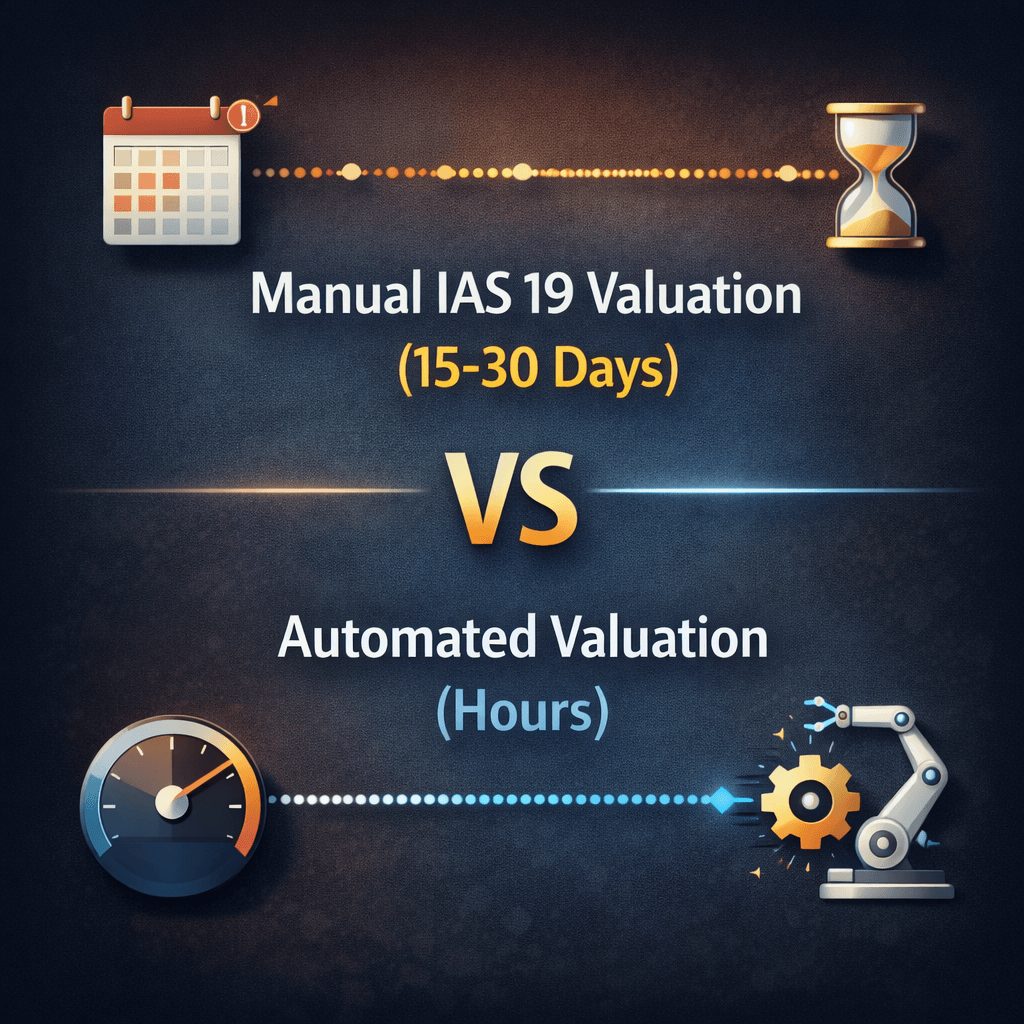
Speed and consistency comparison
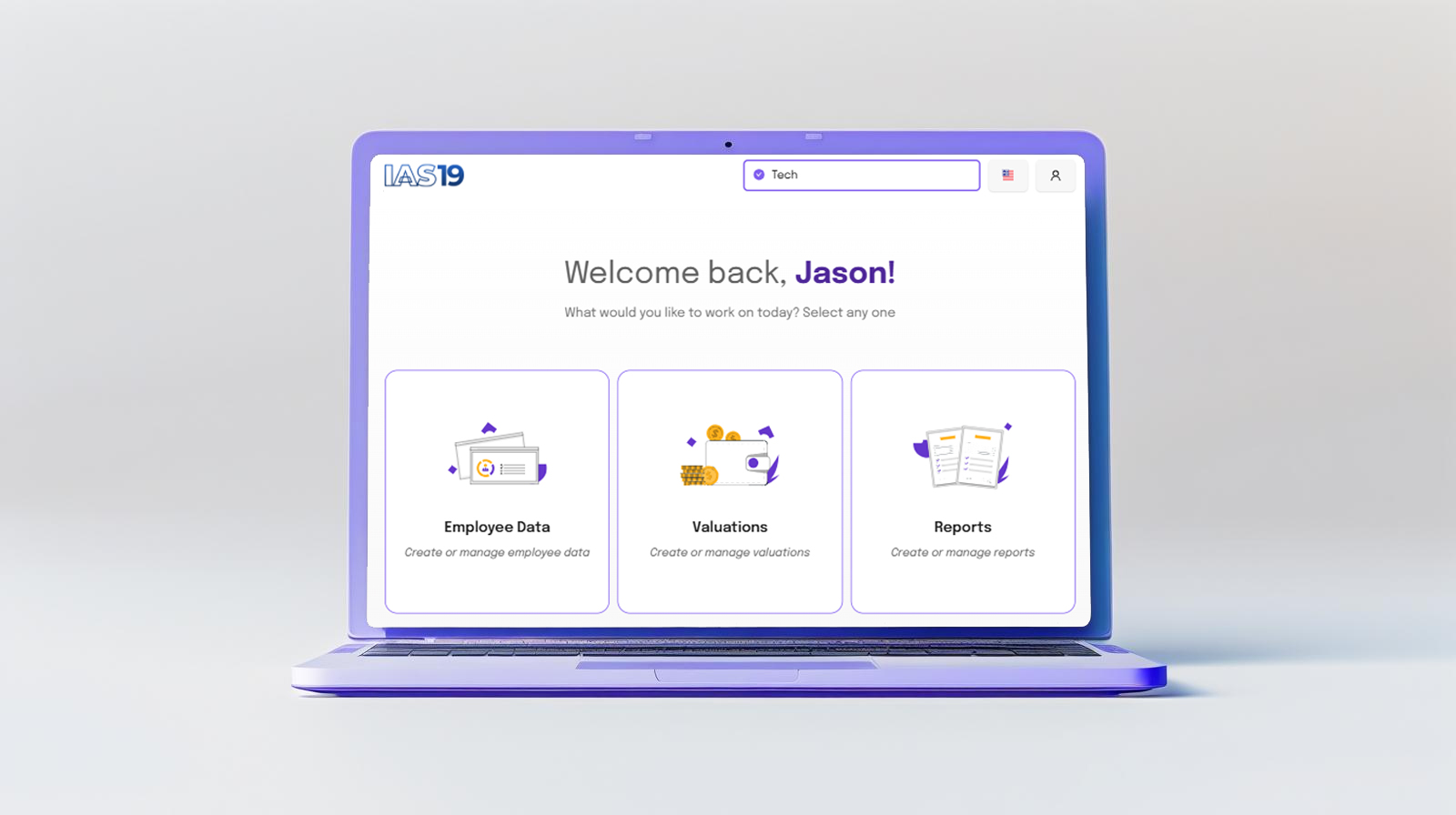
When your IAS 19 valuation runs through an automated process, data flows from your HR system directly into calculations. There’s no manual data entry. No transcription errors. When you update an assumption, the system propagates that change everywhere it’s needed instantly.
The calculation that took three weeks in a manual environment takes three hours. Your team isn’t waiting for data preparation. They’re not doing rework when assumptions change. The process is consistent. The same methodology applies every time.
That speed creates flexibility. You can run scenarios. You can test different assumptions. You can respond quickly to management requests. You can hit reporting deadlines comfortably instead of scrambling at the last minute.
Assumption governance differences
In an automated environment, assumptions live in a central repository. Everyone sees the same current assumptions. When something changes, there’s a documented reason and effective date. There’s a version history. You can see what assumptions were used for each reporting period.
That governance prevents drift. It prevents inconsistency across calculations. It provides the documentation your auditors need to validate that your assumptions were appropriate.
Assumption updates happen in one place. They propagate automatically. You don’t have to manually update multiple spreadsheets. You don’t have to worry about whether everyone’s working from the current version.
Risk exposure comparison
In a manual environment, your risks are operational. Key person dependency. Data integrity gaps. Control weaknesses. Audit inefficiency. These are all embedded in your process.
In an automated environment, risks shift. Your system availability matters. Data security matters. System access controls matter. But those are manageable risks. They’re understood. You can build controls around them.
Most important, the operational risks shrink. You’re not dependent on one person. Your data integrity is stronger because validation is systematic. Your auditors can rely on system controls. Your process is documented and repeatable.
When Manual IAS 19 Valuation Becomes Unsustainable
Growth, restructuring, or plan changes
The moment you add complexity to your IAS 19 environment, manual processes start to strain. A major acquisition means multiple plans to value. A restructuring means plan amendments that change calculations. Geographic expansion means valuations in multiple currencies and jurisdictions.
Manual processes don’t scale gracefully. They break under the weight of complexity. You move from managing one spreadsheet to managing five or ten. You’re asking your team to hold multiple methodologies in their head. You’re increasing the chance of errors.
That’s when organizations typically realize they’ve outgrown the manual process. But by then they’re already under pressure from the business event itself. They’re implementing change while trying to manage an overwhelmed IAS 19 process.
Increased reporting and disclosure demands
IFRS disclosure requirements keep expanding. You need more granular data. You need sensitivity analysis. You need reconciliations. You need to disclose your assumptions and justify them.
A manual process can handle the core calculation. But handling all the supporting analysis and disclosure documentation becomes painful. Someone’s rebuilding sensitivity analysis manually. Someone’s pulling together assumption reconciliations by hand. The documentation effort becomes substantial.
Your auditors see this complexity and ask more questions. They want to understand your control process. They’re looking for evidence of appropriate challenge and review. They want to see that you’ve validated your assumptions against market data.
All of that is harder to demonstrate in a manual environment. Your documentation is scattered. Your control procedures are informal. You can’t easily show the end-to-end process that produced your numbers.
How Automation Fixes IAS 19 Valuation Gaps
Standardized assumptions and controls
An automated system enforces consistent methodology. Your assumptions are documented with effective dates, sources, and rationale. When something changes, that change is recorded. You’ve got a complete audit trail.
Validation happens consistently. Every employee record gets checked against defined rules. Every salary gets validated for reasonableness. Every assumption gets compared against market benchmarks.
The system documents why choices were made. It shows what alternatives were considered. It records approvals. This documentation happens automatically as part of the normal process, not as an afterthought.
Faster close and audit readiness
Your calculations complete in hours instead of weeks. You’ve got time to review the results, run scenarios, and validate the output. You’re not under constant time pressure.
That means better quality output. Your team has time to think. They can answer questions. They can explain methodology.
For your auditors, everything they need is there. Complete calculations with formulas and logic transparent. Detailed assumption documentation. Reconciliations to prior periods. Sensitivity analysis. Complete data validation records. They don’t need to dig through spreadsheets and emails to find what they’re looking for.
Improved transparency and governance
When you automate IAS 19 valuation, you create transparency that serves multiple stakeholders. Your CFO understands the process and the drivers of change. Your audit committee sees appropriate oversight. Your auditors have confidence in your controls. Your investors see stable, reliable financial reporting.
That governance extends beyond just calculation accuracy. It’s about demonstrating that you’ve taken care in your financial reporting. You’ve implemented systems. You’ve documented controls. You’ve validated your work.
That builds confidence. It reduces audit costs because your auditors can rely on your system controls. It smooths your financial close process because reporting is predictable.
Key Takeaways for Finance and HR Teams
The evidence is clear. Manual IAS 19 valuation creates hidden costs that go far beyond the spreadsheet itself. You’re sacrificing speed for familiarity. You’re tolerating operational risks that are entirely avoidable. You’re making audit harder than it needs to be.
The finance teams that recognize this and take action gain real advantages. Their close processes accelerate. Their audit experiences improve. Their reporting becomes more reliable. That matters for your company’s credibility with investors, regulators, and stakeholders.
The question isn’t whether to change your process. It’s when. The longer you operate with manual IAS 19 valuation, the more you’re exposing your organization to risk and inefficiency.
Learn more about streamlining your actuarial reporting at Prima Consulting, where our advisors help finance teams understand their IAS 19 landscape and plan for more sustainable approaches.
Frequently Asked Questions
What counts as a significant delay in IAS 19 valuation timelines?
Most organizations find that moving from manual to standardized processes reduces valuation cycles from 15-30 days to just a few hours. If your current timeline exceeds two weeks from data receipt to final report delivery, you’re likely experiencing delays that manual processes introduce.
How do I know if my IAS 19 assumptions are becoming inconsistent?
Compare your current-period assumptions to the prior year. If you’re struggling to document why something changed, or if different people in your organization are using different assumptions, you likely have consistency issues.
What’s the audit impact of a manual IAS 19 process?
Manual processes typically require 30-50 percent more audit hours because auditors can’t rely on system controls. They’re doing manual verification work throughout their procedures.
Can I automate part of my IAS 19 process without overhauling everything?
Many organizations start by automating data validation and assumption management while keeping their current calculation approach. That reduces rework and improves data quality immediately, even if you’re still running calculations manually.
How does workforce restructuring affect manual IAS 19 valuation?
A restructuring that affects benefit eligibility, plan design, or employee population typically requires redesigning your spreadsheet model. That can add months to your implementation timeline. Automated systems handle these changes through configuration updates.
What should I look for when evaluating whether to change my current approach?
Track your actual time spent on IAS 19 valuation work. Monitor how many iterations you go through before finalizing calculations. Count the number of audit queries you receive. Calculate the cost of external consultant support. Those metrics usually show whether your current process is sustainable for your organization.