✓ Written by Ibrahim Ahmed Zahidie · ✓ Serving GCC, Europe & APAC · ✓ Actuaries + CPAs + CFAs
TL;DR
Vetting tools support IFRS 9 compliance software comes down to proof, not promises. This guide shows you how to test vendors on audit trails, model transparency, integration, and support before you sign. You’ll learn the red flags in tools for IFRS 9 providers that kill deals late, the checklist for support IFRS9 evaluations that saves a failed close, and the questions most buyers forget. Skip the sales deck. Ask for the demo on your own data. Start vetting the way an auditor would.
Why Vetting Tools Support IFRS 9 Compliance Software Beats the Price Tag
Pick the wrong tool and you don’t find out at signing. You find out at quarter-end.
That’s the part most buyers miss. The demo looked clean. The pricing fit. Then the first cycle hits, the numbers won’t reconcile, the auditor asks why a loan moved to Stage 2, and nobody on your team can answer without emailing the vendor.
The market itself explains why this keeps happening. The global IFRS 9 ECL software market reached USD 1.45 billion in 2024, growing at 11.2% a year. More vendors. The more slick decks, more tools support ifrs 9 compliance software claims without the substance behind them.
Here’s what this article covers:
- The vetting criteria that actually predict a clean audit
- Red flags in tools for IFRS 9 providers, and when to walk
- A checklist for support IFRS9 evaluations you can run in one demo
At IFRS TECH, we’ve watched banks replace “compliant” systems within two years because nobody stress-tested them first. So we built our own tools supporting ifrs 9 compliance workflow around the exact questions auditors ask. That bias is worth naming up front.
And timing matters right now. The IASB issued amendments to IFRS 9 and IFRS 7 in May 2024, effective for annual periods from 1 January 2026. Any tool you vet now has to handle those changes, not last year’s rulebook.
What Does “Support for Standards in Evaluating IFRS9 Tools” Actually Mean?
Vendors love the word “compliant.” It means almost nothing on its own.
A tool can technically produce an ECL number and still fail you. Real support for standards in evaluating ifrs9 tools means it handles the full lifecycle: classification, staging, measurement, and disclosure, with a traceable path from source data to the final figure.
Think about what IFRS 9 compliance software really has to do. It classifies financial assets. Applies SICR triggers to move exposures between Stage 1, 2, and 3. It runs PD, LGD, and EAD models. Then it generates IFRS 7 disclosures that match the calculation exactly.
Break any link in that chain and you’ve bought a calculator, not compliance tools software.
KPMG puts the bar plainly: ECLs must be measured as an unbiased, probability-weighted amount using reasonable and supportable forward-looking information, updated every reporting date. If your tool can’t support that kind of scenario weighting and sensitivity analysis, it’s not really one of the tools for ifrs 9 compliance. It’s just storing your assumptions.
So the first vetting question isn’t “is it compliant?” It’s “show me the audit trail from raw exposure to disclosure note.”
The Difference Between Compliant and Auditable
You might think a compliant tool is automatically auditable. It isn’t.
Compliant means it can produce the right output. Auditable means it can prove how it got there, months later, when the person who ran the model has left.
One regional bank we know reduced ECL-related audit findings from seven to zero after moving to a tool with a built-in attribution waterfall. Same bank. Same portfolio. The only change was traceability.
That’s the gap you’re vetting for.
Which Vetting Criteria Predict a Clean Audit?
Not every feature matters equally. Some look great in a demo and never touch a real reporting cycle.
These five criteria do the heavy lifting when you’re evaluating tools for ifrs 9 compliance. Run every shortlisted vendor through all of them. This is the guide for choosing compliance ifrs 9 software that actually holds up under audit.
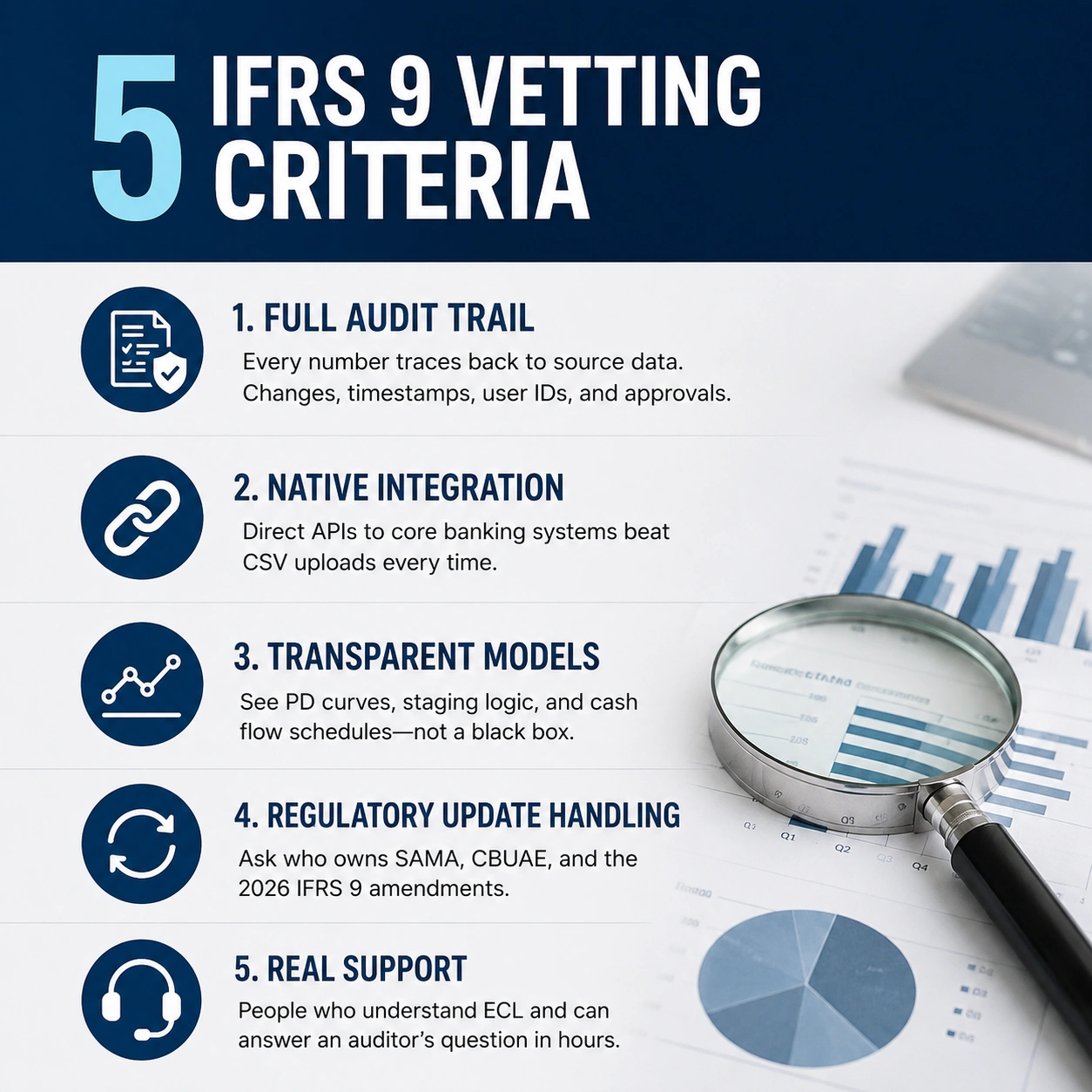
- Full audit trail. Every number traces back to source data. Parameter changes carry timestamps and user IDs. Overrides require approval. This is the single biggest signal of serious ifrs 9 compliance tools software, and the one weak vendors gloss over fastest.
- Native integration. Direct APIs to your core banking system (Temenos, Flexcube, Finacle, SAP) beat CSV uploads every time. File-based workflows delay data and hide errors.
- Transparent models. You should see PD curves, staging logic, and cash flow schedules, not a black box that spits out a provision.
- Regulatory update handling. Ask who owns SAMA, CBUAE, and the 2026 IFRS 9 amendments. If the answer is “you do,” factor that cost in.
- Real support. Not a ticket queue. People who understand ECL and can answer an auditor’s question in hours.
Notice the list has five items, not a tidy three. Real evaluation doesn’t round to a memorable number.
The one I’d weight highest? Audit trail. Everything else is recoverable. A tool that can’t explain itself under scrutiny is not.
How to Assess Support in IFRS 9 Tools During the Demo
Here’s a question worth sitting with before your next vendor call. What happens the first time your auditor challenges a Stage 2 migration and the vendor’s support team is on holiday?
Don’t take “24/7 support” at face value. Ask for named references in your region. How long a typical model validation query takes to resolve. What happens when a regulator changes a rule mid-cycle.
Knowing how to assess support in ifrs 9 tools separates real partners from license resellers. The answers tell you which one you’re talking to.
IFRS Tech
Want to see how Rust IFRS 9 handles your ECL scenario? Book a free product demo on your own data.
No obligation · Live walkthrough · GCC, Europe & APAC
Red Flags in Tools for IFRS 9 Providers
Some warning signs show up early. Others only surface when you dig. Both matter.
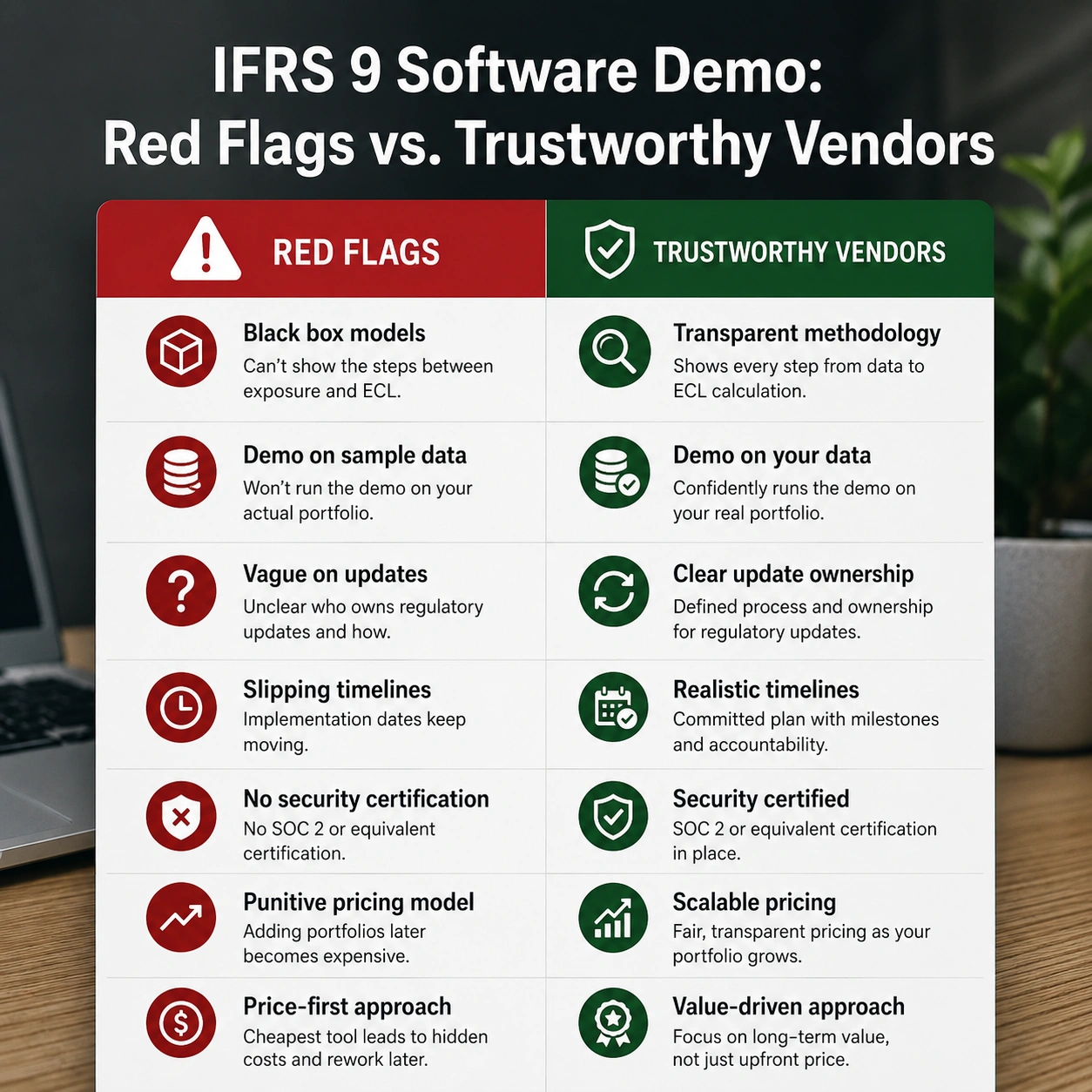
Watch for the black box first. If a vendor can’t show you the intermediate steps between exposure and ECL, walk. Hidden audit risks don’t announce themselves. They wait for the review.
Then watch the demo behavior. A vendor who insists on running the demo on their sample data, not yours, is hiding something. Real tools handle real portfolios.
Other red flags in tools for ifrs 9 providers worth your attention:
- Vague answers on who owns regulatory updates
- Implementation timelines that keep sliding
- No SOC 2 or equivalent security certification
- Pricing that punishes you for adding portfolios later, which quietly turns a cheap tool into an expensive one two years in when your loan book grows
And here’s the one buyers ignore most. Price-first selection. Choosing the cheapest tool to save on licensing creates workarounds, manual patches, and eventual replacement costs that dwarf the savings. That’s how avoiding poor vetting in ifrs 9 software pays for itself.
I’ll admit a limit here. I don’t have clean long-term data on exactly how often price-first buyers end up replacing their tool. What I can tell you is that every rushed selection I’ve seen chosen on price alone came back around.
The Cost of Getting the Decision for Vetting IFRS9 Compliance Support Wrong
Numbers help here. Building a custom IFRS 9 system runs USD 150,000 to 300,000 upfront but generates USD 430,000 to 650,000 in total cost of ownership over five years once you count maintenance, staff turnover, and regulatory updates.
Buy the wrong vendor tool and you land somewhere similar, just with a different logo on the invoice.
Vendor solutions typically go live in 3 to 6 months. Custom builds take 6 to 18. So the decision for vetting ifrs9 compliance support isn’t just about features. It’s about time to compliance, and every month you’re not compliant is a month of risk.
Explore our IFRS software solutions
A Checklist for Support IFRS9 Evaluations
You can run most of this in a single, well-structured demo. Bring your own data. Bring your auditor’s questions.
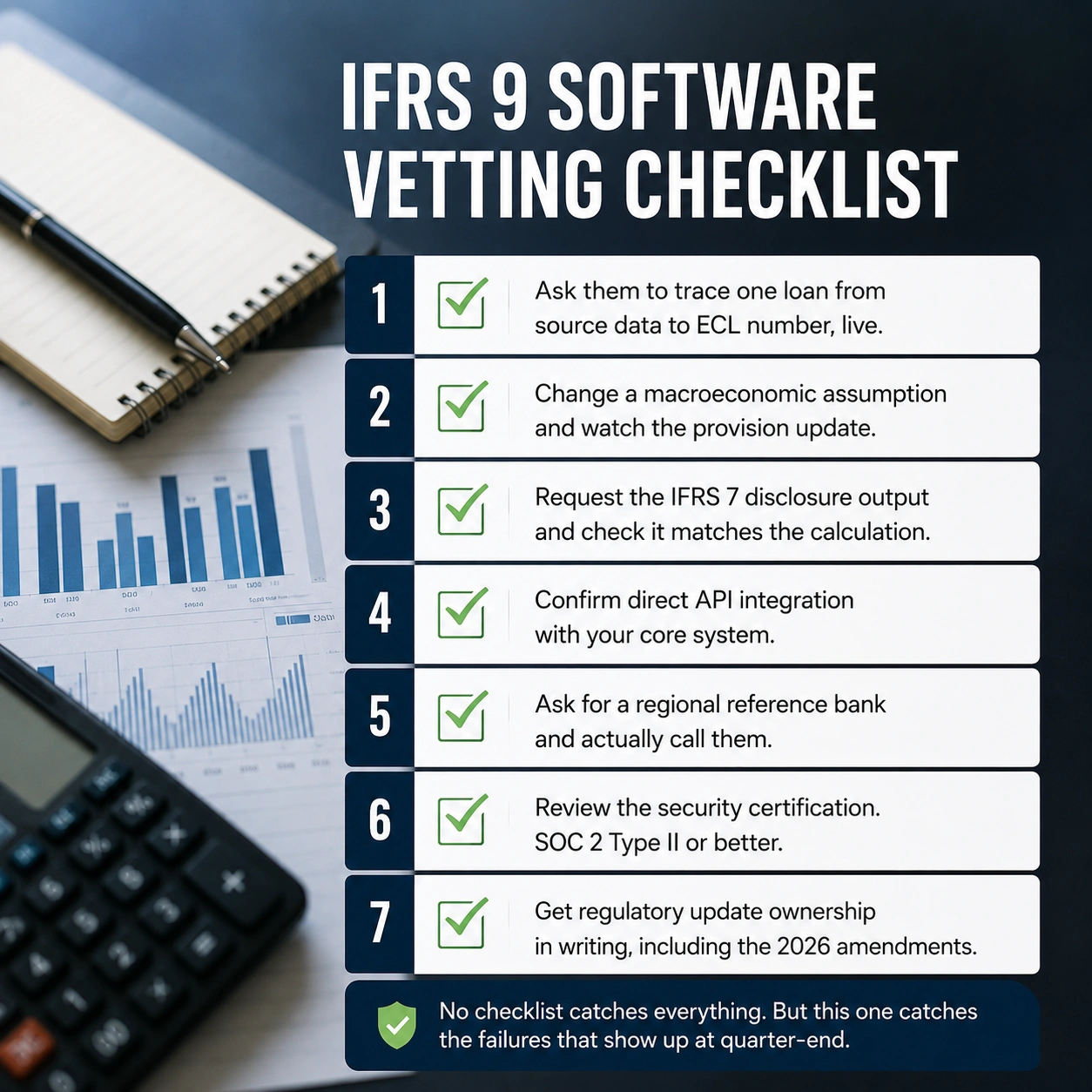
- Ask them to trace one loan from source data to ECL number, live.
- Change a macroeconomic assumption and watch the provision update.
- Request the IFRS 7 disclosure output and check it matches the calculation.
- Confirm direct API integration with your core system.
- Ask for a regional reference bank and actually call them.
- Review the security certification. SOC 2 Type II or better.
- Get regulatory update ownership in writing, including the 2026 amendments.
This checklist for support ifrs9 evaluations won’t catch everything. No checklist does. But it catches the failures that show up at quarter-end, which are the expensive ones. That’s what defines good compliance tools in practice, not the feature list.
Loop back to that regional bank for a second. The one that dropped audit findings to zero also cut its close process from 12 days to 4. That’s the compound payoff of vetting well. Faster close, cleaner audit, fewer late nights.
The best guide for standards ifrs9 compliance is the one you actually run, not the one you file.
What You Now Know
Three things worth keeping:
- Compliant and auditable aren’t the same thing. Vet for auditable.
- The audit trail is your highest-signal criterion. Weight it accordingly.
- Run the demo on your own data, or you’re not really vetting at all.
Where the Right Tools Support IFRS 9 Compliance Software Decision Lands
Vetting tools support ifrs 9 compliance software isn’t a procurement formality. It’s the difference between a routine close and a scramble every quarter for the next five years.
So do it like an auditor would. Demand the trace from source to disclosure. Test the models in the open. Call the references. Read the security cert. And never let price alone make the call, because the cheap tool that fails your first audit was never cheap.
You now have the criteria, the red flags, and the checklist for choosing compliance ifrs 9 software. The one thing left is to put a real tool in front of your real data and watch how it behaves.
See how Rust IFRS 9 Software handles your ECL calculation, staging logic, and audit trail live, on your portfolio, in a free demo.
Free Product Demo
See how Rust IFRS 9 handles your ECL, on your data, your use case.
IFRS Tech’s advisors walk you through Rust IFRS 9 staging, PD/LGD/EAD modeling, and audit trails live. First demo is always free. No pitch, just the product.